


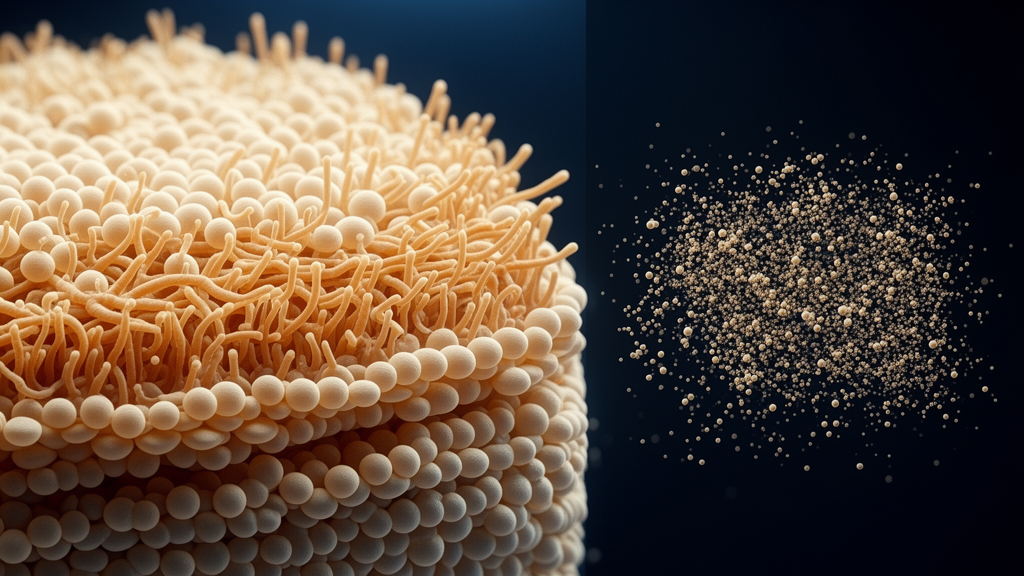
Nakaseomyces glabratus, the opportunistic yeast long known to clinicians as Candida glabrata, is notorious for its ability to coat catheters, epithelial surfaces and other niches with stubborn biofilms. These adhesive communities of cells embedded in a secreted matrix shield the fungus from both the immune system and conventional antifungal drugs, making biofilm formation a central concern in hospital-acquired infection. Now, a study screening 95 clinical isolates of N. glabratus from patients attending two major Portuguese hospitals has mapped the phenotypic and genomic diversity underlying this trait, revealing that strong biofilm producers cluster strikingly in the urinary tract and that the genetic basis of the phenotype is far more polygenic than a single adhesin story would suggest.
The research team, working with isolates collected at Hospital of Santa Maria in Lisboa and Centro Hospitalar São João in Porto, quantified biofilm formation using the crystal violet assay in polystyrene microtiter plates, a standard method in which dye bound to attached biofilm mass is solubilized and measured by absorbance at 590 nanometers. The screening exposed enormous variation across the collection. Most isolates, 53 percent, produced very low levels of biofilm close to the method’s detection limit, while a small fraction, 3 percent, generated large biofilms approaching the assay’s saturation level. The isolates came from a wide range of body niches, including blood, pus, bronchial lavage, sputum, vaginal smears, other mucosal surfaces, urine and feces, with donors ranging from 16 to 93 years of age and roughly half aged 70 or older.
When the researchers correlated biofilm capacity with clinical variables, the results were revealing in their negatives as much as their positives. Biofilm formation did not correlate with the donor’s age or sex, nor with minimum inhibitory concentration values for azole antifungal drugs. But the anatomical origin told a different story. Isolates associated with the urinary tract exhibited on average twice as much biofilm total mass as isolates from other sites, a difference that reached statistical significance with a p value of 0.016 in a one-tailed Welch t-test. Seven of the ten most productive isolates had been retrieved from urine samples, and urine-derived biofilms showed the highest mean and variance values, averaging 1.72 times the biofilm measured from all other clinical samples.
The selective logic of the urinary niche offers several possible explanations. Urine transits through the tract as a liquid with greater fluidity, volume and speed than the mucus of the respiratory tract, mouth or vagina, imposing shear forces that biofilms are well suited to resist. Biofilm formation also enhances persistence on abiotic surfaces such as catheters and confers tolerance to antifungal agents, and urinary catheterization is a common invasive hospital procedure that repeatedly exposes this niche to easily colonized inert surfaces. Resistance to being swept away by flow, to phagocytosis and to soluble antimicrobial compounds secreted by uroepithelial cells would all favor biofilm-associated traits in this environment. Whether the urinary tract actively selects for these variants or catheterization simply facilitates their expansion, the ecological association had never before been demonstrated for this species, despite earlier studies in other Candida species linking bloodstream or diabetic oral mucosa origins to increased biofilm formation.
To dissect the phenotype mechanistically, the team selected four high biofilm producers and three weak producers from opposite ends of the spectrum and characterized their extracellular matrices. In Candida albicans, matrix proteins account for roughly 55 percent of biofilm dry weight, exceeding carbohydrate content, and in N. glabratus the two components had been described as roughly equal. That balance held only for the weak producers in this study. In strong biofilm producers, average carbohydrate concentration was 5.9 times higher than protein concentration. Carbohydrate levels measured 42.1 milligrams per liter in strong producers versus 32.1 milligrams per liter in weak ones, a statistically significant difference, and the average metabolic activity of strong producers was 2.9-fold higher. No significant correlation emerged between biofilm capacity and cell viability, soluble protein or insoluble protein content, indicating that the strong phenotype is driven primarily by increased numbers of biofilm-associated cells and by carbohydrate synthesis and secretion rather than by changes in the protein matrix.
Perhaps the most striking dissociation came from virulence and adhesion testing. Using the Galleria mellonella greater wax moth larva as an infection model, the researchers observed wide strain-dependent lethality, ranging from 53 to 97 percent at 72 hours among strong producers and from 60 to 85 percent among weak producers, with average mortality of 77 and 70 percent respectively. Log-rank survival analysis confirmed no significant difference in infection risk between the two groups. Similarly, adhesion assays with VK2/E6E7 human vaginal epithelial cells showed that most isolates from both groups adhered at levels between 20 and 50 percent, with no correlation between biofilm biomass and epithelial attachment. One strong producer, isolate 56067, exceeded 80 percent adherence, but this feature was not shared by the other high producers tested. Biofilm formation, in other words, appears to contribute to pathogenicity through persistence, environmental resilience and treatment tolerance rather than through enhanced initial host cell attachment or acute virulence.
The genomic arm of the study turned to whole-genome sequencing on an Illumina HiSeq X platform, comparing the seven representative isolates against the CBS138 reference strain. The four high producers shared 2660 common single nucleotide polymorphisms, of which only 10 percent represented non-synonymous mutations in transcribed regions. Under the strictest criterion, only two non-synonymous SNPs were exclusive to all four high producers: a missense mutation, p.Ala118Val, in a putative adhesin encoded by ORF CAGL0L00157g, and a p.Phe40Ser mutation in CAGL0K07502g, a protein of unknown function. Relaxing the criteria, the team identified 38 genes carrying non-synonymous SNPs present in all high producers and absent from weak producers, and 146 genes mutated in at least three of the four high producers, yielding 184 candidates in total. Adhesin genes from the EPA, AWP and PWP families were the most common assigned category, and the transcription factor TEC1, previously characterized as a key biofilm regulator in this species, harbored mutations exclusively in high biofilm-forming isolates.
Adhesins, however, were deliberately excluded from functional validation. These genes sit in subtelomeric regions of the genome that are highly dynamic, subject to rapid mutation and recombination, which complicates any direct association between specific mutations and phenotype. Their preponderance in the candidate list may partly reflect this genomic plasticity and the higher probability of stochastic mutations in repetitive regions. Instead, the researchers selected 24 candidate genes with high SNP frequency in high producers, no prior association with biofilm formation, and predicted roles spanning chromatin regulation, transcription, translation and broader cellular organization. Each gene was deleted by homologous recombination in the laboratory strain KUE-100, and the resulting single-deletion mutants were screened through the crystal violet assay, with growth kinetics confirmed to be virtually indistinguishable from the wild type at the 24-hour time point used for quantification.
Five genes emerged as required for maximal biofilm formation: BST1, EST3, LSM7, AMS1 and ZCF21. Their predicted functions span a remarkable range of cellular processes. BST1 encodes a phosphatidylinositol deacylase linked to cell wall organization, and AMS1 an alpha-mannosidase involved in oligosaccharide catabolism and protein glycosylation, both likely affecting adhesion and matrix structure at the cell surface. ZCF21 encodes a predicted DNA-binding transcription factor, suggesting a regulatory role, while LSM7 participates in mRNA processing and turnover, pointing to post-transcriptional control. EST3 contributes to telomere maintenance and genome stability, raising the intriguing possibility of a link between telomere integrity and subtelomeric gene regulation, since telomere structure is known to influence chromatin and gene silencing at chromosome ends.
These findings fit coherently into the known regulatory architecture of N. glabratus biofilms. Biofilm formation in this species relies on transcriptional remodeling under the control of the Sir-dependent silencing complex, which governs the expression of subtelomerically encoded EPA adhesins such as EPA1, EPA6 and EPA7, and is complemented by conserved transcription factors like Efg1 and Tec1 that control adhesion, extracellular matrix production and biofilm architecture. Within this framework, ZCF21 and LSM7 could plausibly modulate transcriptional and post-transcriptional outputs of Sir-regulated loci, while BST1 and AMS1 may affect the functional deployment of adhesins at the cell surface. The overall picture is one of a multilayered network integrating chromatin organization, gene expression control and cell surface architecture, in which different genetic trajectories can converge toward similar biofilm phenotypes. The study also suggests that within-host evolution, particularly in the urinary tract, may recurrently generate genetic variants associated with enhanced biofilm formation through diverse and interconnected mechanisms, expanding the roster of non-canonical pathways that shape one of this pathogen’s most clinically consequential traits.
Subject of Research: Genetic and ecological determinants of biofilm formation diversity in clinical isolates of Nakaseomyces glabratus
Article Title: Genomic Landscape Underlying Biofilm Formation Diversity in Nakaseomyces glabratus Clinical Isolates
Article References: Costa, I. V., Zolotareva, M., Cavalheiro, M., Mil‐Homens, D., Miranda, I. M., Sasamoto, K., Fialho, A., Rodrigues, A. G., Chibana, H., & Teixeira, M. C. (2026). Genomic Landscape Underlying Biofilm Formation Diversity in Nakaseomyces glabratus Clinical Isolates. MicrobiologyOpen, 15(5), Article e70444. https://doi.org/10.1002/mbo3.70444
Image Credits: AI Generated
DOI: 10.1002/mbo3.70444
Keywords: Nakaseomyces glabratus, Candida glabrata, biofilm, clinical isolates, whole-genome sequencing, urinary tract, adhesins, extracellular matrix, gene deletion, virulence, subtelomeric silencing, antifungal tolerance
Cite Scienmag News
Juliet Wilcox. (October 25, 2026). Genomic Scan Reveals Why Some Clinical Strains of a Candida Relative Build Twice as Much Biofilm. Scienmag. https://scienmag.com/genomic-scan-reveals-why-some-clinical-strains-of-a-candida-relative-build-twice-as-much-biofilm/
Juliet Wilcox. "Genomic Scan Reveals Why Some Clinical Strains of a Candida Relative Build Twice as Much Biofilm." Scienmag, 25 October 2026, https://scienmag.com/genomic-scan-reveals-why-some-clinical-strains-of-a-candida-relative-build-twice-as-much-biofilm/. Accessed 25 October 2026.
Juliet Wilcox. "Genomic Scan Reveals Why Some Clinical Strains of a Candida Relative Build Twice as Much Biofilm." Scienmag. October 25, 2026. https://scienmag.com/genomic-scan-reveals-why-some-clinical-strains-of-a-candida-relative-build-twice-as-much-biofilm/


