


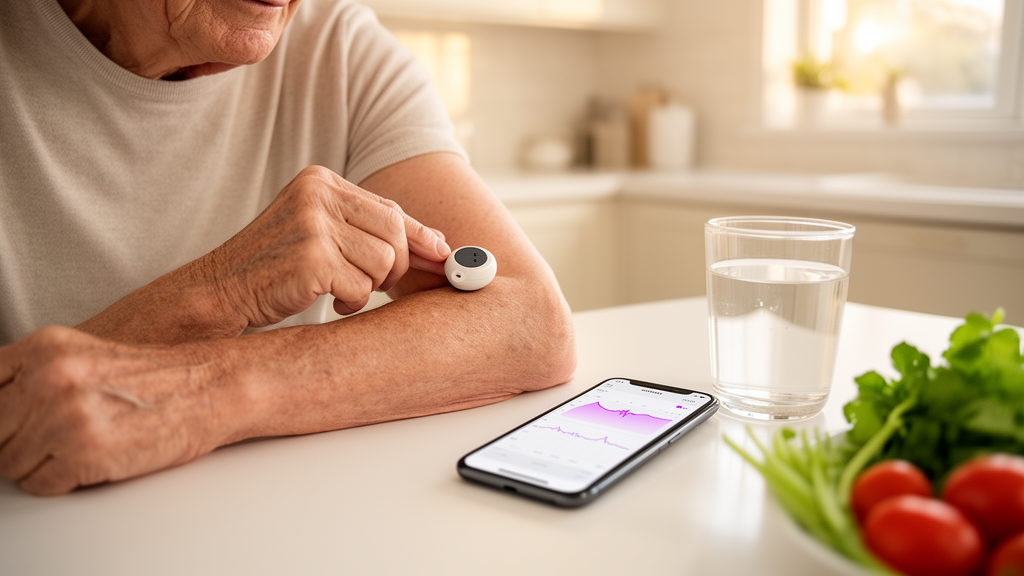
People with insulin-treated diabetes and chronic kidney disease who began using real-time continuous glucose monitoring experienced a significantly slower loss of kidney function over three years than comparable patients who did not use the devices, according to a retrospective analysis of United States electronic health records. The study, drawn from a national database spanning more than 130 million adults, also found that continuous glucose monitoring initiation was associated with a greater reduction in HbA1c, the standard laboratory measure of long-term blood sugar control. The findings address a population that has long been underrepresented in glucose-monitoring research, because managing diabetes in the setting of declining kidney function is notoriously difficult.
Chronic kidney disease is a common complication and comorbidity in people living with diabetes. Glycemic management in this group is challenging for several reasons: reduced clearance of anti-diabetic medications raises the risk of hypoglycemia, and hemoglobin A1c itself becomes a less reliable yardstick as kidney function deteriorates. A recent consensus report has advocated for greater use of continuous glucose monitoring in people with diabetes and kidney disease, while calling for additional research to determine the technology’s effects on hypoglycemia, hyperglycemia, chronic kidney disease progression, and broader cardio-kidney-metabolic risk. The new analysis set out to fill part of that evidence gap using real-world data rather than a randomized trial.
The researchers used de-identified data from Truveta, a national electronic health record database that aggregates information from integrated health systems across the United States, including patient demographics, diagnoses, encounters, and medications. They identified adults with type 1 or type 2 diabetes who were treated with any insulin and whose estimated glomerular filtration rate, calculated with the creatinine-based CKD-EPI formula, fell between 15 and 89 milliliters per minute per 1.73 square meters of body surface area. Allowing values up to 89 was deliberate: it captured individuals considered at risk for chronic kidney disease who might cross the diagnostic threshold during the three-year follow-up period. People with prior glucose monitor use, dialysis, kidney transplant, an Elixhauser comorbidity score of 10 or higher, liver cirrhosis, pregnancy, or anemia were excluded.
The exposed group consisted of individuals who initiated a Dexcom G-series real-time continuous glucose monitor between August 1, 2018 and December 31, 2023, with the index date defined as the first prescription fill and at least one refill required within six months. Controls were assigned index dates based on their first outpatient encounter with an eGFR laboratory order. The investigators tracked changes in eGFR, the albumin-to-creatinine ratio, and HbA1c from baseline to three years, with baseline values drawn from a window running from twelve months before the index date to seven days after, and follow-up values taken closest to exactly three years post-index within a six-month margin on either side.
To reduce the influence of differences between users and non-users, the team performed one-to-one propensity-score matching without replacement using a nearest-neighbor algorithm with a caliper of 0.2. Matching variables included age, gender, race and ethnicity, insurance type, diabetes type, baseline eGFR, baseline HbA1c, baseline albumin-to-creatinine ratio in the albuminuria model, and the use of sodium-glucose cotransporter 2 inhibitors, incretin mimetics such as GLP-1 and dual GIP/GLP-1 receptor agonists, or renin-angiotensin-aldosterone system inhibition therapies. Multivariable linear regression then estimated the association between monitor initiation and changes in each outcome, with additional covariates covering census region and histories of hypertension, microvascular complications, and macrovascular complications.
The matched cohorts were closely balanced at the start. In the eGFR model, with 518 patients per group, mean age at index was about 60 years in both arms, roughly 52 percent of participants were female, and about 57 percent of the monitoring group and 59 percent of the control group had type 1 diabetes. Mean baseline eGFR was 71.2 in the monitoring arm and 70.9 among non-users, with the large majority of participants in stage G2 and only a small fraction in stages G3b or G4. Around seven in ten participants in both groups were already taking renin-angiotensin-aldosterone system inhibition therapy, roughly one in five used incretin mimetics, and about 14 percent used sodium-glucose cotransporter 2 inhibitors. Mean baseline HbA1c was 8.0 percent in both arms, and hypertension was present in roughly three-quarters of each cohort.
In the model assessing kidney function, with a median follow-up of 3.0 years, those who started real-time monitoring showed an adjusted eGFR decline of 7.72 milliliters per minute per 1.73 square meters, compared with 9.46 in the non-user group. The adjusted difference of 1.74, with a standard error of 0.83, reached statistical significance at a p-value of 0.04. Because the matched groups started from nearly identical baselines, the difference represents a meaningfully slower rate of kidney function loss among monitor users over the observation period.
The glycemic results pointed in the same direction. In a model of 461 patients per cohort, HbA1c fell by 0.33 percentage points among monitor users versus 0.13 among non-users, an adjusted difference of 0.20 percentage points with a standard error of 0.08 and a p-value of 0.01. The albumin-to-creatinine ratio told a less decisive story: in a smaller model of 138 patients per cohort with a median follow-up of 2.9 years, the adjusted change favored the monitoring group by 38.1 milligrams per gram, but the difference was not statistically significant, with a p-value of 0.36. The authors note that prior clinical trials have generally reported larger HbA1c improvements after monitor initiation than those observed here, and that HbA1c measurements lose accuracy in advanced kidney disease, including in patients on dialysis, which complicates interpretation even though the measure remains widely used in clinical practice.
Placing the findings in context, persistent chronic hyperglycemia is a key driver of the development and worsening of diabetic kidney disease, and several studies support the idea that improving HbA1c helps delay disease progression. The authors hypothesize that real-time monitoring may facilitate lifestyle modifications, medication adherence, or medication optimization that support glucose management. They also point to a recent study in people with type 2 diabetes and chronic kidney disease finding that monitor initiation was associated with reductions of 17.0 percent in hypoglycemia crises and 18.2 percent in hyperglycemia crises. Extensive evidence already supports continuous glucose monitoring in type 1 and type 2 diabetes generally, but evidence specific to patients with kidney disease or at risk for it has been thinner, which is precisely what the consensus report flagged.
The study’s strengths include its longitudinal design with three years of follow-up and its use of a nationally representative database of integrated health systems. But the limitations are substantial and the authors are explicit that a causal relationship between monitor use and the observed outcomes cannot be determined. Relatively few participants had advanced kidney disease, and the analysis did not exclude acute kidney injury events. Adherence was assessed only through the requirement of at least one refill within six months of the index date, leaving long-term device engagement unmeasured. Propensity matching in the eGFR and HbA1c models could not incorporate baseline albumin-to-creatinine ratio, a potential confounder associated with the decision to start monitoring, and factors such as medication intensification, socioeconomic status, education level, provider type, and healthcare utilization rates could not be included. A longer follow-up of five years or more might reveal larger outcome differences, and the authors call for sensitivity analyses to address residual confounding.
Taken together, the results suggest that initiating real-time continuous glucose monitoring could be considered among people with diabetes and chronic kidney disease or those at risk for it, while stopping well short of proof that the devices themselves slow kidney decline. Because HbA1c is an imperfect measure in this population, the authors argue that future prospective studies should assess whether improvements in continuous glucose monitoring metrics, such as time-in-range, mean glucose, or glycemic variability, correlate with delayed chronic kidney disease progression. Until such trials are conducted, the association reported here adds real-world weight to the case for closer glucose surveillance in one of diabetes medicine’s most vulnerable populations, while leaving open the question of whether the monitor, the care patterns that accompany it, or the characteristics of patients who obtain one are doing the work.
Subject of Research: Real-time continuous glucose monitoring and kidney function decline in people with diabetes and chronic kidney disease
Article Title: Real‐Time Continuous Glucose Monitoring Use and Kidney Function Among People With Diabetes and CKD or At‐Risk for CKD
Article References: Hannah, K. L., Chen, C., Castle, J. R., Norman, G. J., & Galindo, R. J. (2026). Real‐Time Continuous Glucose Monitoring Use and Kidney Function Among People With Diabetes and CKD or At‐Risk for CKD. Endocrinology, Diabetes & Metabolism, 9(6), Article e70344. https://doi.org/10.1002/edm2.70344
Image Credits: AI Generated
DOI: 10.1002/edm2.70344
Keywords: continuous glucose monitoring, chronic kidney disease, diabetes, eGFR, HbA1c, albumin-to-creatinine ratio, insulin therapy, electronic health records, propensity-score matching, diabetic kidney disease, retrospective study, glycemic control
Cite Scienmag News
Jerry Hayes. (October 25, 2026). Glucose Monitors Linked to Slower Kidney Decline in Diabetes and CKD. Scienmag. https://scienmag.com/glucose-monitors-linked-to-slower-kidney-decline-in-diabetes-and-ckd/
Jerry Hayes. "Glucose Monitors Linked to Slower Kidney Decline in Diabetes and CKD." Scienmag, 25 October 2026, https://scienmag.com/glucose-monitors-linked-to-slower-kidney-decline-in-diabetes-and-ckd/. Accessed 25 October 2026.
Jerry Hayes. "Glucose Monitors Linked to Slower Kidney Decline in Diabetes and CKD." Scienmag. October 25, 2026. https://scienmag.com/glucose-monitors-linked-to-slower-kidney-decline-in-diabetes-and-ckd/


