

Saturday, October 24, 2026
Science
No Result
View All Result
  • Login
  • HOME
  • SCIENCE NEWS
  • CONTACT US
  • HOME
  • SCIENCE NEWS
  • CONTACT US
No Result
View All Result
Scienmag
No Result
View All Result
Home Science News Medicine

Generative AI sharpens laryngeal lesion classification from radiomic features

October 24, 2026
in Medicine
Ophelia Keating
By Ophelia Keating Scienmag Editorial Profile - Health Services Research
Reading Time: 2 mins read
0
Generative AI sharpens laryngeal lesion classification from radiomic features

Generative AI sharpens laryngeal lesion classification from radiomic features

65
SHARES
587
VIEWS
Share on FacebookShare on Twitter
ADVERTISEMENT

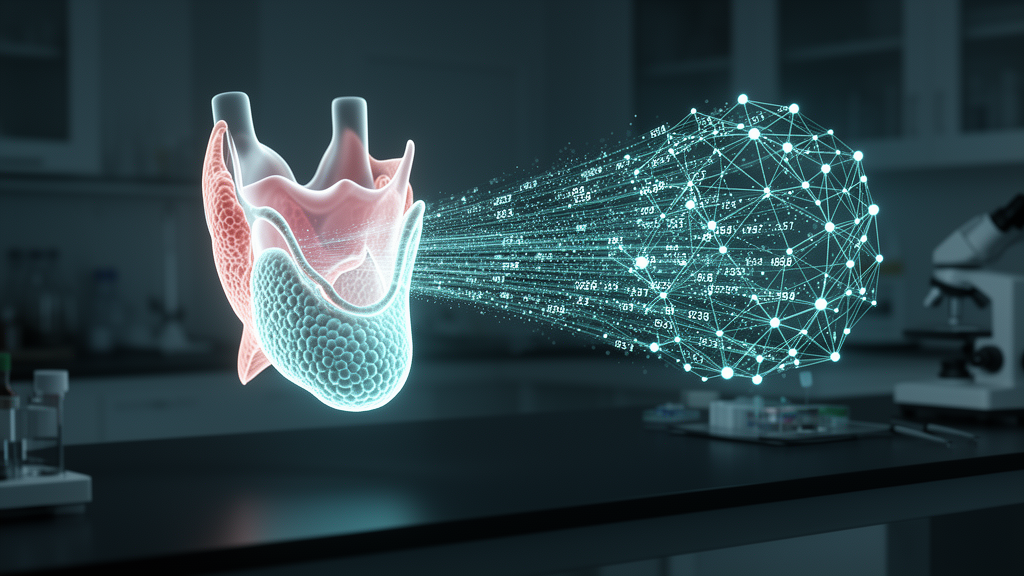
Researchers have developed a generative artificial intelligence framework that improves the classification of laryngeal lesions without creating a single synthetic medical image. The approach, described in an open-access study in BMC Medical Imaging, trains generative models directly in the radiomic feature space, the high-dimensional space of quantitative descriptors extracted from medical images, rather than fabricating new pictures. In an evaluation on an independent, unseen test set, the framework’s best-performing configuration, Radiomics-GAN, achieved a median F1-score of 0.851, outperforming a baseline model balanced with SMOTE but without generative augmentation, which reached 0.806.

The study addresses a persistent bottleneck in computer-assisted diagnosis of laryngeal cancer. Narrow-band imaging, or NBI, is an endoscopic technique that enhances mucosal and vascular contrast and has become an important modality for the early detection of laryngeal cancer. Radiomics can extract high-dimensional quantitative features from NBI images, feeding machine-learning classifiers that assist diagnosis. However, the availability and heterogeneity of annotated datasets remain limited, which constrains both the development of machine-learning models and their generalizability to new patients and imaging conditions.

Rather than generating synthetic NBI images, the proposed framework trains generative models to learn realistic distributions of radiomic features and to produce valid synthetic radiomic representations. By enriching the radiomic feature manifold in this way, the authors report, the method effectively mitigates sample scarcity and improves classifier performance. The framework was evaluated with multiple machine-learning classifiers on a laryngeal cancer diagnosis task, and generative augmentation consistently improved classification performance across all classifiers tested. Among the generative models evaluated, Generative Adversarial Networks delivered the most consistent gains.

The dataset comprised 11,144 NBI images from 210 adult patients, divided into a development set of 180 patients and an independent internal held-out test set of 30 patients. Performance was assessed on the unseen test set using accuracy, precision, recall and F1-score. The reported advantage of Radiomics-GAN over the SMOTE-balanced baseline indicates that feature-space augmentation can outperform conventional resampling approaches for this task, although the held-out test cohort was small and the evaluation remained internal.

The authors conclude that the framework supports the development of more robust AI-assisted tools for laryngeal cancer diagnosis. Future work, they write, will focus on external validation and on conditional generative models tailored to lesion subtypes and to variability in imaging acquisition, directions that will show how the reported gains extend beyond this internal evaluation.

Subject of Research: Generative AI augmentation of radiomic features for laryngeal lesion classification on narrow-band imaging

Article Title: Radiomics-GenAI: a novel model for laryngeal lesion classification

Article References: Wang, H., Xie, Z., & Mainardi, L. (2026). Radiomics-GenAI: a novel model for laryngeal lesion classification. BMC Medical Imaging. https://doi.org/10.1186/s12880-026-02963-3

Image Credits: AI Generated

DOI: 10.1186/s12880-026-02963-3

Keywords: radiomics, generative AI, GAN, laryngeal lesions, narrow-band imaging, medical imaging, machine learning, feature augmentation, computer-assisted diagnosis, laryngeal cancer, Radiomics-GenAI, novel

Cite Scienmag News

Ophelia Keating. (October 24, 2026). Generative AI sharpens laryngeal lesion classification from radiomic features. Scienmag. https://scienmag.com/generative-ai-sharpens-laryngeal-lesion-classification-from-radiomic-features/


Ophelia Keating. "Generative AI sharpens laryngeal lesion classification from radiomic features." Scienmag, 24 October 2026, https://scienmag.com/generative-ai-sharpens-laryngeal-lesion-classification-from-radiomic-features/. Accessed 24 October 2026.

Ophelia Keating. "Generative AI sharpens laryngeal lesion classification from radiomic features." Scienmag. October 24, 2026. https://scienmag.com/generative-ai-sharpens-laryngeal-lesion-classification-from-radiomic-features/

Tags: addressing dataset heterogeneity in radiomicsAI-driven radiomic feature augmentationcomputer-assisted diagnosisearly detection of laryngeal cancer using NBI imagingenhancement of radiomic data with generative modelsfeature augmentationGaNgenerative AIGenerative AI for laryngeal lesion classificationhigh-dimensional feature extraction in limproving diagnostic accuracy with AIlaryngeal cancerlaryngeal lesionsMachine learningmachine learning in laryngeal cancer diagnosisMedical Imagingnarrow band imagingnon-image synthetic data generation in medical imagingnovelradiomic feature space modelingradiomicsradiomics-GAN for medical imagingRadiomics-GenAItexture-based medical image analysis
Share26Tweet16
Previous Post

Pretend play performance across support levels in autistic children: a mixed methods study

Next Post

KOH-Treated Activated Carbon Triples Formaldehyde Capture Through Surface Chemistry, Not Pores

Related Posts

Pretend play performance across support levels in autistic children: a mixed methods study
Medicine

Pretend play performance across support levels in autistic children: a mixed methods study

October 24, 2026
Co-designed self-management support takes shape for older adults with osteoarthritis and multiple conditions
Medicine

Co-designed self-management support takes shape for older adults with osteoarthritis and multiple conditions

October 24, 2026
Post-Soviet Health Systems Faced a Pandemic Stress Test They Were Never Ready For
Medicine

Post-Soviet Health Systems Faced a Pandemic Stress Test They Were Never Ready For

October 24, 2026
Scoping review maps landscape of Black health research in Canada
Medicine

Scoping review maps landscape of Black health research in Canada

October 24, 2026
Experimental drug rejuvenates aged rat livers, halving amyloid beta and LDL
Medicine

Experimental drug rejuvenates aged rat livers, halving amyloid beta and LDL

October 24, 2026
Mental health research in Mozambique’s 18 million young people remains scarce, review finds
Medicine

Mental health research in Mozambique’s 18 million young people remains scarce, review finds

October 24, 2026
Next Post
KOH-Treated Activated Carbon Triples Formaldehyde Capture Through Surface Chemistry, Not Pores

KOH-Treated Activated Carbon Triples Formaldehyde Capture Through Surface Chemistry, Not Pores

  • Mothers who receive childcare support from maternal grandparents show more optimized

    Mothers who receive childcare support from maternal grandparents show more parental warmth, finds NTU Singapore study

    27656 shares
    Share 11059 Tweet 6912
  • University of Seville Breaks 120-Year-Old Mystery, Revises a Key Einstein Concept

    1061 shares
    Share 424 Tweet 265
  • Bee body mass, pathogens and local climate influence heat tolerance

    682 shares
    Share 273 Tweet 171
  • Researchers record first-ever images and data of a shark experiencing a boat strike

    546 shares
    Share 218 Tweet 137
  • Groundbreaking Clinical Trial Reveals Lubiprostone Enhances Kidney Function

    531 shares
    Share 212 Tweet 133
Science

Embark on a thrilling journey of discovery with Scienmag.com—your ultimate source for cutting-edge breakthroughs. Immerse yourself in a world where curiosity knows no limits and tomorrow’s possibilities become today’s reality!

RECENT NEWS

  • Swapping One Element Decides Whether Mixed High-Entropy Alloys Turn Glassy
  • AI Maps Glioma Ecosystems and Exposes a Macrophage-Driven Vulnerability in Glioblastoma
  • Survey Links Critical Thinking to Creative Problem-Posing in College Students
  • KOH-Treated Activated Carbon Triples Formaldehyde Capture Through Surface Chemistry, Not Pores

Categories

  • Agriculture
  • Anthropology
  • Archaeology
  • Athmospheric
  • Biology
  • Biotechnology
  • Blog
  • Bussines
  • Cancer
  • Chemistry
  • Climate
  • Earth Science
  • Editorial Policy
  • Marine
  • Mathematics
  • Medicine
  • Pediatry
  • Policy
  • Psychology & Psychiatry
  • Science Education
  • Science News
  • Social Science
  • Space
  • Technology and Engineering

Subscribe to Blog via Email

Enter your email address to subscribe to this blog and receive notifications of new posts by email.

Join 5,152 other subscribers

© 2025 Scienmag - Science Magazine

Welcome Back!

Login to your account below

Forgotten Password?

Retrieve your password

Please enter your username or email address to reset your password.

Log In
No Result
View All Result
  • HOME
  • SCIENCE NEWS
  • CONTACT US

© 2025 Scienmag - Science Magazine

Discover more from Science

Subscribe now to keep reading and get access to the full archive.

Continue reading