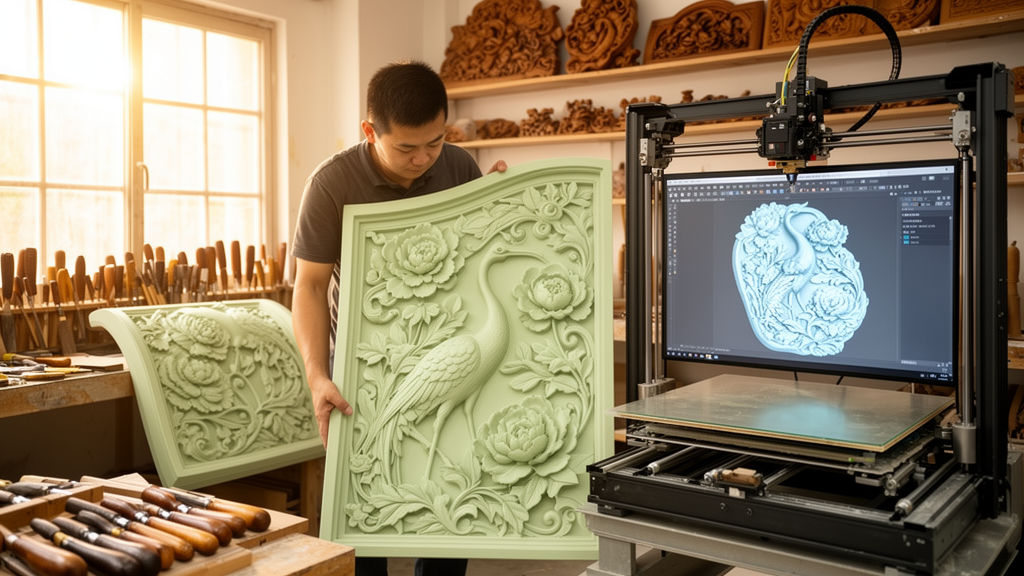
A team of researchers in China has demonstrated an end-to-end workflow that couples generative artificial intelligence with 3D printing to design, analyze, and fabricate Lingnan stucco relief, a traditional decorative craft found on historic buildings in Guangdong and Fujian. The craft, recognized as a national intangible cultural heritage, involves sculpting lime-based mortars over internal frameworks of copper wire, iron nails, and bamboo nails, and it faces declining intergenerational transmission and heavy labor demands. The study, published in AI in Civil Engineering, proposes a complementary digital pathway rather than a replacement for artisans, aiming to ease the pressures of long restoration timelines and the growing scarcity of skilled conservators.
The workflow begins with design. The researchers fine-tuned a Stable Diffusion v1.5 text-to-image model using Low-Rank Adaptation, or LoRA, a lightweight method that adapts a pretrained model to a specific style with minimal parameter changes. Their training set consisted of just 43 images of stucco reliefs gathered from the internet and field photographs, processed to a uniform resolution of 1,472 by 640 pixels to preserve the horizontal format typical of the craft. Images were automatically captioned with the CLIP model, manually corrected, and horizontally flipped to enlarge the dataset. Training ran for roughly 20 hours on a single RTX 3090 GPU, with checkpoints saved at 7,396, 14,972, and 22,188 steps.
Checkpoint selection proved decisive. At 7,396 iterations the model could produce stucco relief subjects but with significant deviations in color and style. By 14,972 iterations the generated images closely resembled real stucco relief artworks, whereas after 22,188 iterations quality degraded into distortion and chaotic compositions, an apparent overfitting effect. The mid-training model was therefore adopted. Evaluation with the Gram distance and LPIPS metrics indicated relatively low perceptual similarity but high stylistic consistency between generated and training images, suggesting the model produced distinct yet stylistically unified designs rather than near-copies. A CLIPScore of 0.7997 for generated images, against 0.7399 for the training set, indicated improved alignment with the specially annotated prompts used in training.
Because two-dimensional imagery alone cannot capture the geometry of high reliefs and full round sculptures, the team converted generated images into three-dimensional models. For low reliefs, a grayscale map served as an alpha mask in Blender to raise surface undulations. For more complex geometries, they compared several image-to-3D reconstruction models and selected InstantMesh, which generates multi-view images with a diffusion model and then predicts a 3D mesh using a large reconstruction model. Each reconstruction took about 30 seconds on the RTX 3090 workstation, producing a colored OBJ mesh that required only modest post-processing, including vertical scaling to correct an overly planar bird subject and re-baking vertex colors into texture maps. The authors note that this shifts digital model acquisition from a post-construction activity to a preparatory design step.
Structural safety required material characterization. Working with materials supplied by a Guangzhou-based inheritor of the craft, the researchers tested three lime mortars used in stucco relief: a straw-mixed mortar for the base layer, a paper-strip-mixed mortar for the surface, and a colored variant with pigments. Cubic and beam specimens were cured under natural conditions and tested for compressive and flexural strength at 14, 28, and 90 days. The straw-mixed lime mortar, the primary load-bearing component, showed progressively improving mechanical behavior with curing age. At 14 days it sustained load with minimal degradation despite cracking, while at 28 and 90 days it displayed brittle failure with rapid stress drop, followed by a secondary strengthening phase at compressive strains exceeding 25 percent. Scanning electron microscopy revealed amorphous calcium carbonate and crystalline calcite between aggregates, with a measured porosity of 34.5 percent.
Using these test results, the team built a finite element model based on a concrete damage plasticity constitutive law, with parameters adjusted to match the experimental stress-strain response. A representative bird-shaped relief design of roughly 300 millimeters in height, generated through the AI workflow, was simulated under self-weight and wind loading with an embedded 25-millimeter copper wire frame. The analysis indicated predominantly compressive stresses carried largely by the internal frame, with localized damage at corners and some detachment at the mortar-frame interface, though stresses remained within the elastic range. A parametric study of a cantilever beam with a 15 by 15 millimeter cross-section found that without tilt the cantilever could extend to 90 millimeters with internal frame support, but only 60 millimeters at a 15-degree tilt, with failure occurring beyond 45 millimeters at 30 degrees. The authors stress that the finite element model remains preliminary and unvalidated against on-site measurements, and that it overestimates compressive strength by approximately 30 percent.
On the fabrication side, the team explored several additive manufacturing routes. A multi-nozzle material jetting printer produced small-scale, full-color photopolymer prototypes of 20 centimeters that accurately reproduced the AI-generated colors and relief textures. For meter-scale molds and replicas, sand mold printing enabled rapid production of a full-scale, 1:1 model, which the authors suggest could suit non-essential traditional decorations and modern replica adornments. Low-cost fused deposition modeling was used to print modular formworks and structural supports that are assembled on site and filled with stucco relief materials for integral forming, allowing formwork to be prefabricated in a factory and transported to the construction site.
Physical trials validated the construction methods at small scale. Low-relief formworks printed in PLA and TPU95A were filled with paper-strip-mixed lime mortar, vibrated, and demolded after three days, yielding fine surface details that would be difficult to replicate manually. A freestanding bird-shaped sculpture was built with a printed PETG reinforcement integrated with its base and interlocking PLA molds; demolding after one month revealed a preliminary form with a rough surface finish but strong adhesion between the mortar and the printed reinforcement. A flexible silicone mold, cast from a printed replica, produced a sculpture with complete geometric detail after 24 hours of curing. The authors emphasize that these methods have only been validated at small scale and that resulting structures still require manual finishing by skilled artisans.
Based on interviews with practitioners, the team estimated that the workflow could reduce the overall duration of traditional construction for a medium-sized shallow relief by approximately 50 percent, excluding formwork and reinforcement production time, and could enable parallel installation of multiple pre-printed molds. They are careful to position the approach as a supplementary engineering tool: the AI-reconstructed relief does not carry the cultural value of a handcrafted piece, the subtle gestures and layering sequences of the craft have not been encoded, and ControlNet-based image restoration of damaged reliefs yielded limited results, particularly for non-training-set images. The authors call for larger datasets, better metrics linking model loss to generative quality, refined constitutive models with more test specimens, and systematic comparison between original craft objects and digitally fabricated results as the framework matures toward practical heritage conservation.
Subject of Research: An AI-driven generative design, structural analysis, and additive manufacturing workflow for Lingnan stucco relief in historical building renovation
Article Title: Coupling generative AI with 3D printing for historical building renovation: a case study of Lingnan stucco relief
Article References: Yin, Y., Cheng, J., Zhou, J., Xiao, Z., Chen, W., Zheng, H., & Hu, N. (2026). Coupling generative AI with 3D printing for historical building renovation: a case study of Lingnan stucco relief. AI in Civil Engineering, 5(1), Article 21. https://doi.org/10.1007/s43503-026-00106-9
Image Credits: AI Generated
DOI: 10.1007/s43503-026-00106-9
Keywords: generative AI, Stable Diffusion, LoRA fine-tuning, 3D printing, Lingnan stucco relief, intangible cultural heritage, lime mortar, finite element analysis, additive manufacturing, historical building renovation, 3D reconstruction, Guangdong
Cite Scienmag News
Denise Maddox. (October 28, 2026). Generative AI and 3D printing join forces to revive Lingnan stucco relief craft. Scienmag. https://scienmag.com/generative-ai-and-3d-printing-join-forces-to-revive-lingnan-stucco-relief-craft/
Denise Maddox. "Generative AI and 3D printing join forces to revive Lingnan stucco relief craft." Scienmag, 28 October 2026, https://scienmag.com/generative-ai-and-3d-printing-join-forces-to-revive-lingnan-stucco-relief-craft/. Accessed 28 October 2026.
Denise Maddox. "Generative AI and 3D printing join forces to revive Lingnan stucco relief craft." Scienmag. October 28, 2026. https://scienmag.com/generative-ai-and-3d-printing-join-forces-to-revive-lingnan-stucco-relief-craft/