


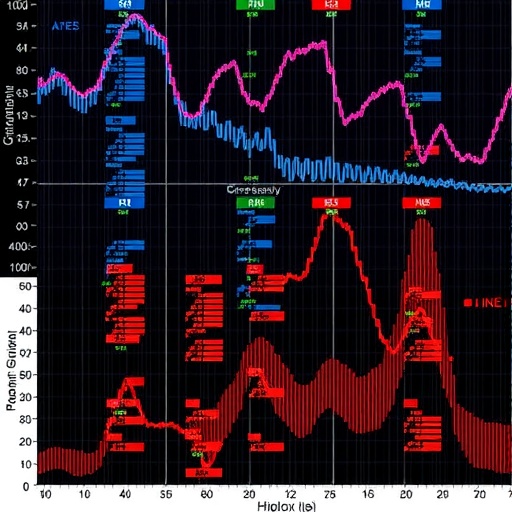
Oxygen deprivation may be rewriting the molecular instructions inside cells far more extensively than conventional RNA sequencing analyses reveal, according to a new study of human vascular endothelial cells. Researchers report that hypoxic adaptation involves thousands of changes in the use of individual RNA transcripts—molecular messages produced from the same gene—even when the total output of those genes appears unchanged. The finding challenges a widespread assumption in genomics: that measuring whether a gene becomes more or less active is sufficient to understand how cells respond to environmental stress. Instead, the study suggests that cells can rapidly reorganize which versions of a gene’s RNA they produce, potentially altering protein structure, localization, stability, or function without changing the gene’s overall expression level.
The work, published in BMC Genomics, examined the response of human umbilical vein endothelial cells to hypoxia, a condition in which oxygen availability falls below the level required for normal cellular metabolism. Endothelial cells line blood vessels and are among the first cells to encounter changing oxygen conditions in tissues. Their responses influence vascular tone, vessel growth, inflammation, permeability, and tissue survival. Hypoxia is a central feature of diseases including pulmonary hypertension, cancer, stroke, heart disease, and chronic lung disorders, as well as a normal component of development and adaptation at high altitude. Understanding how endothelial cells alter their gene activity under low oxygen could therefore illuminate both protective biological responses and disease-promoting mechanisms.
RNA sequencing, or RNA-seq, is widely used to investigate these responses. In a typical experiment, cellular RNA is converted into complementary DNA, sequenced, and mapped back to the genome. The resulting reads can be assigned to genes, providing an estimate of how much RNA each gene produced. This gene-level approach is powerful and relatively straightforward, but it compresses the output of a complex genomic system into one number per gene. Most mammalian genes can generate multiple transcript isoforms through alternative splicing, in which different combinations of exons are joined together, and alternative promoter usage, in which transcription begins at different points. These isoforms may encode proteins with distinct domains or produce RNAs with different regulatory properties. Summing all transcripts together can conceal a decisive switch from one isoform to another.
To uncover such switches, the researchers applied complementary statistical methods to their RNA-seq data. Differential exon usage analysis tested whether individual exons were included at different frequencies under hypoxia. Transcript usage analysis examined whether the relative contribution of each transcript to a gene’s total RNA output changed. Alternative-splicing analysis assessed specific RNA-processing events, such as exon skipping, alternative splice-site selection, and changes involving transcript ends. These approaches do not simply ask whether a gene is more active; they ask whether the internal composition of its RNA output has been remodeled. The study also compared these results with conventional gene-level differential-expression analyses performed using established tools including DESeq2, edgeR, and limma-voom.
The temporal pattern was one of the study’s most striking findings. At the earliest stages of hypoxic exposure, the endothelial response was dominated by transcript usage changes rather than broad increases or decreases in total gene expression. In other words, cells appeared to adjust the molecular forms of existing gene outputs before substantially changing how much RNA those genes produced overall. As hypoxia continued, the transcript-level and gene-level responses increasingly converged, indicating that prolonged oxygen deprivation eventually affected both the composition and quantity of cellular RNA. This sequence suggests that transcript remodeling may be part of an early-response system, allowing cells to fine-tune protein production quickly while preserving overall transcriptional output.
The distinction is biologically important because RNA isoforms can behave like different molecular products even when they originate from the same gene. Alternative exons may add or remove protein-interaction domains, change catalytic activity, expose or hide localization signals, or alter a protein’s sensitivity to degradation. Differences in untranslated regions can affect how efficiently an RNA is translated or how long it survives in the cell. A shift in promoter use can also select a different transcriptional start site and modify the resulting protein or regulatory sequence. Consequently, a gene whose total RNA abundance remains constant may still undergo a functional transformation if hypoxia changes which transcript is predominant. A gene-level analysis would record stability and could incorrectly suggest that the gene is uninvolved.
Across the hypoxic time course, the researchers identified thousands of hypoxia-responsive genes that conventional gene-level analyses did not detect. Most alternatively spliced genes remained invisible to standard differential-expression testing, even though their RNA-processing patterns changed significantly. The result demonstrates that transcript remodeling is not merely a minor refinement layered on top of gene activation and repression. In many cases, it occurs independently of changes in total gene expression. The authors also found that different analytical approaches captured overlapping but nonidentical sets of responsive genes, underscoring how strongly conclusions can depend on whether data are summarized at the gene, exon, transcript, or individual splicing-event level.
The expanded view also changed the biological pathways associated with hypoxia. Gene-level analyses identified some of the expected cellular programs involved in oxygen sensing and adaptation, but incorporating transcript-level information substantially increased the number of hypoxia-associated pathways. The additional signals may represent regulatory programs that do not require wholesale changes in transcription. Instead, they may depend on selective RNA processing, shifts in isoform proportions, or coordinated remodeling of exon usage across groups of genes. Such mechanisms could help endothelial cells alter metabolism, cytoskeletal organization, cell-cell interactions, vascular signaling, and stress responses with greater precision than a simple gene-on or gene-off model allows.
The study carries practical implications for how biomedical researchers interpret transcriptomic experiments. A gene that fails to meet a differential-expression threshold should not automatically be classified as biologically unchanged, particularly when cells are responding rapidly to a stimulus. Conversely, a change in one transcript may have consequences that are diluted when all isoforms are combined into a single gene-level measurement. The researchers used methods including DEXSeq for exon-level usage, DRIMSeq for transcript-level usage, and SUPPA2 for event-based alternative-splicing analysis, illustrating that no single summary captures the full structure of the RNA response. Combining these approaches can reveal both the magnitude and timing of regulatory changes that would otherwise be missed.
The findings do not mean that conventional RNA-seq analysis is obsolete. Gene-level measurements remain useful for identifying large and coordinated shifts in transcription, comparing experiments, and building broad models of cellular physiology. However, the new results indicate that gene-level analysis should be treated as one layer of interpretation rather than a complete description of RNA biology. The study was conducted in commercially obtained human umbilical vein endothelial cells, so the precise patterns may differ among tissues, individuals, or disease states. Further work will be needed to determine which remodeled transcripts produce functional protein changes and whether the same temporal strategy occurs in living tissues. Even so, the central message is clear: during hypoxic adaptation, cells may begin by changing what their genes say before they change how loudly those genes speak.
Cite Scienmag News
Juliet Wilcox. (August 27, 2026). Gene-level RNA sequencing masks widespread transcript-level remodeling during adaptation to hypoxia. Scienmag. https://scienmag.com/gene-level-rna-sequencing-masks-widespread-transcript-level-remodeling-during-adaptation-to-hypoxia/
Juliet Wilcox. "Gene-level RNA sequencing masks widespread transcript-level remodeling during adaptation to hypoxia." Scienmag, 27 August 2026, https://scienmag.com/gene-level-rna-sequencing-masks-widespread-transcript-level-remodeling-during-adaptation-to-hypoxia/. Accessed 6 September 2026.
Juliet Wilcox. "Gene-level RNA sequencing masks widespread transcript-level remodeling during adaptation to hypoxia." Scienmag. August 27, 2026. https://scienmag.com/gene-level-rna-sequencing-masks-widespread-transcript-level-remodeling-during-adaptation-to-hypoxia/


