Tuesday, October 27, 2026
Science
No Result
View All Result
  • Login
  • HOME
  • SCIENCE NEWS
  • CONTACT US
  • HOME
  • SCIENCE NEWS
  • CONTACT US
No Result
View All Result
Scienmag
No Result
View All Result
Home Science News Technology and Engineering

Gecko-inspired laser-textured titanium surface boosts composite laminate bonding by 202%

October 27, 2026
in Technology and Engineering
Denise Maddox
By Denise Maddox Scienmag Editorial Profile - Mechanical Engineering
Reading Time: 3 mins read
0
Gecko-inspired laser-textured titanium surface boosts composite laminate bonding by 202%

Gecko-inspired laser-textured titanium surface boosts composite laminate bonding by 202%

65
SHARES
587
VIEWS
Share on FacebookShare on Twitter
ADVERTISEMENT

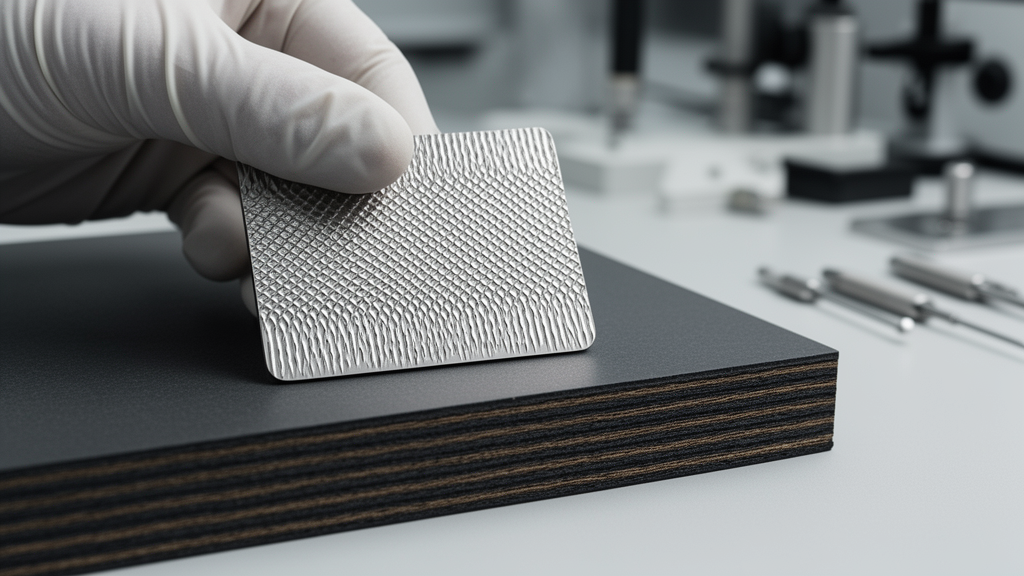
The research team, led by Fangting Qu and Chunming Ji with colleagues including Hongbo Huang, Yingze Li, Xiaodong He and Bing Wang, reports that a carefully engineered hierarchical surface on titanium raised the apparent interlaminar shear strength of the laminate from 29.27 MPa to 88.39 MPa, an increase of 201.98%. Failures in these laminates tend to occur as delamination at the metal-composite interface, which undermines the very reason for combining the two materials. The first scale is microscale.

Using laser-induced micro-texturing, the researchers engraved ordered grooves into the titanium plate, systematically varying groove depth and spacing to map how geometry affects bonding. The second scale is nanoscale. Onto the laser-textured surface they grew highly ordered arrays of titanium dioxide nanotubes using a two-step anodic oxidation process, so that the nanotubes formed both on the flat surface and inside the microgrooves.

Characterization of the treated surfaces showed that the uniform, ordered TiO2 nanotube arrays formed successfully within the grooves and across the plate. The team then measured how the surface interacted with liquids, a key indicator of how well molten PEEK would wet and infiltrate the texture during bonding. Within the investigated parameter range, the best performance emerged at a groove depth of 15 micrometers and a groove spacing of 1.0 millimeter.

Under that condition, the water contact angle dropped to 14.59 degrees, indicating a strongly hydrophilic surface, and the surface free energy reached 83.25 mJ/m2. Those surface changes translated directly into mechanical performance. The apparent interlaminar shear strength of laminates built on the optimally textured titanium reached 88.39 MPa, the 201.98% increase over the untreated baseline of 29.27 MPa.

The authors attribute the gain to a combination of effects working in concert: microscale mechanical interlocking as PEEK flows into the laser-cut grooves, nanoscale anchoring as the polymer penetrates the TiO2 nanotube pores, improved wettability, and a larger effective bonding area created by the texture. Fracture surface analysis provided visual support for that mechanism. Microscopy revealed PEEK retained inside the laser-induced micro-textures after failure, and the authors report morphological evidence suggesting possible PEEK penetration into the nanotube nanopores, forming what they describe as a multiscale mechanical interlocking effect.

Importantly, the treatment changed not just how strong the interface was but how it failed: the dominant failure mode shifted from interfacial delamination to cohesive and mixed failure modes, meaning the bond line itself became stronger relative to the materials it joins. The study is a laboratory-scale materials engineering investigation, and its conclusions are bounded by the parameter ranges the team tested; the reported optimum of 15 micrometer depth and 1.0 millimeter spacing applies within that window rather than as a universal rule. The article was published open access on 27 October 2026 as a peer-reviewed accepted manuscript shared ahead of final version-of-record edits, so some details may be refined in the final version.

The fracture-surface evidence for nanotube infiltration is described as suggestive rather than definitive, and the authors frame it as morphological support for the interlocking hypothesis. Even with those caveats, the approach stands out for its controllability. The authors position the work as an integrated and controllable micro-nano interface engineering approach for manufacturing CF/PEEK-titanium hybrid laminates with excellent interlaminar behavior.

Subject of Research: Gecko-inspired hierarchical surface engineering of titanium for CF/PEEK hybrid laminate interfaces

Article Title: Gecko-inspired tunable hierarchical interface for CF/PEEK-titanium hybrid laminates: synergistic enhancement via laser-induced micro-texturing and in-situ grown TiO2 nanotube arrays

Article References: Qu, F., Ji, C., Huang, H., Li, Y., He, X., & Wang, B. (2026). Gecko-inspired tunable hierarchical interface for CF/PEEK-titanium hybrid laminates: synergistic enhancement via laser-induced micro-texturing and in-situ grown TiO2 nanotube arrays. Advanced Composites and Hybrid Materials. https://doi.org/10.1007/s42114-026-02150-6

Image Credits: AI Generated

DOI: 10.1007/s42114-026-02150-6

Keywords: gecko-inspired materials, CF/PEEK, titanium, hybrid laminates, TiO2 nanotubes, laser texturing, interlaminar shear strength, surface wettability, mechanical interlocking, anodic oxidation, composites, interface engineering

Cite Scienmag News

Denise Maddox. (October 27, 2026). Gecko-inspired laser-textured titanium surface boosts composite laminate bonding by 202%. Scienmag. https://scienmag.com/gecko-inspired-laser-textured-titanium-surface-boosts-composite-laminate-bonding-by-202/

Denise Maddox. "Gecko-inspired laser-textured titanium surface boosts composite laminate bonding by 202%." Scienmag, 27 October 2026, https://scienmag.com/gecko-inspired-laser-textured-titanium-surface-boosts-composite-laminate-bonding-by-202/. Accessed 27 October 2026.

Denise Maddox. "Gecko-inspired laser-textured titanium surface boosts composite laminate bonding by 202%." Scienmag. October 27, 2026. https://scienmag.com/gecko-inspired-laser-textured-titanium-surface-boosts-composite-laminate-bonding-by-202/

Tags: anodic oxidationanodic oxidation of titanium for nanotube growthbiomimetic surface design for aerospaceCF/PEEKcompositesfailure analysis of metal-composite laminatesgecko-inspired materialsgecko-inspired surface engineeringhierarchical micro-nano surface modificationhybrid laminatesinterface engineeringinterlaminar shear strengthinterlaminar shear strength improvement in compositeslaser micro-texturing for metal-polymer interfaceslaser texturinglaser-textured titanium for enhanced composite bondingmechanical interlockingmicrogroove geometry optimization in titanium bondingnanoscale surface patterning for bonding strengthsurface wettabilitysurface wettability and bonding performanceTiO2 nanotubestitaniumtitanium dioxide nanotube arrays for adhesion
Share26Tweet16
Previous Post

New Scale Measures Graded Exposure to Violent Pornography in Young Adults

Next Post

Simple Blood Ratio Predicts Short-Term Death Risk After Heart Attack, Large Study Finds

Related Posts

Global checklist brings order to deep-sea polychaete diversity
Biology

Global checklist brings order to deep-sea polychaete diversity

October 27, 2026
Highway runoff carries microplastics and tyre rubber into Swedish stormwater
Technology and Engineering

Highway runoff carries microplastics and tyre rubber into Swedish stormwater

October 27, 2026
Research report: A collaborative multi-LLM framework with self-reflection iterative prompting for automated essay scoring
Science News

Research report: A collaborative multi-LLM framework with self-reflection iterative prompting for automated essay scoring

October 27, 2026
New framework asks whether nations can keep information trustworthy in the age of synthetic media
Science News

New framework asks whether nations can keep information trustworthy in the age of synthetic media

October 27, 2026
Self-driving vehicle carries LiDAR to map aerosols in three dimensions
Athmospheric

Self-driving vehicle carries LiDAR to map aerosols in three dimensions

October 27, 2026
New Algorithm Finds Network Communities by Hunting for Core Nodes First
Technology and Engineering

New Algorithm Finds Network Communities by Hunting for Core Nodes First

October 27, 2026
Next Post
Simple Blood Ratio Predicts Short-Term Death Risk After Heart Attack, Large Study Finds

Simple Blood Ratio Predicts Short-Term Death Risk After Heart Attack, Large Study Finds

  • Mothers who receive childcare support from maternal grandparents show more optimized

    Mothers who receive childcare support from maternal grandparents show more parental warmth, finds NTU Singapore study

    27656 shares
    Share 11059 Tweet 6912
  • University of Seville Breaks 120-Year-Old Mystery, Revises a Key Einstein Concept

    1061 shares
    Share 424 Tweet 265
  • Bee body mass, pathogens and local climate influence heat tolerance

    682 shares
    Share 273 Tweet 171
  • Researchers record first-ever images and data of a shark experiencing a boat strike

    546 shares
    Share 218 Tweet 137
  • Groundbreaking Clinical Trial Reveals Lubiprostone Enhances Kidney Function

    531 shares
    Share 212 Tweet 133
Science

Embark on a thrilling journey of discovery with Scienmag.com—your ultimate source for cutting-edge breakthroughs. Immerse yourself in a world where curiosity knows no limits and tomorrow’s possibilities become today’s reality!

RECENT NEWS

  • Almond-Shell Biochar Turns Iron Into a Near-Perfect CO2-to-CO Catalyst
  • Stiffer Ankle Braces Cut Push-Off Work Across Everyday Movements in Calf Weakness
  • Long-read sequencing uncovers a novel ethA deletion driving ethionamide resistance in multidrug-resistant tuberculosis
  • Flightless female moth discovered in the Alps reveals new case of wing loss

Categories

  • Agriculture
  • Anthropology
  • Archaeology
  • Athmospheric
  • Biology
  • Biotechnology
  • Blog
  • Bussines
  • Cancer
  • Chemistry
  • Climate
  • Earth Science
  • Editorial Policy
  • Marine
  • Mathematics
  • Medicine
  • Pediatry
  • Policy
  • Psychology & Psychiatry
  • Science Education
  • Science News
  • Social Science
  • Space
  • Technology and Engineering

Subscribe to Blog via Email

Enter your email address to subscribe to this blog and receive notifications of new posts by email.

Join 5,151 other subscribers

© 2025 Scienmag - Science Magazine

Welcome Back!

Login to your account below

Forgotten Password?

Retrieve your password

Please enter your username or email address to reset your password.

Log In
No Result
View All Result
  • HOME
  • SCIENCE NEWS
  • CONTACT US

© 2025 Scienmag - Science Magazine

Discover more from Science

Subscribe now to keep reading and get access to the full archive.

Continue reading