Physicists hunting for an almost invisible nuclear transformation have long been haunted by a stubborn impostor: alpha particles from trace radioactive contamination that can mimic the very signal they seek. A new study now shows that a single machine-learning filter, trained exclusively on gamma-ray data, can sweep away both the multi-site gamma backgrounds and the troublesome alpha events in high-purity germanium detectors, achieving an alpha-rejection factor exceeding 27,000 while preserving more than 80 percent of the signal-like events.
In the isotope germanium-76, the signal would appear as an extraordinarily sharp energy peak at 2039.06 keV. Experiments such as Heidelberg-Moscow, IGEX, the Majorana Demonstrator and GERDA have progressively pushed the lower limit on the half-life of this decay, with GERDA reporting one of the lowest background indices of the previous generation, 5.2 times ten to the minus four counts per keV, kilogram and year, and a half-life limit of 1.8 times ten to the twenty-sixth years at 90 percent confidence. LEGEND, building on that legacy, recently combined data from GERDA, the Majorana Demonstrator and its own first year of running to set the most stringent limit to date, 1.9 times ten to the twenty-sixth years.
The enemy in these searches is background, and one particularly insidious source comes from the long-lived daughters of radon-222: polonium-210 and its ancestor lead-210. Lead-210 decays with a half-life of 22.3 years, ultimately producing polonium-210, which emits a 5.3 MeV alpha particle. If such an emitter sits directly on the thin, boron-implanted p-plus contact of a germanium detector, the alpha particle can deposit a significant fraction of its energy in the active volume. Under suitable emission angles, the registered energy can land close to the decay’s Q-value of 2039 keV, right inside the region of interest. The thick lithium-diffused n-plus contact, by contrast, stops alpha particles in its own dead layer, so contamination there can be neglected. The problem is therefore concentrated at the p-plus surface, and it persists because the number of alpha events recorded over an experiment’s lifetime is far too small to train a dedicated classifier, even though the events still contribute to the background.
The study’s central question was whether a pulse shape discrimination classifier trained and calibrated solely on gamma-ray events could also eliminate alpha events without any additional adaptation. Pulse shape discrimination exploits the fact that different physical processes leave different fingerprints in the detector’s electrical waveforms. A gamma ray that deposits energy at a single location in the crystal produces a single-site event, while one that Compton-scatters at several separated locations produces a multi-site event. For neutrinoless double beta decay, the energy deposition is expected within a volume of roughly one cubic millimetre, so every multi-site event is unwanted background by definition. Alpha particles, which deposit all their energy within less than 50 micrometres of germanium, are also single-site-like, but their occurrence right at the p-plus contact leads to very fast charge collection that can, in principle, distort the pulse shape in characteristic ways.
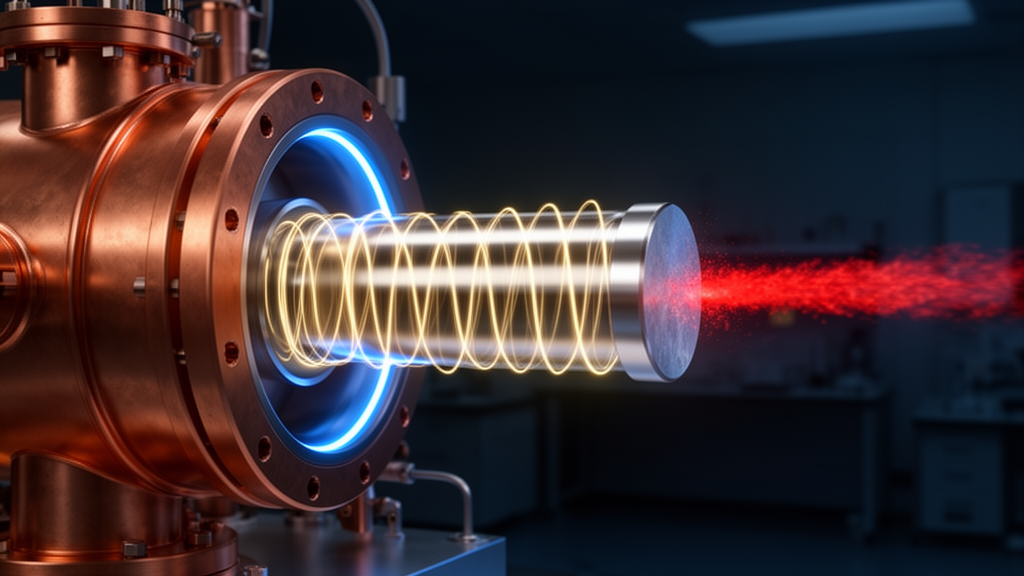
To test the idea, the team used a point-contact germanium detector of the BEGe type, installed in a vacuum cryostat at surface level, shielded by ten centimetres of lead and equipped with a plastic scintillator veto for cosmic muons. Pulses were recorded directly from the preamplifier with a 100 MHz, 14-bit flash analogue-to-digital converter. Two measurement campaigns were carried out: the first with polonium-209, which emits 4.88 MeV alpha particles, and the second with polonium-210, emitting 5.30 MeV alphas, both deposited on a thin gold foil placed directly on the p-plus contact. The foil’s four-millimetre diameter was deliberately smaller than the eight-millimetre contact, ensuring that nearly all alpha particles entering the detector struck the contact itself. After subtracting background counts, the campaigns yielded 136,000 and 1.87 million alpha events respectively, in a region of interest spanning 3500 to 5300 keV.
The machine-learning pipeline was deliberately simple in its inputs. From each raw waveform, 64 points along the rising edge of the current signal were selected, and a standard scaler fitted on the training data normalised the features. Two classifiers were compared: a projective likelihood estimator, a Naive Bayesian method that multiplies one-dimensional probability densities of individual features, and a multilayer perceptron, an artificial neural network with six dense layers of dimensions 64, 32, 16, 8, 4 and 1, using ReLU activations and a sigmoid output, trained with the Adam optimizer and L1 regularisation on the first layer. Training data came from calibration runs with a thorium-228 source, whose spectrum offers relatively clean samples of single-site events in the double escape peak and Compton edge, and multi-site events in the single escape peaks, full energy peaks and multi-Compton regions. Six training configurations were explored, each balanced to contain equal numbers of signal and background events, with roughly 20,000 events per configuration in the low-statistics campaign and 100,000 in the high-statistics one.
Cut values were chosen by maximising a figure of merit based on the significance of a counting experiment, using the thorium-208 double escape peak as a proxy for the neutrinoless double beta decay signal and the single escape and full energy peaks as background proxies. Survival fractions were extracted from Gaussian fits to each peak before and after the cut. The results were striking. Configurations trained on the double escape peak clearly outperformed those trained on the Compton edge, reflecting the lower purity of the latter samples. For the high-statistics run, the best multilayer perceptron configuration achieved double escape peak survival above 80 percent, multi-site event survival below 20 percent, and a 90 percent confidence level lower limit on the alpha-rejection factor of 27,100. The low-statistics campaign yielded a corresponding limit of 1,100. Notably, the configurations best at rejecting multi-site gamma events also performed best against alphas, suggesting the two tasks share a common structure in the waveform data.
The benchmark A/E classifier, the ratio of the maximum current pulse to the event energy, long used by GERDA and LEGEND, fared considerably worse against alphas. Although its upper cut could reject a large fraction of alpha events, with a rejection factor of roughly 50, the polonium peaks remained clearly visible after the cut in both campaigns, and tightening the cut would have driven the signal survival to unacceptably low levels. The neural network, by contrast, suppressed the polonium peaks and their tails so thoroughly that the remaining counts were consistent with residual muon background. One subtlety emerged in the high-statistics data: a small second cluster of alpha events, representing about one percent of the sample, sat closer to the signal band, possibly related to the non-flatness of the source producing events near the contact edges. The authors note that such events were absent in the low-statistics run and would be negligible in real low-background conditions. A hardware caveat also applies: the JFET transistor was replaced between campaigns, so PSD performance before and after the swap is not directly comparable.
The authors are candid about limitations. The multilayer perceptron architecture was chosen empirically, and a systematic exploration of alternatives was not performed. Sensitivity was limited by statistics and by the residual muon flux at the surface. To address the latter, the team measured the muon flux in the Ksiaz Underground Laboratory, at roughly 270 metres water equivalent, finding it 35 times lower than at the surface; repeating the experiment underground would likely leave only about ten surviving events, corresponding to a rejection factor on the order of one hundred thousand. Although the study focused on a BEGe-like detector, the authors expect similar performance for other p-type point-contact geometries, including the inverted coaxial detectors used in LEGEND, based on prior experience with single-site and multi-site discrimination in GERDA, the Majorana Demonstrator and LEGEND. A dedicated measurement campaign with a LEGEND-like inverted coaxial detector is planned to verify that expectation experimentally.
Subject of Research: Machine-learning pulse shape discrimination trained solely on gamma-ray data to reject alpha and multi-site gamma backgrounds in high-purity germanium detectors for neutrinoless double beta decay searches.
Article Title: Pulse shape discrimination for event rejection in BEGe-type high-purity germanium detectors
Article References: Biondi, A., Szczepaniec, K., Mróz, T., Misiaszek, M., & Zuzel, G. (2026). Pulse shape discrimination for event rejection in BEGe-type high-purity germanium detectors. The European Physical Journal C, 86(10), Article 1216. https://doi.org/10.1140/epjc/s10052-026-16463-9
Image Credits: AI Generated
DOI: 10.1140/epjc/s10052-026-16463-9
Keywords: high-purity germanium detectors, pulse shape discrimination, neutrinoless double beta decay, LEGEND, machine learning, multilayer perceptron, alpha rejection, BEGe detector, gamma-ray background, polonium sources, dark matter, rare-event searches
Cite Scienmag News
Grant Pearson. (October 29, 2026). Gamma-only training teaches germanium detectors to reject alpha backgrounds. Scienmag. https://scienmag.com/gamma-only-training-teaches-germanium-detectors-to-reject-alpha-backgrounds/
Grant Pearson. "Gamma-only training teaches germanium detectors to reject alpha backgrounds." Scienmag, 29 October 2026, https://scienmag.com/gamma-only-training-teaches-germanium-detectors-to-reject-alpha-backgrounds/. Accessed 29 October 2026.
Grant Pearson. "Gamma-only training teaches germanium detectors to reject alpha backgrounds." Scienmag. October 29, 2026. https://scienmag.com/gamma-only-training-teaches-germanium-detectors-to-reject-alpha-backgrounds/