


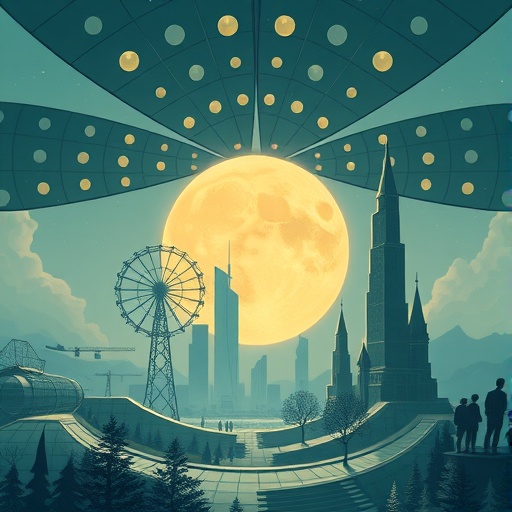
In the rapidly evolving realm of technology and artificial intelligence, the future of education stands as one of the most critically examined arenas. The utilization of advanced AI systems such as ChatGPT, Gemini, and Deepseek has given rise to extensive discussions regarding their potential to reshape educational structures and experiences. A new study by researcher J. Wong sheds light on the speculative futures of education, projecting both utopian and dystopian scenarios that could emerge as these technologies become increasingly integrated into learning environments.
Wong’s exploration initiates with a backdrop of widespread digital transformation, emphasizing how tools like ChatGPT and others are not merely adjuncts but pivotal constituents of modern educational paradigms. The study elucidates the promise of personalized education through AI, suggesting that these technologies can tailor learning experiences to individual student needs, harnessing data to forecast and adapt to challenges. The notion of customized learning paths becomes a focal point, promising to enhance student engagement and efficacy in knowledge acquisition.
However, with great potential comes significant challenges. Wong delves into the dystopian aspects of AI in education, articulating concerns about surveillance, data privacy, and the erosion of traditional teaching roles. The study pinpoints how the increasing reliance on AI tools could lead to a depersonalized educational landscape where human interaction diminishes. This tension between technological efficiency and humanistic education raises critical questions about the role of teachers in a future dominated by AI.
As Wong navigates through speculative scenarios, one particularly Utopian vision emerges: a world where AI facilitates collaborative learning not only among students but across geographical and cultural boundaries. In this setting, virtual classrooms would bring together diverse learners to collaborate on projects and ideas, fostering an enriched educational experience that defies physical limitations. The prospect of AI-enabled global collaboration could democratize access to knowledge, enabling underprivileged communities to partake in high-quality educational resources previously unattainable.
Conversely, Wong explores a darker vision where the proliferation of AI could exacerbate educational inequalities. In scenarios where only affluent institutions can afford cutting-edge AI technologies, a two-tiered system might emerge. Those with access to AI-enhanced learning could find themselves academically ahead, while others remain stagnated in outdated educational models. This potential divide raises alarm bells regarding fairness in access to education, a cornerstone of democratic societies.
Additionally, Wong’s analysis underscores the ethical implications inherent in adopting AI technologies in education. The potential risks of algorithmic bias and the propagation of stereotypes through AI learning tools cannot be overstated. The study implies that if left unchecked, these biases could seep into educational content, perpetuating existing societal divides rather than bridging them. Wong calls for a proactive stance in developing ethical AI frameworks that guide the creation and implementation of educational technologies.
Another critical future consideration discussed by Wong is the impact of AI on the cultivation of critical thinking skills. In an age where information can be generated at the click of a button, the ability to discern credible sources and synthesize information becomes paramount. Wong articulates that while AI can support educational endeavors by providing vast resources, it is essential that students are taught to critically engage with these tools rather than passively accept their outputs.
Wong also touches upon the potential for AI to enhance teacher training programs. By using AI simulations, educators could better prepare for real classroom challenges in a controlled environment. Imagine a future where novice teachers can engage with sophisticated AI systems that simulate various classroom dynamics, equipping them with the skills to adapt to diverse student needs and behaviors. This dual approach of collaboration between human educators and AI could refine the teaching process.
Moreover, the potential for lifelong learning will be unfurled in Wong’s speculative scenarios, highlighting how AI can support adults in non-traditional educational settings. As global economies evolve and job markets shift, continuous education and skill acquisition become imperative. AI could play a catalytic role in this transition, offering adaptive learning platforms that respond to the changing demands of careers in an increasingly automated world.
In examining the societal implications, Wong also considers how AI could influence broader educational policy-making. With real-time data analytics enabled by AI tools, administrators could make informed decisions that affect curriculum development, resource allocation, and student support systems. However, the challenge remains in protecting user data and ensuring that such information is utilized ethically and transparently to foster student success.
Wong’s work ultimately positions education in the intersection of hope and caution, advocating for a balanced approach toward AI integration. The speculative scenarios outlined reveal that the future of education mediated by technology will be heavily shaped by prevailing societal values and ethical considerations. Crafting a future where AI serves as an ally rather than a barrier will require collaborative efforts from educators, technologists, policymakers, and communities alike.
In conclusion, Wong’s study invites us to critically reflect on the dual nature of technological advancement in education. The utopian visions beckon with opportunities for growth and connection, while the dystopian warnings remind us of the perils that could accompany unbridled technological reliance. As we stand on the precipice of a new educational era, it is crucial to engage in these discussions with both optimism and vigilance, ensuring that the future we build is equitable, inclusive, and human-centered.
In summary, J. Wong’s exploration into the speculative futures of education articulated through advanced AI provides valuable insights into the vast potential technology holds for reshaping learning environments. It compels us to confront both the opportunities and challenges ahead, urging all stakeholders to collaborate in creating educational paradigms that embrace innovation with an unwavering commitment to equity and ethical responsibility.
Wong, J. Speculative futures of education: utopian and dystopian scenarios envisioned by Chatgpt, Gemini, and Deepseek.
Discov Educ 4, 261 (2025). https://doi.org/10.1007/s44217-025-00692-3
Cite Scienmag News
Courtney Benton. (August 30, 2025). Futuristic Education: Utopia vs. Dystopia Explored. Scienmag. https://scienmag.com/futuristic-education-utopia-vs-dystopia-explored/
Courtney Benton. "Futuristic Education: Utopia vs. Dystopia Explored." Scienmag, 30 August 2025, https://scienmag.com/futuristic-education-utopia-vs-dystopia-explored/. Accessed 5 September 2026.
Courtney Benton. "Futuristic Education: Utopia vs. Dystopia Explored." Scienmag. August 30, 2025. https://scienmag.com/futuristic-education-utopia-vs-dystopia-explored/


