


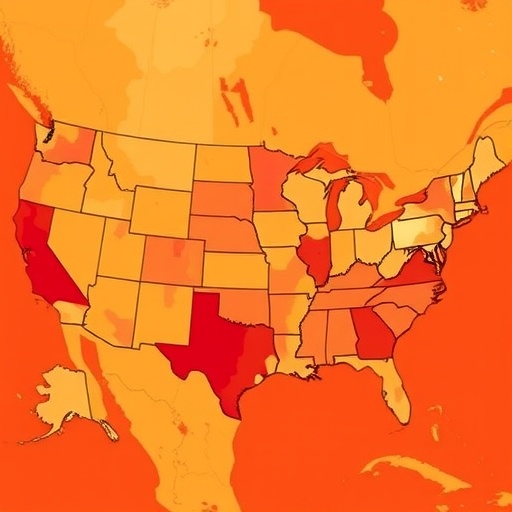
Flood risk in the United States may be moving in an unexpected direction: away from the nation’s biggest rivers and toward the smaller waterways that cut through towns, suburbs and growing communities. A new study projects that residents living near small rivers could face the sharpest increases in climate-related flood danger by 2050, even though these waterways often receive far less attention and protection than major river systems. The research, published in Nature Sustainability, combines high-resolution flood simulations with demographic projections and an assessment of existing flood defences across the contiguous United States. Its central warning is stark: the places most sensitive to worsening flood intensity may also be the places least prepared to withstand it.
Flood research has traditionally focused on large rivers, where catastrophic inundation can affect extensive urban areas, critical infrastructure and millions of people. Regional studies have also often combined rivers of different sizes into broad averages, making it difficult to see how risk is distributed within individual watersheds. The new analysis takes a more detailed approach by examining how flood risk changes according to river size. This distinction matters because a river’s width and discharge do not simply determine the danger it poses. Smaller rivers can respond rapidly to intense rainfall, have limited engineered protection and run through communities that may not be represented in national-scale assessments. Their risks can therefore rise quickly even when the total amount of water involved is far smaller than during a major flood on a large river.
The researchers used high-resolution hydrodynamic modelling to simulate how water moves across river channels and surrounding floodplains. Hydrodynamic models represent the physical behaviour of floodwater, including how it spreads over land, how deep it becomes and which areas are exposed as river discharge increases. By working at high spatial resolution, the study could better distinguish nearby communities, local terrain and differences between river corridors. These simulations were combined with projections of future population and socioeconomic development, allowing the researchers to estimate not only where floods may become more intense, but also how many people and assets could be located in exposed areas by mid-century. Current flood-defence levels were incorporated into the assessment, providing a more realistic picture than a calculation based on hazard alone.
The projections point to a clear pattern: smaller rivers appear more sensitive to increases in flood intensity caused by climate change. As a warmer atmosphere alters precipitation patterns and increases the likelihood of heavier rainfall in many regions, the flood response of small waterways can become especially severe. A short, intense storm may send water levels rising quickly through a narrow channel, leaving less time for warnings, evacuation or emergency intervention. Larger rivers can also experience worsening floods, but their risk profile is different. Their broad floodplains and heavily populated corridors mean that changes in exposure—more people, buildings and economic activity in harm’s way—play a larger role in determining future losses.
The study’s findings expose a potentially dangerous mismatch between flood risk and flood protection. Defences along small rivers are currently weaker than those along larger waterways, according to the analysis. This may reflect the way infrastructure decisions are made: major rivers often support large cities, ports, industrial zones or nationally important transport routes, creating strong political and economic incentives for levees, walls, channels and other protective works. Smaller rivers may pass through communities with fewer financial resources and less influence, even when their flood risk is rising rapidly. The absence of substantial defences does not mean that flooding is unlikely. Instead, it can leave residents exposed when an extreme event overwhelms natural channels and spreads into built-up areas.
One of the study’s most striking estimates concerns the investment needed to return future flood risk near small rivers to historical levels. The researchers calculate that doing so could require flood-defence spending of up to approximately 4 million US dollars per kilometre, measured in 2005 dollars. The figure is not a universal price tag for every small river, nor does it imply that concrete barriers alone can solve the problem. Rather, it indicates the scale of the financial challenge when rising hazard is combined with limited existing protection. Defence strategies could include engineered structures, improved drainage, floodplain restoration, land-use planning, early-warning systems and relocation in especially vulnerable areas. The estimate highlights how expensive it may become to delay action until risks have already intensified.
The analysis also separates the main forces driving risk along rivers of different sizes. Near small rivers, increasing climate-related hazard severity and low defence levels appear to be the dominant factors. In other words, stronger or more frequent flooding is colliding with inadequate protection. Along larger rivers, by contrast, growing exposure is the primary influence. Population growth, economic development and expanding construction in flood-prone corridors can raise potential losses even without an equally large increase in flood intensity. This contrast is crucial for policymakers. A single national flood strategy may overlook the different mechanisms producing risk in different river environments, leading to investments that protect already well-defended areas while leaving smaller and less visible waterways behind.
The results carry implications far beyond flood maps. Communities near small rivers may include households that have limited access to insurance, emergency transportation, resilient housing or the financial resources needed to recover after repeated disasters. Flooding can damage homes, roads, bridges, wastewater systems, farms and local businesses, while also creating long-term health and displacement pressures. Because small-river floods can develop quickly, residents may receive less warning than people living along large rivers monitored through longstanding forecasting networks. Improving risk management will therefore require better local data, stronger communication systems and planning that accounts for the full floodplain rather than focusing only on the visible river channel. It will also require officials to identify who is exposed, not simply how much land is inundated.
The study does not suggest that large rivers have become safe or that investment in their protection should stop. Instead, it reveals how national attention can be distorted when flood risk is judged mainly by river size, historical disasters or the number of people already concentrated in major urban centres. Small rivers may be less dramatic on a map, yet they can become highly dangerous as rainfall intensifies and development continues. By combining physical flood modelling, demographic forecasts and defence assessments, the researchers show that future vulnerability will not be distributed evenly across the river network. The message for the United States is both urgent and practical: flood resilience must include the overlooked waterways where hazard is accelerating, protection is weakest and communities may be least prepared. Without a major shift in planning and investment, the next generation of flood losses could be concentrated not only beside the nation’s famous rivers, but along the smaller streams that have long escaped the spotlight.
Cite Scienmag News
Violet Maxwell. (August 25, 2026). Future Flood Risks Concentrate Among U.S. Residents Living Near Small Rivers. Scienmag. https://scienmag.com/future-flood-risks-concentrate-among-u-s-residents-living-near-small-rivers/
Violet Maxwell. "Future Flood Risks Concentrate Among U.S. Residents Living Near Small Rivers." Scienmag, 25 August 2026, https://scienmag.com/future-flood-risks-concentrate-among-u-s-residents-living-near-small-rivers/. Accessed 3 September 2026.
Violet Maxwell. "Future Flood Risks Concentrate Among U.S. Residents Living Near Small Rivers." Scienmag. August 25, 2026. https://scienmag.com/future-flood-risks-concentrate-among-u-s-residents-living-near-small-rivers/


