


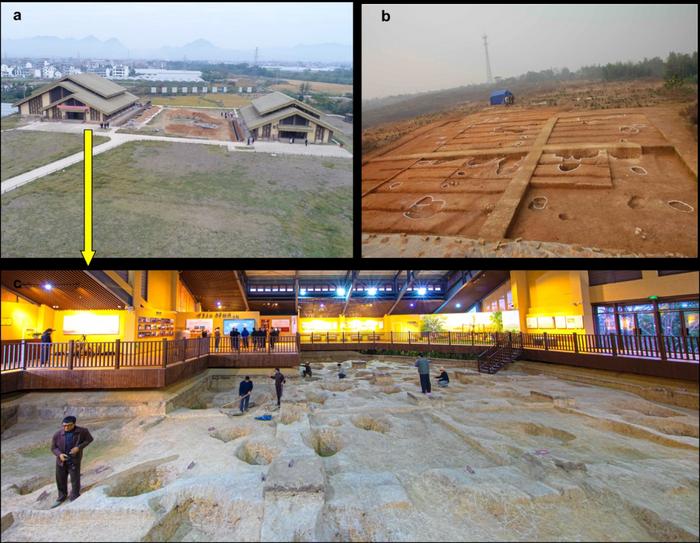
According to a study published in Science on May 24, scientists have used phytolith analysis and other methods to reveal the continuous evolutionary history of rice from wild to domesticated over an astonishing span of 100,000 years, providing new evidence for understanding the development of human society and the origins of agricultural civilization, and confirming that China is the birthplace of rice (Oryza sativa).

Credit: ZHANG Jianping & JIANG Leping
According to a study published in Science on May 24, scientists have used phytolith analysis and other methods to reveal the continuous evolutionary history of rice from wild to domesticated over an astonishing span of 100,000 years, providing new evidence for understanding the development of human society and the origins of agricultural civilization, and confirming that China is the birthplace of rice (Oryza sativa).
The study, conducted in the Shangshan cultural area of Zhejiang by a joint research team from the Institute of Geology and Geophysics of the Chinese Academy of Sciences (IGGCAS), the Zhejiang Provincial Institute of Cultural Relics and Archaeology, Linyi University, the Administration Center of Shangshan Site, and experts from 13 institutions nationwide, underscores the importance of Shangshan culture in the origins of global agriculture.
The origin of agriculture marks a crucial turning point in human society, transitioning from a hunter-gatherer economy to an agricultural production economy. Rice, as the staple food for half of the world’s population, has had a profound impact on the formation and development of Chinese civilization through its cultivation and domestication. Questions such as when humans began to explore wild rice and how the process of domesticating wild rice occurred have long been the focus of various disciplines.
Over the past century, the study of rice origins has been a controversial topic. It was not until the discovery of rice-related archaeological evidence beginning in the 1970s at sites such as Hemudu, Shangshan, and other locations in the middle and lower reaches of the Yangtze River that the international scientific community began to recognize this region as a significant area for the origin of rice. However, finding long-preserved identifiers that could distinguish wild and domesticated rice in the Yangtze River basin since the last glacial maximum and uncovering the processes and mechanisms of human collection and domestication of wild rice remained key challenges in this research.
In this study, a research team led by Dr. LYU Houyuan of IGGCAS built on years of systematic research on phytoliths in modern wild and domesticated rice plants and soils. The researchers clarified that the increase in the number of fish-scale facets on rice bulliform phytoliths correlates with enhanced domestication and agronomic traits. By establishing the threshold for distinguishing wild rice from domesticated rice based on the proportion of bulliform phytoliths with fish-scale facets, they set standards for identifying wild and domesticated rice.
The researchers used phytolith analysis in combination with pollen, charcoal, soil microstructure, grain size, magnetic susceptibility, geomorphological surveys, 14C probability density analysis of archaeological sites, and archaeological excavations to conduct systematic studies of the archaeological stratigraphy and natural profiles of the Shangshan site in Pujiang County and the Hehuashan site in Longyou County, Zhejiang.
Using Bayesian models of high-precision optically stimulated luminescence ages and phytolith 14C ages from these sites, they established a continuous chronological sequence dating back about 100,000 years. Systematic analysis of samples from these stratigraphic sequences revealed the continuous trajectory of rice from wild to domesticated within the stratigraphy of the Shangshan cultural site area and its relationship to human activity and climate change.
The researchers suggested that wild rice was already widespread in the lower Yangtze region about 100,000 years ago, setting the stage for subsequent rice use and domestication. Around 24,000 years ago, as the climate began to enter the Last Glacial Maximum, humans began to collect and use wild rice, indicating an effort to explore new food sources in response to a cooling climate. Around 13,000 years ago, humans began pre-domesticating wild rice. About 11,000 years ago, the proportion of domesticated rice phytoliths increased rapidly, reaching domestication thresholds and marking the origin of rice agriculture in East Asia.
This study demonstrates that the origins of rice agriculture in East Asia and wheat agriculture in Southwest Asia were synchronous, representing a significant milestone in human development and greatly deepening our understanding of the global origins of agriculture.
The 100,000-year continuous evidence from the distribution of wild rice to its eventual domestication at the Shangshan cultural site reveals the complex relationship between rice, climate, human activity, and cultural development. It also highlights the prolonged domestication process of rice. The research has received high praise from peer reviewers, who consider this innovative discovery a major contribution to the study of human–rice co-evolution.
This work has significant implications for our understanding of human social development, the origins of agricultural civilization, and the significance of Shangshan culture.
Journal
Science
Article Title
Rice’s trajectory from wild to domesticated in East Asia
Article Publication Date
24-May-2024
Cite Scienmag News
Alan Morgan. (May 28, 2024). From wild to domesticated: Scientists reveal 100,000 years of continuous rice evolution. Scienmag. https://scienmag.com/from-wild-to-domesticated-scientists-reveal-100000-years-of-continuous-rice-evolution/
Alan Morgan. "From wild to domesticated: Scientists reveal 100,000 years of continuous rice evolution." Scienmag, 28 May 2024, https://scienmag.com/from-wild-to-domesticated-scientists-reveal-100000-years-of-continuous-rice-evolution/. Accessed 4 September 2026.
Alan Morgan. "From wild to domesticated: Scientists reveal 100,000 years of continuous rice evolution." Scienmag. May 28, 2024. https://scienmag.com/from-wild-to-domesticated-scientists-reveal-100000-years-of-continuous-rice-evolution/

