

Thursday, September 3, 2026
Science
No Result
View All Result
  • Login
  • HOME
  • SCIENCE NEWS
  • CONTACT US
  • HOME
  • SCIENCE NEWS
  • CONTACT US
No Result
View All Result
Scienmag
No Result
View All Result
Home Science News Cancer

From wearables to swallowables: USC Engineering researchers create GPS-like smart pills with AI

June 12, 2024
in Cancer
Denise Maddox
By Denise Maddox Scienmag Editorial Profile - Mechanical Engineering
Reading Time: 3 mins read
0
From wearables to swallowables: USC Engineering researchers create GPS-like smart
67
SHARES
607
VIEWS
Share on FacebookShare on Twitter
ADVERTISEMENT

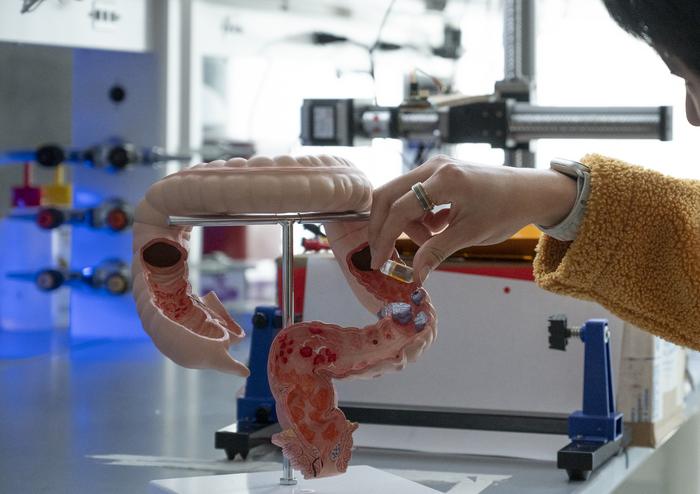
Imagine finding your location without GPS. Now apply this to tracking an item in the body. This has been the challenge with tracking “smart” pills – pills equipped with smart sensors–once swallowed. At the USC Viterbi School of Engineering, innovations in wearable electronics and AI have led to the development of ingestible sensors that not only detect stomach gasses but also provide real-time location tracking. Developed by the Khan Lab, these capsules are tailored to identify gasses associated with gastritis and gastric cancers. The research, to be published in Cell Reports Physical Science, shows how these smart pills have been accurately monitored through a newly designed wearable system. This breakthrough represents a significant step forward in ingestible technology, which Yasser Khan, an Assistant Professor of Electrical and Computer Engineering at USC, believes could someday serve as a ‘Fitbit for the gut” and for early disease detection.

Utilizing wearable electronics and AI, new ingestible sensors provide real-time 3D monitoring of gastrointestinal health

Credit: Khan Lab at USC Viterbi School of Engineering

Imagine finding your location without GPS. Now apply this to tracking an item in the body. This has been the challenge with tracking “smart” pills – pills equipped with smart sensors–once swallowed. At the USC Viterbi School of Engineering, innovations in wearable electronics and AI have led to the development of ingestible sensors that not only detect stomach gasses but also provide real-time location tracking. Developed by the Khan Lab, these capsules are tailored to identify gasses associated with gastritis and gastric cancers. The research, to be published in Cell Reports Physical Science, shows how these smart pills have been accurately monitored through a newly designed wearable system. This breakthrough represents a significant step forward in ingestible technology, which Yasser Khan, an Assistant Professor of Electrical and Computer Engineering at USC, believes could someday serve as a ‘Fitbit for the gut” and for early disease detection.

While wearables with sensors hold a lot of promise to track body functions, the ability to track ingestible devices within the body has been limited. However, with innovations in materials, the miniaturization of electronics, as well as new protocols developed by Khan, researchers have demonstrated the ability to track the location of devices specifically in the GI tract. 

Khan’s team with the USC Institute for Technology and Medical Systems Innovation (ITEMS) at the Michelson Center for Convergent Biosciences, placed a wearable coil that generates a magnetic field on a t-shirt. This field coupled with a trained neural network, allows his team to locate the capsule within the body. According to Ansa Abdigazy, lead author of the work and a PhD student in the Khan Lab, this has not been demonstrated with a wearable before. 

The second innovation within this device is the newly created “sensing” material. Capsules are outfitted not just with electronics for tracking location but with “optical sensing membrane that is selective to gasses.” This membrane is comprised of materials whose electrons change their behavior within the presence of ammonia gas. Ammonia—is a component of H pylori — gut bacteria that when elevated, could be a signal of peptic ulcer, gastric cancer, or irritable bowel syndrome. Thus, says, Khan, “The presence of this gas “is a proxy” and “can be used as an early disease detection mechanism.” 

The USC team has tested this ingestible device in many different environments including liquid environments and simulating a bovine intestine. “The ingestible system with the wearable coil is both compact and practical, offering a clear path for application in human health,” said Khan. The device is currently patent pending and the next step is to test these wearables with swine models.  

Beyond the use of this device for early detection of peptic ulcers, gastritis, and gastric cancers, there is potential to monitor brain health. How? Because of the brain-gut axis. Neurotransmitters reside in the gut and “how they’re upregulated and downregulated have a correlation to neurodegenerative diseases,” says Khan. This focus on the brain is the ultimate goal of Khan’s research. He is interested in developing non-invasive ways to detect neurotransmitters related to Parkinson’s and Alzheimer’s. 


Journal

Cell Reports Physical Science

Method of Research

Experimental study

Subject of Research

Not applicable

Article Title

3D Gas Mapping in the Gut with AI-Enabled Ingestible and Wearable Electronics

Article Publication Date

12-Jun-2024

Subject of Research: Cancer

Article Title: From wearables to swallowables: USC Engineering researchers create GPS-like smart pills with AI

Article References: Original research article

Image Credits: AI Generated

DOI: Not provided

Keywords: Not provided

Cite Scienmag News

Denise Maddox. (June 12, 2024). From wearables to swallowables: USC Engineering researchers create GPS-like smart pills with AI. Scienmag. https://scienmag.com/from-wearables-to-swallowables-usc-engineering-researchers-create-gps-like-smart-pills-with-ai/

Denise Maddox. "From wearables to swallowables: USC Engineering researchers create GPS-like smart pills with AI." Scienmag, 12 June 2024, https://scienmag.com/from-wearables-to-swallowables-usc-engineering-researchers-create-gps-like-smart-pills-with-ai/. Accessed 3 September 2026.

Denise Maddox. "From wearables to swallowables: USC Engineering researchers create GPS-like smart pills with AI." Scienmag. June 12, 2024. https://scienmag.com/from-wearables-to-swallowables-usc-engineering-researchers-create-gps-like-smart-pills-with-ai/

Share27Tweet17
Previous Post

Award-winning sustainable business ideas: Artificial intelligence and innovative products help shape the future

Next Post

Housing compatible shelter dogs together could reduce stress and might help them find homes sooner

Related Posts

Mini-Tumors Meet Immune Cells: Organoid Co-Cultures Emerge as Personalized Cancer Immunotherapy Testbeds
Cancer

Mini-Tumors Meet Immune Cells: Organoid Co-Cultures Emerge as Personalized Cancer Immunotherapy Testbeds

September 3, 2026
Virologist awarded $2 million NIH grant to investigate how virus-infected cells live and die
Cancer

Virologist awarded $2 million NIH grant to investigate how virus-infected cells live and die

September 3, 2026
Multicenter prospective observational study to evaluate the clinical utility of rs61094339 SNP Kit in predicting response to intravesical Bacillus Calmette-Guérin therapy for highest-risk non-muscle-invasive bladder cancer: the PRECISE-BCG study
Cancer

Multicenter prospective observational study to evaluate the clinical utility of rs61094339 SNP Kit in predicting response to intravesical Bacillus Calmette-Guérin therapy for highest-risk non-muscle-invasive bladder cancer: the PRECISE-BCG study

September 3, 2026
Vasopressin boosts the antiproliferative effect of dynasore and wortmannin in triple-negative breast cancer cells
Cancer

Vasopressin boosts the antiproliferative effect of dynasore and wortmannin in triple-negative breast cancer cells

September 3, 2026
Developmental venous anomalies on fetal magnetic resonance imaging: prevalence and reproducible radiological phenotypes
Cancer

Developmental venous anomalies on fetal magnetic resonance imaging: prevalence and reproducible radiological phenotypes

September 3, 2026
GALNT5 fuels colorectal cancer growth and drug resistance through PI3K/Akt/ABCC1 pathway
Cancer

GALNT5 fuels colorectal cancer growth and drug resistance through PI3K/Akt/ABCC1 pathway

August 31, 2026
Next Post
Housing compatible shelter dogs together could reduce stress and might

Housing compatible shelter dogs together could reduce stress and might help them find homes sooner

  • Mothers who receive childcare support from maternal grandparents show more optimized

    Mothers who receive childcare support from maternal grandparents show more parental warmth, finds NTU Singapore study

    27656 shares
    Share 11059 Tweet 6912
  • University of Seville Breaks 120-Year-Old Mystery, Revises a Key Einstein Concept

    1061 shares
    Share 424 Tweet 265
  • Bee body mass, pathogens and local climate influence heat tolerance

    682 shares
    Share 273 Tweet 171
  • Researchers record first-ever images and data of a shark experiencing a boat strike

    546 shares
    Share 218 Tweet 137
  • Groundbreaking Clinical Trial Reveals Lubiprostone Enhances Kidney Function

    531 shares
    Share 212 Tweet 133
Science

Embark on a thrilling journey of discovery with Scienmag.com—your ultimate source for cutting-edge breakthroughs. Immerse yourself in a world where curiosity knows no limits and tomorrow’s possibilities become today’s reality!

RECENT NEWS

  • Comprehension is in the Eye of the Reader: An Eye Tracking Study of Children and Adults
  • Scientists reveal sugar transporter gene regulation in peony by ABA signals
  • New Mixed-Ligand Metal Complexes Show Promise as Antibiotics, Antioxidants and Corrosion Shields
  • Seasonal shifts, not trends, drive urban air pollution extremes in Northeast India

Categories

  • Agriculture
  • Anthropology
  • Archaeology
  • Athmospheric
  • Biology
  • Biotechnology
  • Blog
  • Bussines
  • Cancer
  • Chemistry
  • Climate
  • Earth Science
  • Editorial Policy
  • Marine
  • Mathematics
  • Medicine
  • Pediatry
  • Policy
  • Psychology & Psychiatry
  • Science Education
  • Social Science
  • Space
  • Technology and Engineering

Subscribe to Blog via Email

Enter your email address to subscribe to this blog and receive notifications of new posts by email.

Join 5,151 other subscribers

© 2025 Scienmag - Science Magazine

Welcome Back!

Login to your account below

Forgotten Password?

Retrieve your password

Please enter your username or email address to reset your password.

Log In
No Result
View All Result
  • HOME
  • SCIENCE NEWS
  • CONTACT US

© 2025 Scienmag - Science Magazine

Discover more from Science

Subscribe now to keep reading and get access to the full archive.

Continue reading