


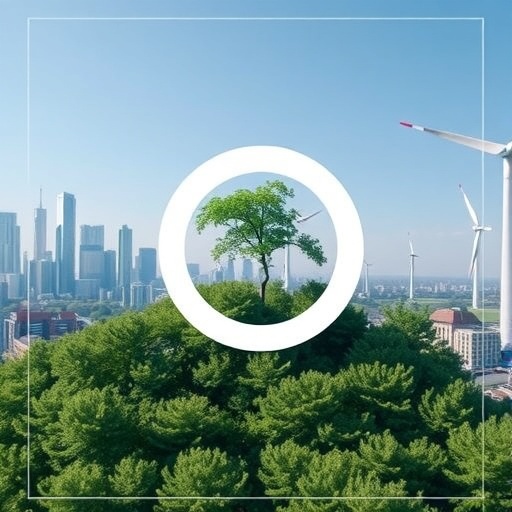
The European Union stands on the precipice of an extraordinary transformation in its energy landscape, moving beyond the ambitious goal of net-zero greenhouse gas emissions towards a future completely devoid of fossil fuel dependence. This transition, explored in groundbreaking research by Schreyer, Ueckerdt, Pietzcker, and colleagues, presents a visionary pathway that not only seeks to decarbonize but to entirely eliminate fossil fuels from the EU’s energy system. Their model pushes the boundaries of existing climate policy ambitions, envisioning a continent where sustainable, renewable, and innovative energy technologies fuel an economy no longer tethered to carbon-intensive sources.
The study, recently published in Nature Communications, meticulously dissects the practical and technological challenges inherent in this transition, emphasizing the urgency and scale of the undertaking. While the net-zero target has been a pivotal rallying point for policymakers and industries alike, the researchers argue that net-zero is merely a midpoint, a stepping stone towards a more radical goal: zero-fossil. The distinction is critical, grounded in the understanding that net-zero strategies frequently rely on offsetting emissions rather than wholly eradicating fossil use. Transitioning to zero-fossil thus eliminates reliance on carbon capture, storage, or forest capacity, demanding cleaner, direct solutions.
Central to the research is an advanced modeling framework that integrates energy demand projections with supply-side technological advancements across the EU’s diverse regions. This framework incorporates a broad array of sectoral energy usages – from transportation and industry to residential and commercial sectors – highlighting how each must be reimagined with near-complete electrification and renewable integration. The model simulates scenarios where fossil fuel reliance is steadily phased out by 2050 and beyond, emphasizing a technologic symphony that combines wind, solar, bioenergy, hydrogen, and advanced storage solutions to meet soaring electricity demands.
One of the pivotal findings from Schreyer and co-authors is the indispensable role of electrification, especially in traditionally fossil-fuel-heavy sectors such as transport and heavy industry. Electrification, bolstered by renewable capacity, represents the backbone of the zero-fossil energy system. However, the research dives deeper to identify that electrification alone is insufficient and must be complemented by energy carriers like green hydrogen and synthetic fuels, especially where direct electrification poses technological or economic barriers. This strategy ensures a resilient, flexible energy system capable of responding to intermittency and balancing supply and demand across temporal and spatial scales.
Beyond technological rearrangements, their analysis identifies a critical need to enhance energy efficiency aggressively. The path to zero-fossil necessitates not only cleaner supply but also smarter demand management. By reducing overall energy consumption through structural economic shifts, building retrofits, and behavioral changes, the EU can alleviate pressure on renewable capacities and storage requirements. The research highlights a multi-faceted efficiency push that aligns with circular economy principles, recognizing that every efficiency gain multiplies the system’s ability to function without fossil fuels.
A standout element of this work is the emphasis on sectoral coupling – the systemic integration between electric power, heating, transport, and industrial sectors. This coupling is a technological and logistical challenge that must harmonize the flow of energy carriers and optimize end-use flexibility. Utilizing excess electricity from renewables to produce hydrogen or power heat pumps exemplifies these synergies, where infrastructures traditionally operating in silos converge, enhancing system resilience and cost-effectiveness.
Moreover, the study addresses the pivotal role of renewable energy infrastructure expansion. To achieve zero-fossil status, the EU must accelerate the deployment of renewables at unprecedented rates. Offshore wind and solar PV are primary drivers, requiring both innovation in technology and extensive grid enhancements. The authors underscore that grid expansion and smart grid technologies are as crucial as generation itself, enabling efficient cross-border electricity trading and reducing curtailment losses, which can be significant in renewable-heavy systems.
Storage solutions also receive focused attention, as balancing fluctuating renewable inputs demands a portfolio of storage technologies, ranging from short-term electric batteries to long-duration thermal and chemical storage. The research suggests that advances in storage technology and widespread deployment will underpin the flexibility required for a 100% renewable energy supply. This also includes the utilization of power-to-X technologies, converting electricity into energy-dense molecules for use in transportation, heating, and industry, underscoring the interplay of innovation and system architecture.
Importantly, the research does not shy away from addressing the socio-economic implications. Transitioning to zero-fossil will be a colossal economic undertaking, requiring substantial investments and policy reforms designed to foster innovation, ensure equitable distribution of costs and benefits, and prevent energy poverty. Schreyer and team envision a coordinated policy framework capable of mobilizing public and private capital while fostering social acceptance and workforce transformation through retraining and education programs.
The environmental co-benefits of a zero-fossil strategy are immense and multifaceted. Beyond slashing carbon emissions, the reduction of air pollutants such as nitrogen oxides and particulates will significantly improve public health outcomes across Europe. The authors discuss these synergies, highlighting how a fossil-free energy system aligns with broader sustainability goals, including biodiversity conservation and land use management, particularly when bioenergy scales are carefully managed to avoid ecosystem degradation.
Their comprehensive modeling also reflects upon the geopolitical shifts inherent to shedding fossil fuels. By dramatically reducing dependency on fossil fuel imports, the EU gains unprecedented energy sovereignty and enhances its resilience against volatile global markets. This independence could reshape global energy geopolitics, repositioning the EU as a leader in clean technology exports and climate policy, amplifying its influence in international negotiations.
Nevertheless, the researchers are clear-eyed about the uncertainties and risks. Technological breakthroughs, cost reductions in emerging clean technologies, and regulatory landscapes all hold pivotal sway in determining the feasibility and timeline of zero-fossil energy. They advocate for robust, adaptive pathways that can accommodate changing conditions and emergent challenges, prioritizing flexibility, innovation diffusion, and continuous monitoring.
In sum, Schreyer, Ueckerdt, Pietzcker, and their team craft a compelling, technically detailed narrative that pushes beyond the net-zero rhetoric pervasive in current climate discourse. Their vision for a zero-fossil energy system transforms the EU not just through decarbonization but by fundamentally reengineering energy production, distribution, and consumption. This study serves as both a blueprint and a call to action for governments, industries, and societies committed to a sustainable, fossil-independent future.
The research represents a pivotal turning point in energy transition science, invigorating debate about what a truly sustainable future entails. It combines multidisciplinary expertise with sophisticated modeling to provide an actionable roadmap aligned with the urgency demanded by climate imperatives. As the EU navigates this unprecedented transformation, this work lays the foundation upon which the continent’s energy future can be resilient, equitable, and fossil-free.
Cite Scienmag News
Violet Maxwell. (December 10, 2025). From Net-Zero to Zero-Fossil: Transforming EU Energy. Scienmag. https://scienmag.com/from-net-zero-to-zero-fossil-transforming-eu-energy/
Violet Maxwell. "From Net-Zero to Zero-Fossil: Transforming EU Energy." Scienmag, 10 December 2025, https://scienmag.com/from-net-zero-to-zero-fossil-transforming-eu-energy/. Accessed 3 September 2026.
Violet Maxwell. "From Net-Zero to Zero-Fossil: Transforming EU Energy." Scienmag. December 10, 2025. https://scienmag.com/from-net-zero-to-zero-fossil-transforming-eu-energy/


