


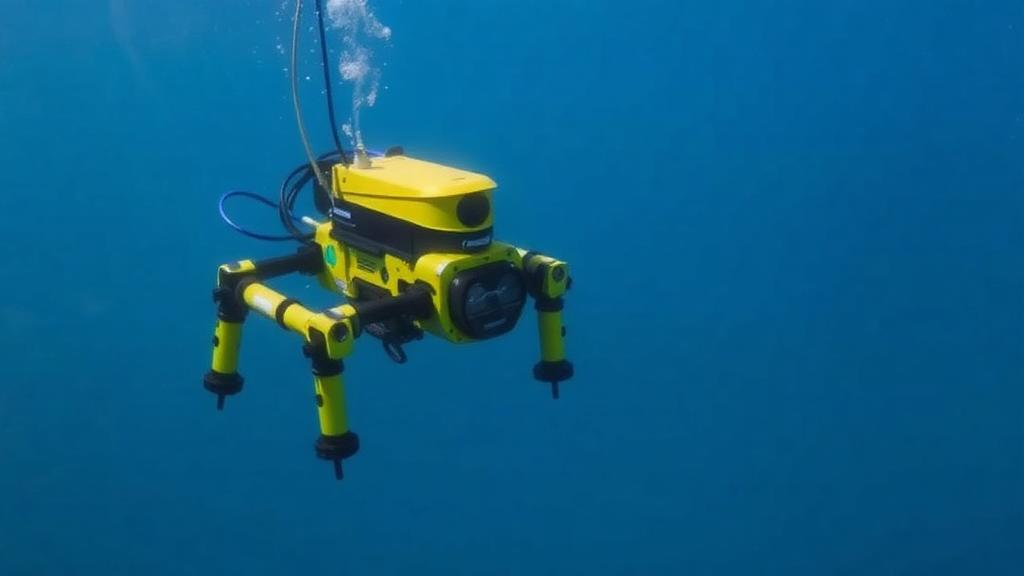
Underwater robotics has entered a period of remarkable creative ferment, with vehicles now ranging from torpedo-shaped autonomous underwater vehicles and tethered remotely operated vehicles to hybrid platforms that switch between both modes, and onward to soft, squishy machines modeled on fish, rays, worms, and crabs. Yet according to a new structured narrative review published in the International Journal of Intelligent Robotics and Applications, the field’s dazzling laboratory performance masks a stubborn truth: most of these systems are still far from operational maturity. The review, authored by Omer K. Ahmed of Northern Technical University in Mosul, Sameer Algburi of Al-Kitab University, and Hidouri Khaoula of the University of Gabès, synthesizes peer-reviewed work published mainly between January 2018 and August 2026, and concludes that high scores in controlled tests do not necessarily translate into the ability to survive and work in real seas.
The authors tackle a problem that has long hampered progress in this domain: fragmentation. Research on underwater robots is scattered across platform design, actuation, sensing, navigation, communication, control, and application-specific validation, often with little cross-pollination between communities. To impose order, the team built a unified framework that classifies every system along six axes: platform type, embodiment and actuation, perception, control level, application, and validation environment. That last axis turns out to be the review’s sharpest analytical tool. The authors explicitly distinguish simulation studies, laboratory and tank experiments, pool trials, coastal or open-water deployments, and industrial validation, and then compare representative systems on autonomy, sensing, communication, endurance, depth capability, robustness, and field readiness. The gap between the top and bottom of that hierarchy is where the field’s most uncomfortable realities live.
Conventional platforms remain the workhorses. Autonomous underwater vehicles now achieve impressive endurance and depth, with designs documented at the 10,000-meter class, while remotely operated vehicles dominate tasks requiring human judgment and dexterous manipulation. Hybrid AUV/ROV systems attempt to capture the best of both worlds, operating untethered during transit and tethered during precision work. But the review’s most vivid material concerns the newer generation of bio-inspired and soft machines. Robotic fish built on direct drive of continuum bodies have demonstrated unusual agility, manta-ray-inspired vehicles are being deployed to detect damage in underwater concrete structures, and modular magnetic bio-inspired designs draw on fish-like swimming to combine propulsion and maneuverability. Snake robots, meanwhile, are being optimized to hold position in the vortex wakes of bluff bodies using extremum-seeking control, a capability relevant to inspecting offshore structures where currents swirl unpredictably.
Soft actuation is arguably the field’s most exciting frontier, and also its most fragile. The review highlights jelly-like artificial muscles that have powered untethered underwater robots, ionic hydrogel sensors that combine strain and triboelectric sensing for underwater soft grasping, and multifunctional robotic electrofluids for soft fluidic actuation. These materials promise quiet, compliant, camouflage-capable machines that can squeeze into confined spaces rigid robots cannot enter. A flexible modular worm-inspired robot for multi-scenario pipeline exploration exemplifies the confined-space ambition, while crab-like robots with foot-and-paddle coupling borrow from biological observation to handle complex seabed locomotion. Even weakly electric fish have contributed, inspiring active-electrolocation sensing that lets robots perceive three-dimensional objects in murky, complex environments where optical cameras fail.
Perception and control have advanced in parallel. Machine learning now permeates the field, from autonomous manipulation control learned through reinforcement learning to digital-twin-based stress prediction for underwater grasping, and from brain-inspired spiking neural networks for obstacle avoidance in spherical robots to evolutionary-algorithm-driven reinforcement learning frameworks for designing underwater robots from scratch. Vision systems have grown correspondingly sophisticated: multi-scale deformable convolution networks with attention mechanisms enhance underwater imagery, and YOLOX-based detection systems with domain generalization target large-scale underwater concrete inspection. Underwater manipulation, long a bottleneck, is benefiting from learning strategies, visual servoing for automatic sorting of crustaceans, and parent-child robot systems in which a large vehicle deploys a smaller manipulator platform for structure maintenance.
Applications are proliferating across industry and science. Hull-cleaning robots with wear-resistant, antifouling coatings address biofouling on ship hulls, a major fuel-efficiency drain for global shipping. Robotic fish have been used to detect underwater gas leaks, floating waste-collecting robots exploit vortex phenomena to gather debris, and autonomous vehicles inspect marine cables, Posidonia oceanica meadows, and flooded open-cut mines. In defense and security contexts, side-scan sonar datasets support mine detection, and multi-vehicle mission planning under multi-objective optimization targets mine countermeasures. Multi-robot cooperation is a growing theme, including pursuit-evasion games among multiple AUVs trained through offline reinforcement learning and USV-AUV collaborative systems designed to function in extreme sea conditions using Fisher information and reinforcement learning.
Yet the review’s central message is a sobering one. The authors identify a set of unresolved barriers that separate impressive prototypes from dependable field systems. Pressure-resistant soft materials remain immature, and long-term seawater durability, including fouling, corrosion, and material degradation, is poorly characterized for many novel actuators. Untethered energy storage constrains endurance, particularly for soft platforms whose power budgets are tight. Robust proprioception, the robot’s sense of its own body configuration, is unreliable in compliant structures that deform continuously underwater. Communication remains a fundamental constraint: acoustic links offer range but little bandwidth, optical links offer bandwidth but almost no range or turbidity tolerance, and hybrid radio-frequency and underwater optical communication schemes are still being statistically characterized for realistic channels. Sim-to-real transfer of learned controllers is unreliable, and the absence of standardized benchmarks means results from different labs often cannot be compared at all.
The validation-environment analysis drives the point home. A controller that performs flawlessly in a swimming pool may fail in coastal water with currents, waves, turbidity, and electromagnetic noise. The review explicitly warns that simulation and laboratory success is the weakest evidence of operational readiness, and it calls for repeatable testing protocols and genuine real-environment deployment as community priorities. Some studies are already moving in that direction, including stereo visual navigation for AUV docking, digital representations of closed aquaculture structures for robotic inspection, and protocols explicitly designed for AI-based concrete overhaul in real marine environments. But these remain exceptions rather than the rule, and the authors argue that the field needs a cultural shift toward reporting failures and standardized metrics alongside successes.
The proposed research priorities are concrete: develop pressure-tolerant and durable soft materials, extend untethered energy systems, harden proprioceptive sensing for compliant bodies, engineer communication architectures that bridge the acoustic-optical divide, and establish benchmark missions that any lab can replicate. If the community follows through, the payoff could be substantial, from safer offshore infrastructure inspection and cleaner ship hulls to deep-sea ecological restoration informed by interconnected robotic platforms. The review’s authors make clear that the building blocks, from jelly-like muscles to learning-based manipulation to cooperative fleets, already exist in impressive form. What is missing is not imagination but engineering endurance: the unglamorous work of proving that a robot that dazzles in a tank can still deliver after months in salt water, at depth, with no tether and no second chances.
Subject of Research: Field readiness and recent advances of conventional, soft, and bio-inspired underwater robotic systems
Article Title: Recent advances, soft and bio-inspired systems, and field readiness in underwater robotics: a structured narrative review
Article References: Recent advances, soft and bio-inspired systems, and field readiness in underwater robotics: a structured narrative review. (n.d.). https://doi.org/10.1007/s41315-026-00600-4
Image Credits: AI Generated
DOI: 10.1007/s41315-026-00600-4
Keywords: underwater robotics, autonomous underwater vehicles, remotely operated vehicles, soft robotics, bio-inspired robotics, underwater sensing, underwater communication, machine learning, field validation, underwater manipulation, multi-robot cooperation, marine engineering
Cite Scienmag News
Denise Maddox. (October 12, 2026). From Lab Tanks to Open Ocean: Why Underwater Robots Still Struggle in the Real World. Scienmag. https://scienmag.com/from-lab-tanks-to-open-ocean-why-underwater-robots-still-struggle-in-the-real-world/
Denise Maddox. "From Lab Tanks to Open Ocean: Why Underwater Robots Still Struggle in the Real World." Scienmag, 12 October 2026, https://scienmag.com/from-lab-tanks-to-open-ocean-why-underwater-robots-still-struggle-in-the-real-world/. Accessed 12 October 2026.
Denise Maddox. "From Lab Tanks to Open Ocean: Why Underwater Robots Still Struggle in the Real World." Scienmag. October 12, 2026. https://scienmag.com/from-lab-tanks-to-open-ocean-why-underwater-robots-still-struggle-in-the-real-world/


