For millions of new mothers, the weeks and months after childbirth are shadowed not just by sleepless nights and round-the-clock feedings, but by something far more insidious: a creeping fog of sadness, worry, and dread that refuses to lift. Postpartum depression has long been the headline-grabber, the condition screened for at checkups and discussed in parenting forums. But anxiety, its quieter companion, has often been relegated to a footnote. Now, a new longitudinal study from China suggests that treating these two conditions as separate problems may be a fundamental mistake — because in the real lives of postpartum women, they rise, fall, and intertwine together in patterns that standard screening approaches completely miss.
The research, published in BMC Public Health by a team led by Jinyi Li and Shiying Wang, tracked 474 postpartum women recruited from three tertiary hospitals in Guangdong Province. Rather than measuring depression and anxiety at a single moment in time, the researchers followed participants across three critical checkpoints: 42 days after delivery — the traditional end of the Chinese postpartum confinement period — and then again at three months and six months postpartum. At each visit, women completed the Edinburgh Postnatal Depression Scale, a widely validated ten-item instrument for depressive symptoms, and the Self-Rating Anxiety Scale, a twenty-item measure of clinical anxiety. This repeated-measures design allowed the team to chart not just who was struggling, but how their struggles evolved over the first half-year of motherhood.
The analytical engine behind the study is a statistical technique with a forbidding name but an elegant logic: parallel-process latent class growth modeling, or PP-LCGM. Traditional approaches to longitudinal mental health data typically assume that everyone in a sample follows roughly the same trajectory, with individual variation treated as noise. Latent class growth modeling flips that assumption on its head. It searches the data for hidden subgroups — unobserved classes of people whose symptoms follow distinct developmental paths — and estimates the shape of each path simultaneously. The parallel-process twist is the crucial part: instead of modeling depression and anxiety separately, the method models both symptom streams at once, asking whether combinations of trajectories recur across the population. In effect, the algorithm asks not “what does postpartum depression look like over time?” but “what distinct combinations of depression and anxiety do real women experience over time?”
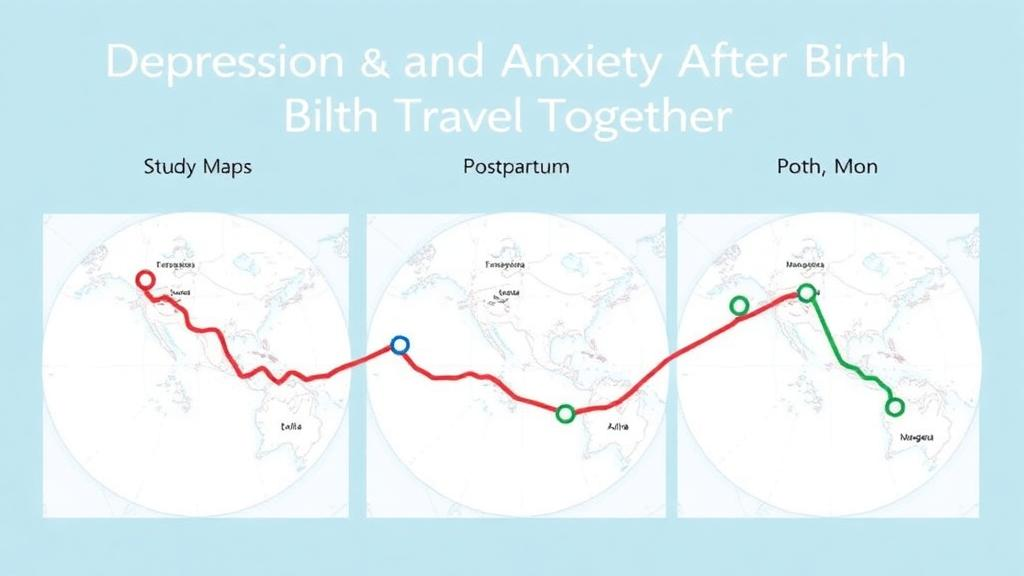
The answer, it turns out, comes in three flavors. The largest group — just over half of the sample, at 50.2 percent — followed a low-level trajectory for both depressive and anxiety symptoms, remaining essentially psychologically healthy throughout the six-month window. A second, much smaller group, comprising 8.7 percent of participants, started with high levels of both symptoms and gradually improved over the study period. But the third group is the one that should make clinicians sit up: 41.1 percent of women — more than four in ten — followed a divergent path in which their anxiety symptoms climbed steadily while their depressive symptoms receded. In other words, the most common problematic pattern in this sample was not co-occurring high depression and anxiety, but a shifting burden in which depression faded only for anxiety to take its place.
That finding has profound implications for how postpartum mental health care is delivered. Screening protocols in most maternity systems, including China’s, focus heavily on depression, often using the Edinburgh scale as the sole gatekeeper for referral. A woman whose depressive symptoms are improving might be discharged from monitoring, even as her anxiety quietly accelerates toward clinical significance. The study’s trajectory data suggest that such a woman is not an outlier — she belongs to the single largest at-risk subgroup in the sample. If anxiety is not measured alongside depression, this transition can go entirely undetected, leaving a substantial fraction of mothers without the support they need during a period when untreated maternal anxiety is linked to difficulties with infant bonding, feeding, and early child development.
So who ends up on which path? To answer that question, the researchers turned to multinomial logistic regression, a statistical method for estimating how a set of predictor variables shifts the odds of belonging to one group versus another, using the low-symptom group as the reference category. The results paint a coherent picture of vulnerability. Three factors elevated the odds of membership in both problematic trajectory groups: higher levels of postpartum fatigue, poorer postpartum sleep quality, and a total monthly household income at or below 5,000 Chinese yuan — a threshold that marks genuine economic precarity in urban Guangdong. These are not exotic clinical variables; they are the mundane, grinding stressors of early motherhood, and their statistical fingerprints appear across both the high-symptom and anxiety-climbing groups.
Two additional characteristics distinguished the high-level and decreasing group specifically: being unemployed and feeding infants with formula rather than breastfeeding were associated with membership in that group alone. The pattern makes intuitive sense. Unemployment compounds financial strain and can deepen feelings of isolation and lost identity, while formula feeding — whether by circumstance or choice — is sometimes entangled with medical complications, guilt, and social pressure, particularly in cultural contexts where breastfeeding is strongly normed. Meanwhile, one factor pointed in the protective direction: multiparity, meaning having given birth before, was associated with lower odds of landing in either problematic group. Experienced mothers, it seems, weather the postpartum period with greater psychological resilience, perhaps because prior experience defuses the uncertainty and self-doubt that amplify distress in first-time mothers.
The methodological rigor underlying these conclusions deserves attention. The researchers did not simply eyeball their data and declare three groups; they compared models with increasing numbers of latent classes using a battery of formal fit indices, including the Akaike information criterion, the Bayesian information criterion and its adjusted variant, the Vuong-Lo-Mendell-Rubin likelihood ratio test, and the bootstrap likelihood ratio test — statistical tools that collectively determine whether adding another subgroup genuinely improves the model’s fit to the data or merely overfits noise. The three-class solution emerged as the defensible winner. The study was conducted in accordance with the Declaration of Helsinki, approved by the ethics committee of Dongguan Traditional Chinese Medicine Hospital, and all participants provided written informed consent. The work was supported by grants from the Natural Science Foundation of Guangdong Province and other regional funding bodies.
Still, the study has boundaries that readers should keep in view. The sample of 474 women was drawn from tertiary hospitals in a single, economically dynamic province, and the authors themselves frame the findings as a foundation for future research rather than a definitive map. Self-report scales, however well validated, capture symptoms as women experience and report them, and the six-month window, while longer than most cross-sectional studies, cannot speak to trajectories beyond the first half-year. The associated characteristics identified in the regression models are just that — associated characteristics — and the design cannot establish whether fatigue, poor sleep, and low income cause the symptom trajectories or merely travel alongside them in a web of mutual reinforcement. Indeed, the causal arrows likely point in both directions: anxiety disrupts sleep, poor sleep deepens fatigue, and exhaustion feeds back into anxiety.
Yet the core message survives every caveat intact, and it is one that clinicians, researchers, and new parents alike should absorb. Depression and anxiety in the postpartum period are not parallel silos to be screened and treated independently; they are coupled dynamical systems whose joint behavior produces patterns invisible to single-symptom monitoring. Nearly one in ten women in this study carried high levels of both symptoms from the start, and more than four in ten rode a rising tide of anxiety even as their mood appeared to recover. Fatigue, sleep quality, and household income — modifiable or at least identifiable factors — mark the women most at risk, while prior birth experience appears to buffer against the storm. The authors’ conclusion is understated but consequential: future postpartum mental health research and care should consider depressive and anxiety symptoms jointly. For the new mother lying awake at 3 a.m., heart racing over a checklist of worries while her screening form asks only about feeling down, that shift in perspective cannot come soon enough.
Subject of Research: Joint longitudinal trajectories of postpartum depressive and anxiety symptoms
Article Title: Joint trajectories and associated characteristics of postpartum depressive and anxiety symptoms: a longitudinal study
Article References: Li, J., Wang, S., Liang, Y., Tao, J., Zhao, M., Guo, Z., Hu, Z., Yang, H., & Zhai, J. (2026). Joint trajectories and associated characteristics of postpartum depressive and anxiety symptoms: a longitudinal study. BMC Public Health. https://doi.org/10.1186/s12889-026-29826-4
Image Credits: AI Generated
DOI: 10.1186/s12889-026-29826-4
Keywords: postpartum depression, postpartum anxiety, latent class growth modeling, longitudinal study, maternal mental health, Edinburgh Postnatal Depression Scale, sleep quality, postpartum fatigue, China, BMC Public Health, screening, multiparity
Cite Scienmag News
Glenn Wilkins. (October 12, 2026). Depression and Anxiety After Birth Travel Together: Study Maps Three Postpartum Paths. Scienmag. https://scienmag.com/depression-and-anxiety-after-birth-travel-together-study-maps-three-postpartum-paths/
Glenn Wilkins. "Depression and Anxiety After Birth Travel Together: Study Maps Three Postpartum Paths." Scienmag, 12 October 2026, https://scienmag.com/depression-and-anxiety-after-birth-travel-together-study-maps-three-postpartum-paths/. Accessed 12 October 2026.
Glenn Wilkins. "Depression and Anxiety After Birth Travel Together: Study Maps Three Postpartum Paths." Scienmag. October 12, 2026. https://scienmag.com/depression-and-anxiety-after-birth-travel-together-study-maps-three-postpartum-paths/