


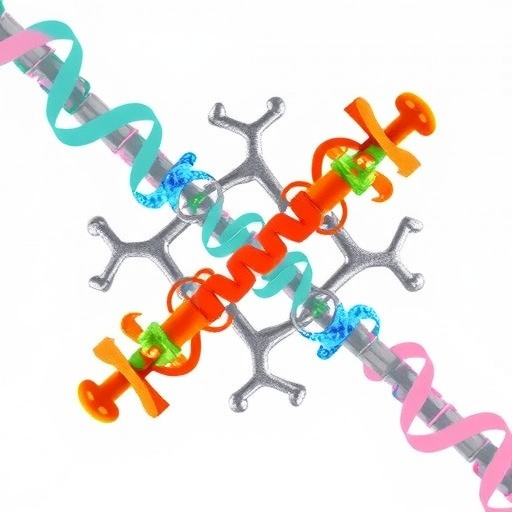
A decade of work in Harvard’s Soft Math Lab has shown how traditional paper-inspired ideas can be translated into inverse-designed structures that dramatically change shape—and with them, function. Now, a team has introduced a different mechanical language for programmable deformation, not based on folds or cuts, but on linkages: networks built from interconnected scissor-like mechanisms.
The new study presents a framework for “collapsible scissored surfaces,” a deployable class of metamaterial lattices. These systems transition from a compact, one-dimensional collapsed state into two-dimensional configurations with prescribed geometry. Instead of treating the transformation as a global problem to be optimized, the researchers formalize it as a constructible process.
Led by physics graduate student Noah Toyonaga, the work is published in Proceedings of the National Academy of Sciences. Senior author L. Mahadevan positions the approach as complementary to origami and kirigami: folds encode shape, cuts unlock motion, and linkages encode connections—so the overall behavior emerges from local mechanical rules.
At the core is a geometric algorithm that builds complex surfaces incrementally. Starting from a boundary, the team adds one scissor linkage at a time, enforcing compatibility and preserving deployability and collapsibility. This “local additive construction” sidesteps heavy computation by turning design into a sequence of constrained geometric decisions.
Crucially, the researchers show that the geometry of an entire deployable surface can be captured using a small set of parameters. Those parameters determine how the lattice collapses into a tight bundle and then unfolds smoothly into target shapes without losing structural coherence.
To verify the theory, the team combined computational simulation with physical prototypes fabricated using multimaterial 3D printing, including collaborations with Colter Decker in SEAS. The fabricated lattices reliably deploy into striking forms such as helical, toroidal, and doubly curved “eggbox” geometries.
The implications extend well beyond proof-of-concept. Deployable aerospace components, adaptive architectural elements, robotic mechanisms, medical devices, and programmable materials could all benefit from shape encoded directly into geometry rather than into the material itself. As the authors emphasize, future mechanical design may hinge not only on what materials are used, but on how they are assembled.
In this framework, geometry becomes a universal medium for engineering matter—where local linkage rules steer global form in a predictable, mathematically grounded way.
Cite Scienmag News
Reid Dalton. (July 26, 2026). From Cuts and Folds to New Linkages in Science Breakthrough. Scienmag. https://scienmag.com/from-cuts-and-folds-to-new-linkages-in-science-breakthrough/
Reid Dalton. "From Cuts and Folds to New Linkages in Science Breakthrough." Scienmag, 26 July 2026, https://scienmag.com/from-cuts-and-folds-to-new-linkages-in-science-breakthrough/. Accessed 4 September 2026.
Reid Dalton. "From Cuts and Folds to New Linkages in Science Breakthrough." Scienmag. July 26, 2026. https://scienmag.com/from-cuts-and-folds-to-new-linkages-in-science-breakthrough/


