


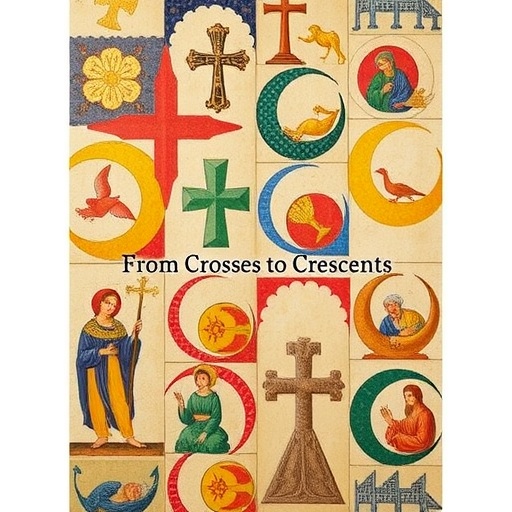
In the intricate tapestry of the medieval Mediterranean, art emerged as a vibrant conduit bridging the divide between Islam and Christianity. Long before modern political narratives sought to define these religions as irreconcilably opposed, the material culture of the period tells a different story—one of coexistence, cultural intermingling, and artistic symbiosis. A groundbreaking scholarly volume offers compelling evidence that artifacts and architectural elements did not merely adorn sacred spaces but actively participated in a dynamic dialogue that transcended religious boundaries across this vast region.
Spanning the coastal expanse of Europe, Asia, and Africa, the medieval Mediterranean was anything but a neatly segmented world determined solely by faith. Instead, it functioned as a sprawling “aesthetic space” where artistic expressions, both Islamic and Christian, circulated and influenced each other deeply. This phenomenon was not the byproduct of formal diplomatic accord or political treaties, but rather the organic result of a shared visual and material language that shaped communal identities and social interactions.
One evocative example lies in the presence of Christian symbols, such as crosses, integrated into the architectural fabric of mosques, and conversely, Islamic ceramic vessels—known as bacini—embedded within the facades of several Christian religious buildings throughout Italy, France, and Germany. These intricately inscribed ceramics, often bearing Islamic script and motifs, were not merely decorative; they signaled a complex narrative of admiration, appropriation, and cultural negotiation. Such objects, while originating in distinctly religious milieus, transcended their initial contexts and were preserved and venerated beyond sectarian lines.
The book meticulously traces these material journeys, highlighting iconic cases such as the transformation of Byzantine slabs once residing in the majestic Hagia Sophia. These slabs were relocated not only to the Mausoleum of Ottoman Sultan Suleiman the Magnificent but eventually found new life incorporated into Istanbul’s imperial mosque architecture. These examples of spolia—architectural elements recycled in new religious settings—underscore how medieval craftsmen and patrons embraced a fluidity in artistic and cultural expressions, challenging contemporary notions of religious exclusivity in material culture.
Further enriching this narrative is the exploration of textiles, particularly the tiraz—luxurious embroidered cloths traditionally associated with Islamic court culture. The volume reveals how Coptic Christian artisans adopted and adapted tiraz styles, creating textiles embroidered with Christian inscriptions. This phenomenon exemplifies the “spoliation of ideas,” where the aesthetic vocabulary and techniques of one tradition were transformative within another, illustrating the porous and multifaceted nature of medieval artistic identities.
Perhaps most striking is the presence of muqarnas—ornamental, honeycomb-like vaulting ubiquitously associated with Islamic architecture—found adorning churches in regions such as Anatolia and Mosul. These three-dimensional decorations were not passive borrowings but vibrant incorporations, imbuing Christian sacred spaces with architectural elements imbued with symbolic and material significance. The volume carefully situates these regions as part of the Mediterranean’s cultural hinterlands, arguing for an expanded geographical understanding that accounts for the flow of ideas and objects beyond strict coastal boundaries.
Artisans and craftsmen navigating this interconnected world operated under principles akin to a “first-come, first-served” logic. Their work transcended sectarian boundaries, with commissions crossing religious divides. Patrons’ identities—whether Muslim, Christian, or otherwise—were secondary to skill, style, and aesthetics. This pragmatic approach to art and architecture reveals a medieval Mediterranean society in which shared visual languages could flourish amid religious difference.
The editors of the volume adeptly challenge prevailing dichotomies, urging a reevaluation of rigid classifications that separate Islamic and Christian art. The concept of an “aesthetic space” offers a compelling framework to apprehend this historical reality, one that destabilizes binary oppositions between the religious and secular and invites nuanced interpretations of medieval material culture.
Throughout the volume’s ten comprehensive chapters, contributors present micro-historical case studies that painstakingly reconstruct the complex histories behind these hybrid objects and architectural forms. Utilizing rigorous textual analysis, cross-comparisons with extant materials, and interpretive methodologies attuned to visual evidence, the research sheds light on otherwise overlooked intersections of faith, culture, and artistry.
The value of this interdisciplinary inquiry is underscored against the backdrop of current socio-political tensions that have shaped perceptions of Islam and Christianity as inherently oppositional. By revealing a medieval Mediterranean landscape where dialogue, exchange, and appropriation were normative, the research invites contemporary societies to reconsider assumptions about religious difference and cultural isolation.
Furthermore, the volume explores the phenomenon of “hybrid objects,” whose multifaceted production histories involve the hands of diverse cultural agents. One notable example is an Orthodox liturgical artifact seamlessly combining Islamic and Latin elements, epitomizing the fluidity of medieval artisanal practices and religious symbolism.
In sum, this scholarship reframes the medieval Mediterranean not as a fractured terrain defined by religious conflict, but as a rich, interconnected mosaic wherein art and architecture served as potent vehicles for cross-cultural conversation. The insights drawn from this period offer invaluable lessons on coexistence, adaptation, and the enduring power of material culture to negotiate complex social realities.
Cite Scienmag News
Courtney Benton. (September 15, 2025). From Crosses to Crescents: How Islamic-Christian Art Unified the Medieval Mediterranean. Scienmag. https://scienmag.com/from-crosses-to-crescents-how-islamic-christian-art-unified-the-medieval-mediterranean/
Courtney Benton. "From Crosses to Crescents: How Islamic-Christian Art Unified the Medieval Mediterranean." Scienmag, 15 September 2025, https://scienmag.com/from-crosses-to-crescents-how-islamic-christian-art-unified-the-medieval-mediterranean/. Accessed 3 September 2026.
Courtney Benton. "From Crosses to Crescents: How Islamic-Christian Art Unified the Medieval Mediterranean." Scienmag. September 15, 2025. https://scienmag.com/from-crosses-to-crescents-how-islamic-christian-art-unified-the-medieval-mediterranean/


