


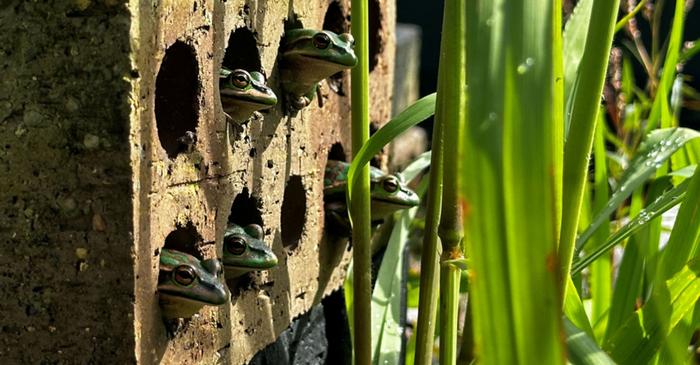
Macquarie University researchers have used heat to develop a simple and effective way to help endangered frogs survive the devastating impacts of a pandemic sweeping multiple species.

Credit: Anthony Waddle
Macquarie University researchers have used heat to develop a simple and effective way to help endangered frogs survive the devastating impacts of a pandemic sweeping multiple species.
In collaboration with the University of Melbourne, researchers homed in on the fungal disease chytridiomycosis, which has already driven at least six amphibian species to extinction in Australia and threatens dozens more worldwide.
The findings, published in the journal Nature on 26 June 2024, offer a potential lifeline for fast-declining populations like the green and golden bell frog (Litoria aurea), which has disappeared from more than 90 per cent of its former native range in Australia.
Dr Anthony Waddle, a Schmidt Science Fellow at Macquarie University’s Applied BioSciences and lead author of the study, says very few interventions address the impacts of the international spread of the disease-causing chytrid fungus (Batrachochytrium dendrobatidis or Bd).
“In the 25 years since chytrid was identified as a major cause of the global collapse of amphibian populations, our results are the first to provide a simple, inexpensive and widely applicable strategy to buffer frogs against this disease,” Dr Waddle says.
Chytridiomycosis (chytrid) typically establishes itself permanently once it spreads to a new environment and has caused greater damage to global biodiversity than any other recorded disease or invasive species.
Of chytrid-stricken species worldwide, 90 have gone extinct or are presumed extinct in the wild. Another 124 species have declined in number by more than 90 percent.
Senior author Professor Rick Shine, from Macquarie University’s School of Natural Sciences says this study has demonstrated a simple intervention which can easily scale up, potentially helping reduce the impact of the deadly chytrid pandemic.
“Chytrid isn’t going away, but our behavioural ecology intervention can help endangered amphibians co-exist with chytridiomycosis in their ecosystems,” Professor Shine says.
The research team found artificial ‘hotspot’ shelters built from readily available materials, such as bricks and PVC greenhouses, can allow frogs to quickly ‘bake off’ infections with the chytrid fungus.
When frogs shifted to hotspot shelters, chytrid infections were reduced significantly.
“The whole thing is like a mini med spa for frogs,” says Dr Waddle.
“In these simple little hotspots, frogs can go and heat up their bodies to a temperature that destroys the infections.
The study also showed that frogs who survive a chytrid infection can develop a form of acquired immunity, making them more resistant to future infections.
“Lowering mortality rates and boosting their immunity to chytrid is the key to protecting amphibians from this disease, which is now endemic around the world,” says Dr Waddle.
Dr Waddle says these simple ‘hotspot’ shelters are easy to reproduce, and the strategy can easily be scaled up with community involvement.
Professor Lee Skerratt, Professorial Fellow in Wildlife Bioscience at the University of Melbourne, says: “This research has great potential to be extrapolated to other endangered frog species threatened by chytridiomycosis, and demonstrates the value of cross-disciplinary and cross-institutional collaboration in tackling this global problem.”
END
Read an extended version of this article on The Lighthouse – Macquarie University’s multi-media publishing platform – please credit when republishing.
Journal
Nature
Method of Research
Experimental study
Subject of Research
Animals
Article Title
Hotspot shelters stimulate frog resistance to chytridiomycosis
Article Publication Date
26-Jun-2024
COI Statement
The authors declare no conflict.
Cite Scienmag News
Drew Townsend. (June 26, 2024). Frog ‘saunas’ a lifeline for endangered frog populations. Scienmag. https://scienmag.com/frog-saunas-a-lifeline-for-endangered-frog-populations/
Drew Townsend. "Frog ‘saunas’ a lifeline for endangered frog populations." Scienmag, 26 June 2024, https://scienmag.com/frog-saunas-a-lifeline-for-endangered-frog-populations/. Accessed 3 September 2026.
Drew Townsend. "Frog ‘saunas’ a lifeline for endangered frog populations." Scienmag. June 26, 2024. https://scienmag.com/frog-saunas-a-lifeline-for-endangered-frog-populations/

