


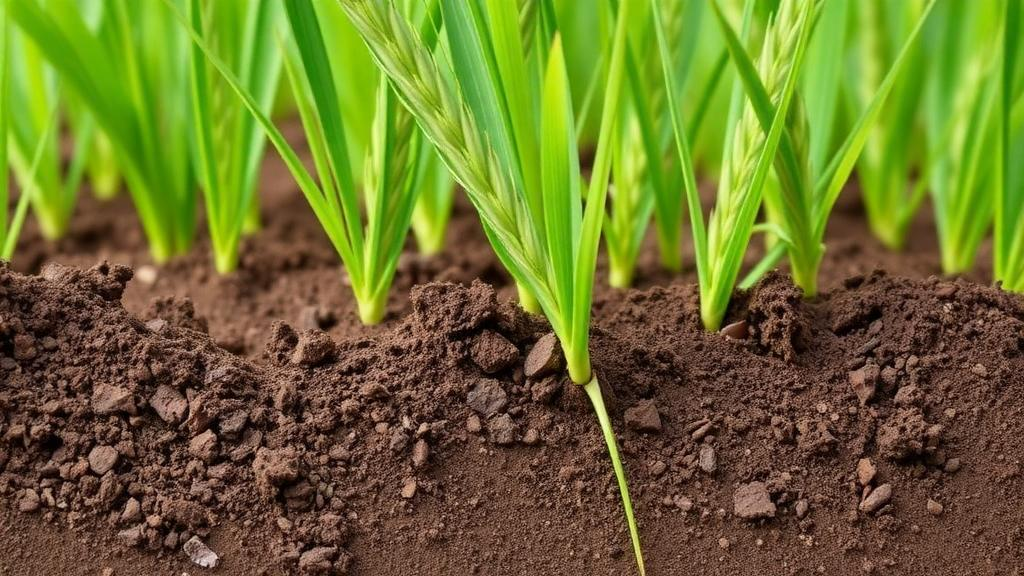
In the push to make agriculture less dependent on synthetic chemicals, few ideas have generated as much enthusiasm as microbial inoculants: living bacteria and fungi that are deliberately added to seeds or soil to boost crop growth, prime plant immunity, or fend off pathogens. Yet a persistent worry shadows this enthusiasm. When farmers release vast numbers of a single bacterial strain into a field, does that strain simply help the crop, or does it also bulldoze its way through the delicate native microbial communities that live around plant roots? A new three-year field study, published in the journal Plant and Soil, offers one of the most detailed answers to date, and the verdict is reassuring for the biostimulant industry: a well-known beneficial bacterium can establish itself durably in the barley rhizosphere year after year while leaving the resident prokaryotic community essentially untouched.
The research, led by Nina Bziuk and Jasper Schierstaedt of the Julius Kühn Institute in Braunschweig, Germany, together with colleagues at the University of Copenhagen, focused on Ensifer meliloti strain Rm2011, a soil-dwelling relative of the nitrogen-fixing symbionts that partner with legumes such as alfalfa. Although E. meliloti is famous for forming nitrogen-fixing nodules on legume roots, previous work had shown that this strain can do something remarkable in barley, a cereal that forms no nodules at all: it produces a quorum-sensing molecule, an N-acyl-homoserine lactone, that primes the barley immune system and reduces infection by leaf rust in certain genotypes. The question was whether this molecular trickster could survive and persist in the harsh, competitive environment of a real field, and what it would do to the microbial neighborhood once it got there.
To find out, the team ran replicated field trials over three consecutive growing seasons at the Julius Kühn Institute experimental site in Braunschweig. Eight different barley genotypes were grown in one-square-meter plots, including the genetically characterized reference lines Golden Promise and Morex and five accessions from the GENOBAR diversity panel. Seeds were soaked in a bacterial suspension containing roughly one hundred million cells per milliliter, and plants were drenched twice more during the growing season, at twenty and forty-one days after sowing, aiming for an inoculum density of one million cells per gram of soil. The researchers then sampled the rhizosphere, the thin layer of soil clinging to the roots and shaped by root exudates, at four time points in each season: 19, 28, 55, and 76 days after sowing.
Tracking the invader required some clever microbiological detective work. Because many soil bacteria are naturally resistant to the antibiotics used for selection, the team generated rifampicin-resistant mutants of Rm2011 and selected the fastest-growing, best quorum-sensing-producing variant for the field. Re-isolated colonies were confirmed as the true inoculant strain by DNA fingerprinting. The results revealed a striking temperature dependence. In two of the three years, a cold snap followed sowing, and no inoculant cells could be recovered from the rhizosphere at the first sampling; laboratory tests confirmed that the strain cannot survive below about eight degrees Celsius. In the warmer year, the bacteria persisted from the seed onward. Seed coating alone, however, delivered only modest colonization, around a few hundred thousand cells per gram of seed, likely because Gram-negative bacteria like E. meliloti are more sensitive to drying than the spore-forming Gram-positive strains that dominate commercial biostimulants.
Soil drenching proved to be the decisive application method. After the drench treatments, the inoculant established stably in the rhizosphere of all barley genotypes, reaching average densities of around eighty million cells per gram of dry root shortly after the second drench and then settling at roughly four million cells per gram for the remainder of the vegetation period. Crucially, this colonization success was independent of plant genotype and of the year, even though the three trials were conducted on different field areas with different preceding crops. That threshold matters: earlier research suggests that a beneficial strain must reach at least one hundred thousand cells to trigger induced systemic resistance in a plant, and the drenched plots comfortably exceeded that level throughout the season.
The bigger ecological question was what all those added cells did to the native community. To answer it, the team sequenced the V3-V4 region of the 16S rRNA gene from hundreds of rhizosphere and bulk soil samples, generating more than 7.5 million reads assigned to over 183,000 amplicon sequence variants. The dominant phyla were the familiar pillars of agricultural soils: Proteobacteria, Bacteroidota, Actinobacteria, Acidobacteria, Firmicutes, and Crenarchaeota, with genera such as Bacillus, Paenibacillus, Massilia, and Rhizobium abundant in nearly every sample. Statistical models revealed a clear hierarchy of forces shaping this community. The sampling year mattered most, followed by the barley genotype and the plant’s developmental stage. The inoculation treatment, by contrast, had only a minor and inconsistent effect on overall community composition across all three years.
Diversity metrics told a similar story. Shannon diversity, a standard measure combining species richness and evenness, was shaped significantly by host genotype at the end of each season, but the inoculant itself rarely moved the needle, with only scattered genotype-specific responses in individual years. Temporal dynamics dominated: the developmental stage of the plant, and the weather that accompanied it, drove the biggest shifts in community structure over the growing season. When the researchers correlated taxon abundances with environmental measurements, consistent patterns emerged. Genera such as Rhizobium, Sphingomonas, Exiguobacterium, and Micrococcaceae tracked soil and air temperatures positively, while Massilia, Rhizobacter, Paenibacillus, and members of Vicinamibacteriales correlated negatively. Nitrososphaeraceae, Pedobacter, and Dyadobacter showed mixed responses, favoring humidity and rainfall but disliking heat. In other words, the weather, not the inoculant, was the loudest voice in the rhizosphere.
There was one notable exception to the inoculant’s invisibility. A single amplicon sequence variant assigned to the genus Ensifer was significantly enriched in inoculated plots across all three years, with a log fold change of nearly seven when all years and time points were pooled. A handful of other taxa, including Streptomyces, Lysobacter, Kosakonia, and Bacillus, also increased modestly in inoculated samples, while one Rhizobium variant was more abundant in controls. These targeted shifts, the authors argue, are exactly what a well-behaved inoculant should look like: the added strain takes up its own niche and is detectable in the sequencing data, but it does not displace or restructure the broader community. Consistent with invader theory, which holds that microbial invaders only reshape communities that are already unstable, the barley rhizosphere appears to have been a stable, resilient system that tolerated the visitor without being transformed by it.
The implications reach well beyond one bacterium and one crop. As European policy pushes to cut chemical inputs in agriculture by half by 2030, demand for reliable biological alternatives is surging, and Gram-negative strains like E. meliloti, with their metabolic versatility and ability to communicate with plants through quorum-sensing signals, represent a largely untapped class of next-generation biostimulants. But this study also delivers practical warnings. Seed coating alone may fail for Gram-negative strains sensitive to desiccation and cold, so drenching at the right moment, after soils have warmed, appears essential. And because colonization success, community dynamics, and even the plant immune response all depend on temperature, genotype, and seasonal conditions, the authors emphasize that no single greenhouse experiment can predict field performance. Only long-term, multi-season studies like this one, they conclude, can reveal whether a beneficial microbe is a genuine ecological citizen or a potential invasive guest, and in this case, three years of evidence suggest Rm2011 is the former: a tolerated visitor that does its job quietly and goes home when the weather turns cold.
Subject of Research: Long-term field assessment of the rhizosphere persistence and ecological impact of the bacterial inoculant Ensifer meliloti Rm2011 on barley microbiomes
Article Title: Spatiotemporal dynamics of the barley rhizosphere prokaryotic community following repeated inoculation with Ensifer meliloti Rm2011 in a three-year field study
Article References: Bziuk, N., Cambeis, M., Pohl, K., Nesme, J., Sørensen, S. J., Schikora, A., Smalla, K., & Schierstaedt, J. (2026). Spatiotemporal dynamics of the barley rhizosphere prokaryotic community following repeated inoculation with Ensifer meliloti Rm2011 in a three-year field study. Plant and Soil. https://doi.org/10.1007/s11104-026-09083-5
Image Credits: AI Generated
DOI: 10.1007/s11104-026-09083-5
Keywords: Ensifer meliloti, barley, rhizosphere, microbiome, microbial inoculant, plant growth-promoting bacteria, 16S rRNA sequencing, field trial, quorum sensing, soil microbiology, sustainable agriculture, biostimulants
Cite Scienmag News
Alan Morgan. (October 2, 2026). Friendly Soil Bacterium Settles Into Barley Roots Without Upsetting the Neighborhood. Scienmag. https://scienmag.com/friendly-soil-bacterium-settles-into-barley-roots-without-upsetting-the-neighborhood/
Alan Morgan. "Friendly Soil Bacterium Settles Into Barley Roots Without Upsetting the Neighborhood." Scienmag, 2 October 2026, https://scienmag.com/friendly-soil-bacterium-settles-into-barley-roots-without-upsetting-the-neighborhood/. Accessed 4 October 2026.
Alan Morgan. "Friendly Soil Bacterium Settles Into Barley Roots Without Upsetting the Neighborhood." Scienmag. October 2, 2026. https://scienmag.com/friendly-soil-bacterium-settles-into-barley-roots-without-upsetting-the-neighborhood/


