


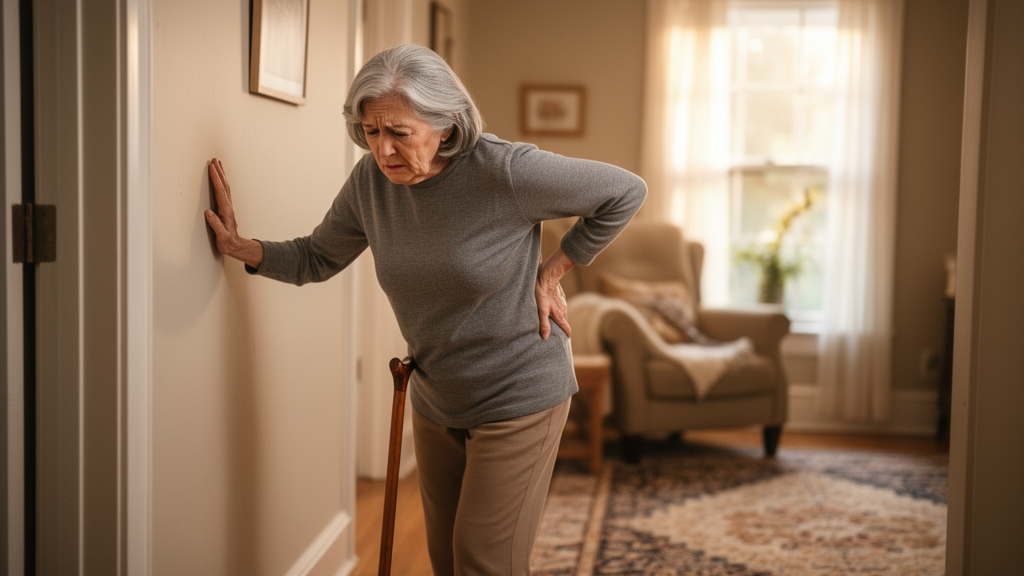
For millions of middle-aged and older people, pain is not an occasional nuisance but a near-constant companion. A new prospective study drawing on one of the largest longitudinal health surveys in China now adds weight to a concern that clinicians have long suspected: that this frequent pain does more than erode quality of life—it appears to set the stage for dangerous falls. The research, published in BMC Public Health by a team led by Yule Zhao and Jiachen Liang of Shanxi Medical University, with corresponding author Min Zhang, analyzed data from 11,411 adults aged 45 and older enrolled in the China Health and Retirement Longitudinal Study, known as CHARLS. The findings suggest that two familiar culprits—disrupted sleep and weakened grip strength—may help explain part of the connection between chronic pain and falling, though the researchers are careful to stress that their analysis stops short of proving a causal chain.
The scale of the problem emerges immediately from the baseline numbers. In the 2015 survey wave, 30.6 percent of participants reported frequent pain, a striking figure that underscores how common persistent discomfort is among people in midlife and beyond. The researchers then tracked whether these individuals experienced a fall during the 2018 follow-up, creating a genuine prospective design in which the exposure—frequent pain—was measured years before the outcome. This temporal separation matters enormously in observational research. Cross-sectional studies, which measure pain and falls at the same moment, can never disentangle whether pain leads to falling or whether a fall, with its injuries and immobility, generates pain. By anchoring the pain measurement three years before fall ascertainment, the CHARLS-based analysis offers a far cleaner window into the direction of the association.
The statistical architecture of the study reflects the growing sophistication of large-cohort epidemiology. The team employed logistic and linear regression models with community-clustered variance estimates, a technical choice that accounts for the fact that participants within the same Chinese communities share environments, health services, and socioeconomic conditions that could otherwise bias the estimates. Models were adjusted in two tiers: a core specification controlling for sociodemographic characteristics, lifestyle factors, and body mass index, and an expanded specification that additionally incorporated depression, chronic conditions, and baseline fall history. This layered approach allows readers to see how robust the associations are—and how much of the raw relationship between pain and falls can be absorbed by pre-existing health vulnerabilities, which are among the most persistent confounders in aging research.
The headline result is unambiguous even after core adjustment. Frequent pain was significantly associated with abnormal sleep duration, with an odds ratio of 1.869, meaning that people with frequent pain had nearly 87 percent higher odds of sleeping fewer than six hours or more than nine hours per night. The same group showed markedly lower grip strength, with a regression coefficient of −1.641 kilograms, indicating that frequent pain was accompanied by a measurable deficit in the handgrip force that clinicians use as a simple, inexpensive proxy for overall muscle function. And when the researchers modeled subsequent falls conditional on sleep duration and grip strength, frequent pain remained significantly associated with falling, with an odds ratio of 1.624. In other words, even after accounting for the two candidate pathways, pain carried its own independent statistical association with fall risk.
The study also quantified the roles of the mediators themselves, and these numbers carry practical significance for anyone thinking about fall prevention. Abnormal sleep duration—defined here as either short sleep under six hours or long sleep exceeding nine hours—was associated with higher odds of falls, at an odds ratio of 1.254. Grip strength told the opposite story: each additional kilogram of handgrip force was associated with 2.0 percent lower odds of falling, an odds ratio of 0.980 per kilogram. These dose-response patterns are biologically plausible. Sleep deprivation degrades attention, reaction time, and balance, while reduced muscle strength undermines the postural control and corrective reflexes that keep an unsteady person upright. A person who is both exhausted and weak is, in mechanical terms, a person whose margin of safety has been shaved from both ends.
To estimate how much of the pain–fall association might travel through these two pathways jointly, the researchers used a technique called exploratory probability standardization, generating model-based contrasts with 95 percent confidence intervals derived from 1,000 whole-community bootstrap resamples. The primary joint indirect association contrast came out at 1.265 percentage points, with a confidence interval of 0.880 to 1.672. When the analysis was restricted to the same 10,281-person subset for consistency, the estimate was 1.247 percentage points under core adjustment. But here the story becomes more nuanced: when the expanded model added depression, chronic conditions, and baseline fall history, the contrast shrank to 0.370 percentage points, with a confidence interval of 0.169 to 0.603. That attenuation is a signal worth reading closely. It suggests that a substantial share of what looks like a sleep-and-strength pathway may actually be entangled with broader mental and physical health burdens that accompany chronic pain.
The authors are notably disciplined about what their findings do and do not establish, and that restraint is itself scientifically important. The study demonstrates an association between frequent pain and subsequent falls, and it shows that abnormal sleep duration and reduced grip strength jointly contributed to an exploratory, model-based association. What it does not claim is independent or sequential causal mediation. In plain terms, the analysis cannot prove that pain causes poor sleep, that poor sleep causes falls, or that the observed contrasts represent genuine causal transmission along that chain. Observational data, however large and however carefully adjusted, cannot rule out unmeasured confounders—ranging from underlying inflammatory disease to medication side effects—that might simultaneously produce pain, sleep disturbance, weakness, and instability. The bootstrap and standardization machinery produces elegant estimates, but the causal interpretation of those estimates remains provisional.
Even so, the practical implications are hard to ignore, particularly for a country like China where the population is aging rapidly and falls among older adults are a leading cause of injury, disability, and loss of independence. The authors suggest that sleep management and muscle-strengthening interventions warrant further evaluation, while explicitly noting that their fall-prevention benefits are not demonstrated by this study. That framing points toward a natural next generation of research: randomized trials testing whether cognitive behavioral therapy for insomnia, an intervention already validated for pain-related sleep disturbance, or structured resistance training programs can measurably reduce fall incidence among people living with frequent pain. If such trials succeed, a relatively low-cost, non-pharmacological package could become a cornerstone of fall prevention—one that targets the modifiable middle of the pathway rather than the pain itself, which is often stubbornly resistant to treatment.
There is also a broader lesson in how the study defines its exposures. By treating abnormal sleep duration as a two-sided phenomenon—both too little and too much sleep—the researchers avoided the common error of assuming that only short sleep is harmful. Epidemiological work has repeatedly found U-shaped relationships between sleep length and adverse health outcomes, and the CHARLS analysis honors that complexity. Similarly, grip strength, measured with a dynamometer, offers a standardized and repeatable metric that can be collected in primary care settings at negligible cost, making the study’s findings immediately actionable for screening. A clinician who identifies a patient with frequent pain, disordered sleep, and declining handgrip force is looking at a constellation that this research identifies as statistically linked to future falls.
What emerges from this study is less a definitive verdict than a carefully mapped terrain. Frequent pain affects nearly a third of Chinese adults over 45 and is associated with a substantially elevated risk of falling within three years. Abnormal sleep and weakened grip strength are both more common in people with frequent pain and both independently associated with falls, and together they account for a measurable, if modest, share of the overall association—an effect that shrinks considerably once depression, chronic disease, and fall history enter the statistical picture. The honest conclusion is that pain, sleep, muscle, and falls form a web of interacting vulnerabilities in aging bodies, and that untangling which threads can be cut to prevent harm will require the interventional studies the authors call for. For now, the message for patients and clinicians alike is one of heightened vigilance: persistent pain deserves attention not only for the suffering it causes directly, but for the cascade of fragility it may quietly set in motion.
Subject of Research: The association between frequent pain and fall risk, and the exploratory roles of abnormal sleep duration and grip strength, in middle-aged and older adults
Article Title: The association between frequent pain and fall risk: exploratory roles of abnormal sleep duration and grip strength in middle-aged and older adults—a prospective study based on CHARLS
Article References: The association between frequent pain and fall risk: exploratory roles of abnormal sleep duration and grip strength in middle-aged and older adults—a prospective study based on CHARLS. (n.d.). https://doi.org/10.1186/s12889-026-29905-6
Image Credits: AI Generated
DOI: 10.1186/s12889-026-29905-6
Keywords: frequent pain, falls, sleep duration, grip strength, CHARLS, aging, middle-aged adults, older adults, prospective study, BMC Public Health, sleep disorders, muscle strength
Cite Scienmag News
Ophelia Keating. (October 15, 2026). Frequent Pain Raises Fall Risk in Older Adults, with Sleep and Muscle Strength Playing a Role. Scienmag. https://scienmag.com/frequent-pain-raises-fall-risk-in-older-adults-with-sleep-and-muscle-strength-playing-a-role/
Ophelia Keating. "Frequent Pain Raises Fall Risk in Older Adults, with Sleep and Muscle Strength Playing a Role." Scienmag, 15 October 2026, https://scienmag.com/frequent-pain-raises-fall-risk-in-older-adults-with-sleep-and-muscle-strength-playing-a-role/. Accessed 15 October 2026.
Ophelia Keating. "Frequent Pain Raises Fall Risk in Older Adults, with Sleep and Muscle Strength Playing a Role." Scienmag. October 15, 2026. https://scienmag.com/frequent-pain-raises-fall-risk-in-older-adults-with-sleep-and-muscle-strength-playing-a-role/


