


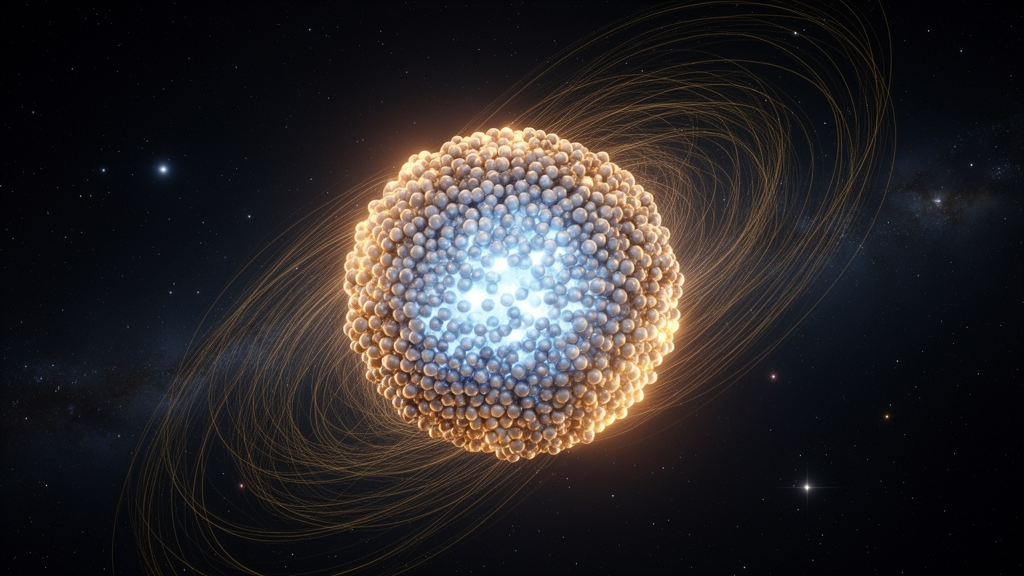
Deep in the cores of the densest objects in the universe, a ghostly particle may be quietly reshaping the very fabric of gravity. New theoretical work suggests that axions—elusive dark matter candidates originally proposed to solve a stubborn puzzle in quantum chromodynamics—could combine with a higher-curvature extension of Einstein’s general relativity to allow quark stars to reach masses well above two solar masses. The study, published in The European Physical Journal C, weaves together microscopic quark-matter physics and macroscopic gravitational corrections into a single framework that may finally describe how the most massive compact stars can exist without collapsing.
Quark stars are hypothetical compact objects composed not of ordinary hadronic matter but of deconfined quarks, the fundamental building blocks that are normally locked inside protons and neutrons. At densities far exceeding those found in atomic nuclei, the strong force may loosen its grip, allowing quarks to roam freely throughout the stellar interior. Whether such objects exist remains one of the most compelling open questions in astrophysics, and their properties depend critically on the equation of state—the relationship between pressure and energy density—of the ultra-dense matter within them.
The research team, led by Guo-yun Shao at Xi’an Jiaotong University, approached this problem from two directions simultaneously. On the microscopic side, they extended the (2+1)-flavor Polyakov–Nambu–Jona-Lasinio model, an effective framework for describing quark interactions, by incorporating a background axion field. The axion enters the thermodynamics of quark matter through the phase θ = a/f_a, where a is the axion field and f_a is the axion decay constant. This phase modifies the instanton-induced ‘t Hooft interaction, introducing CP-odd effects that mix scalar and pseudoscalar channels and fundamentally alter the chiral and deconfinement properties of the system.
On the macroscopic side, the team adopted regularized four-dimensional Einstein–Gauss–Bonnet gravity, a higher-curvature extension of general relativity that has attracted significant attention since a consistent four-dimensional formulation was proposed in 2020. Although the Gauss–Bonnet term is purely topological in exactly four spacetime dimensions, a careful regularization procedure recasts it as an effective scalar–tensor theory of Horndeski type, introducing an auxiliary dimensionless scalar field φ and a coupling constant α that characterizes the strength of higher-curvature corrections. In the limit α → 0, the theory reduces to standard general relativity.
The team solved the modified Tolman–Oppenheimer–Volkoff equations—the stellar structure equations that determine how pressure balances gravity inside a relativistic star—using the axion-modified equation of state as input. Their numerical results reveal two distinct mechanisms that both increase the maximum mass of quark stars. The axion interaction stiffens the equation of state, raising the pressure at fixed energy density and increasing the speed of sound within the matter. Meanwhile, the Gauss–Bonnet correction effectively weakens gravitational compression, allowing the star to support more massive equilibrium configurations with larger radii.
Quantitatively, the effects are striking. In standard general relativity with no axion effects (θ = 0), the maximum mass of a quark star reaches 1.67 solar masses with a radius of 9.8 kilometers. Increasing the axion phase to θ = π raises the maximum mass to 1.94 solar masses and the radius to 11.0 kilometers. When the Gauss–Bonnet coupling is set to α = 6.0 km², the stellar sequences shift further toward higher masses and larger radii. For θ ≥ π/3 combined with α = 6.0 km², the maximum masses exceed the lower bound of the PSR J0740+6620 mass band at 2.01 solar masses, bringing the theoretical predictions into the observational territory occupied by some of the heaviest pulsars ever measured.
The team also examined the compactness and surface gravitational redshift of these stars. Both quantities decrease monotonically with increasing α at fixed stellar mass, reflecting the fact that the EGB correction favors less compact configurations. Similarly, increasing θ reduces compactness and redshift on the stable branch, a direct consequence of the axion-induced stiffening that leads to larger stellar radii. These trends suggest that neither mechanism produces ever-denser objects; instead, both favor configurations that are more massive but less gravitationally extreme than their general-relativistic counterparts.
The speed of sound within the quark matter exhibits a pronounced peak at intermediate densities, and its height increases noticeably with increasing θ. Above approximately 2.5 times nuclear saturation density, the sound speed decreases with density for all considered values of θ, a behavior the team attributes to the appearance of strange quarks at higher densities, which tends to soften the equation of state. At very high densities, the curves gradually increase again and converge, suggesting that the relative impact of axion interactions becomes less pronounced in the ultra-dense regime.
The phenomenological comparison with observations is particularly noteworthy. The team overlaid their theoretical mass–radius sequences with observational constraints from PSR J0740+6620 (2.08 ± 0.07 solar masses), PSR J1614-2230 (1.97 ± 0.04 solar masses), the gravitational-wave event GW170817, and the X-ray source XMMU J173203.3-344518. For all considered values of θ with α = 6.0 km², the quark-star sequences overlap with the GW170817 and XMMU J173203.3-344518 regions, and their maximum masses exceed the lower bound of the PSR J1614-2230 band. This convergence suggests that the interplay between axion-modified dense matter and higher-curvature gravity could provide a viable mechanism for sustaining the massive compact stars that astronomers continue to discover.
While the results are compelling, the authors emphasize that their comparison with observational data is indicative rather than rigorous, since the GW170817 constraints were inferred within general relativity while their stellar sequences incorporate EGB corrections. They also note that a full analysis of radial stability in the presence of 4D EGB gravity remains an open problem. Nevertheless, the framework establishes that the combined effects of axion interactions and modified gravity can support quark stars above two solar masses, opening a new avenue for probing both dark matter candidates and the fundamental nature of gravity through the most extreme objects in the cosmos.
Subject of Research: Effects of axion interactions on quark stars in 4D Einstein–Gauss–Bonnet gravity
Article Title: Effects of axion interactions on quark stars in 4D Einstein–Gauss–Bonnet gravity
Article References: Effects of axion interactions on quark stars in 4D Einstein–Gauss–Bonnet gravity. (n.d.). https://doi.org/10.1140/epjc/s10052-026-16435-z
Image Credits: AI Generated
DOI: 10.1140/epjc/s10052-026-16435-z
Keywords: Effects, axion, interactions, quark, stars, Einstein, Gauss, Bonnet, gravity, scientific research
Cite Scienmag News
Katie Riggs. (October 15, 2026). Axions and Modified Gravity May Explain Massive Quark Stars. Scienmag. https://scienmag.com/axions-and-modified-gravity-may-explain-massive-quark-stars/
Katie Riggs. "Axions and Modified Gravity May Explain Massive Quark Stars." Scienmag, 15 October 2026, https://scienmag.com/axions-and-modified-gravity-may-explain-massive-quark-stars/. Accessed 15 October 2026.
Katie Riggs. "Axions and Modified Gravity May Explain Massive Quark Stars." Scienmag. October 15, 2026. https://scienmag.com/axions-and-modified-gravity-may-explain-massive-quark-stars/


