


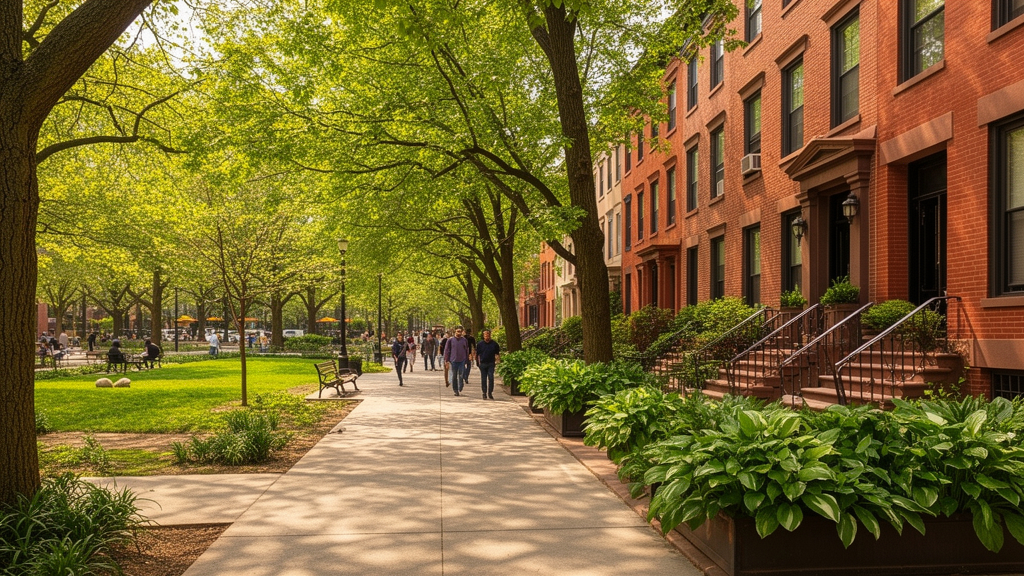
A new study from The Ohio State University has found that the amount of greenery visible from the street where a person died is linked to the odds that the death was a firearm-related homicide, but the protective effect of trees, parks and grass is far from uniform across a city. The research, published this month in the journal Urban Forestry & Urban Greening, examined fatal shootings in Cook County, Illinois, the county that reported the most homicides in the United States in 2022. Its central conclusion is deceptively simple yet consequential for urban policy: green space can help prevent gun violence, but where that green space sits, and what kind of neighborhood surrounds it, determines whether it protects residents or fails them entirely.
The study was led by Gia Barboza-Salerno, an associate professor in Ohio State’s colleges of social work and public health and director of the university’s Investigating Spatial Structures in Urban Environments, or ISSUES, Lab. Her research group specializes in advanced spatial statistics, geospatial artificial intelligence and machine learning to understand how neighborhood environments shape health, safety and social well-being. The impetus for the work came from a point she made at a recent conference that resonated with fellow researchers studying urban greenery and violence prevention. When it comes to the effects of green space on communities, local context matters. It is not as simple as planting a tree and expecting that alone to solve the problem of violence, she argued, because researchers still do not fully understand how, or whether, the local context in which greenery sits interacts with a subsequent reduction in violence.
Technically, the study broke new ground by measuring greenery the way a pedestrian actually experiences it. Previous research on green space and violence has often relied on satellite imagery or aerial assessments of vegetation, which capture tree cover from above but say little about what someone walking down a street can see at eye level. Barboza-Salerno’s team instead turned to Google Street View images and machine learning tools to quantify the amount and types of greenery visible from the street where each death occurred. This street-level, pedestrian perspective had not been applied before to the specific question of greenery near the locations of firearm-related deaths, according to the study, making it a methodological advance in a field where the relationship between vegetation and violent crime has long been recognized but poorly understood.
The case-control design was equally deliberate. The researchers examined 899 firearm homicides and 2,256 natural deaths in Cook County in 2023. For each firearm homicide, they compared the location to natural deaths of people similar in age, sex and race who died nearby, a matching strategy that helps isolate the role of the immediate environment from the characteristics of the people involved. By pairing deaths that occurred in close geographic proximity and among demographically similar individuals, the analysis could ask a focused question: holding the who constant, did the where, specifically the visible greenness of the street, change the odds that a death was a shooting?
The answer, in broad terms, was yes. More visible greenery, greater tree canopy and more green space along walkable streets were linked to lower odds that a death in that location was a firearm-related homicide. This finding aligns with a growing body of research showing that urban green spaces, parks and other areas lined with plants, grass and trees, improve community and individual health outcomes by encouraging physical activity, reducing stress and improving air quality. Green spaces have also been associated with reduced gun violence and other violent crimes in earlier work. But the new study’s most striking result concerns the limits of that protection, and it is here that the research departs from a simple greening prescription.
The benefits of green space were not universal. Tree cover and greenery offered the most protection in less disadvantaged neighborhoods, while in the most disadvantaged neighborhoods, being closer to a park was actually linked to a higher risk of firearm homicide. The researchers attribute this pattern to multidimensional measures of social deprivation, including poverty, structural housing disadvantage, economic inequality, family structure and income, which appear to have a stronger impact on violence risk than a neighborhood’s green spaces themselves. In other words, the social and economic conditions surrounding a park can overwhelm, or even reverse, whatever protective effect the park might otherwise provide.
Barboza-Salerno framed the finding as a double inequity. Green space is very important and critical for violence prevention, she said, but not all green space matters equally. If you lived in a socially advantaged environment, having green space mattered more for reducing violence than in a socially disadvantaged area. Green space should be thought of as a violence-prevention intervention, she argued, yet the green space that does the most protective work tends to be concentrated in more advantaged neighborhoods. Disadvantaged areas get less quality green space, and the green space they do get is less protective without other supports. The result is a compounding disadvantage in which the communities facing the highest burden of firearm violence receive both fewer and weaker environmental buffers against it.
The mechanism behind this reversal, the researchers suggest, lies in maintenance and use. When parks in disadvantaged neighborhoods are not well-maintained or used regularly, they can become more of an eyesore than a protective factor. In neighborhoods with more resources, well-kept parks have a beautification effect that can improve how people feel and strengthen neighbors’ willingness to look out for one another, a dynamic that researchers of urban violence often describe in terms of collective efficacy and informal social control. In the most disadvantaged areas, Barboza-Salerno said, there is a lot of economic disinvestment, and that is the association with violence, not the park per se. The park is not the cause of danger; it is the surrounding disinvestment that turns an asset into a liability.
The study’s authors are careful about what their data can and cannot show. The analysis looked only at environments, not individuals. As Taylor Harrington, a doctoral candidate in public health and a co-author of the study, explained, the team only looked at the location of death for the person in the context of the environment at that moment. The measurement does not encapsulate a person’s whole lived experience or their exposure to green space and deprivation throughout life up until that point. This is a case-control study of places, not a longitudinal study of people, and its findings describe associations between street-level greenness, neighborhood disadvantage and where firearm deaths occurred, not causal guarantees that greening alone will reduce shootings in any given block.
Even so, Barboza-Salerno has seen green space succeed as part of a broader effort. As the lead researcher at the Violence Prevention Collaborative in Boston and Director of Research for the Dudley Street Neighborhood Initiative, she partnered with youth development organizations that employed young people to fix up local parks. The work gave the participants new skills and changed how neighbors perceived them, illustrating how greening projects can double as social interventions. Parks can provide safe places for children to play, socialize and have positive reciprocal interactions. Alongside housing and food security, Barboza-Salerno described green space as one part of a comprehensive community-building approach that needs to be scaled to see effective violence prevention in the United States. If we think carefully about where green spaces are placed and why they make a difference, she said, this could be huge. The study’s message for policymakers is that urban planning is a critical part of public health prevention, and that planting trees without addressing poverty, housing disadvantage and economic inequality is unlikely to deliver the safety benefits that greener, better-resourced neighborhoods already enjoy. Other Ohio State co-authors of the study are Balaji Ramesh and Jeffrey Wing of the College of Public Health.
Subject of Research: Street-level urban greenness, neighborhood deprivation, and firearm-related homicide risk in Cook County, Illinois
Article Title: Green space is linked with fewer gun-related homicides — but not everywhere
Article References: Green space is linked with fewer gun-related homicides — but not everywhere. (n.d.). Original publication
Image Credits: AI Generated
DOI: Not provided
Keywords: urban green space, firearm homicide, gun violence, neighborhood disadvantage, Google Street View, machine learning, geospatial AI, public health, urban planning, Cook County, tree canopy, violence prevention
Cite Scienmag News
Grant Pearson. (October 14, 2026). Street-Level Greenery Cuts Gun Homicide Risk, But Only Where Neighborhoods Thrive. Scienmag. https://scienmag.com/street-level-greenery-cuts-gun-homicide-risk-but-only-where-neighborhoods-thrive/
Grant Pearson. "Street-Level Greenery Cuts Gun Homicide Risk, But Only Where Neighborhoods Thrive." Scienmag, 14 October 2026, https://scienmag.com/street-level-greenery-cuts-gun-homicide-risk-but-only-where-neighborhoods-thrive/. Accessed 14 October 2026.
Grant Pearson. "Street-Level Greenery Cuts Gun Homicide Risk, But Only Where Neighborhoods Thrive." Scienmag. October 14, 2026. https://scienmag.com/street-level-greenery-cuts-gun-homicide-risk-but-only-where-neighborhoods-thrive/


