


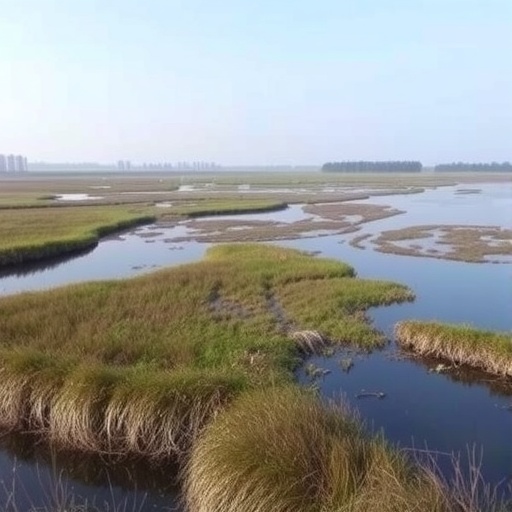
European countries are being asked to restore degraded wetlands, but a new analysis shows that the burden will fall very unevenly—largely because the distribution of wetland types and the extent of human disturbance vary widely across borders. Using criteria aligned with the EU Habitats Directive, researchers treated land-use disturbance as a practical red flag for areas unlikely to meet “good condition” requirements, which include both the site’s ecological structure and its characteristic vegetation.
The team converted these compliance assumptions into “scenario-based” restoration targets. Rather than representing exact legal obligations or implementation plans, the method creates stylized targets that assume a fixed share of disturbed seminatural open wetlands is restored to reach Article 4 percentage goals. For each country and wetland type, restoration area was computed as the mandated proportion applied to the estimated disturbed wetland area.
Disturbed areas were assembled from country-level datasets, with uncertainty carried through the analysis. The study used Monte Carlo propagation (n = 5,000 draws) to produce confidence intervals, reflecting variability in the underlying wetland area estimates and in the disturbance-to-allocation procedure.
Across the EEA38 region, the results suggest that by 2030 about 2.66 million hectares of wetlands need restoration. On average, that translates to roughly 70,000 hectares per country, but several nations require far more. The United Kingdom tops the list with 403,700 ± 99,300 hectares, followed by Ireland (290,300 ± 73,600), Turkey (237,500 ± 100,400), and Romania (200,700 ± 68,400).
The pattern is not simply about land size. Germany, for example, would need 105,600 ± 52,200 hectares—less than the UK by nearly a factor of four—while France (173,900 ± 57,400), Denmark (144,400 ± 51,200), and Norway (141,700 ± 33,500) also exceed the regional mean.
In northern Europe, peatbogs strongly shape demand. Peatbog-specific restoration targets reach 234,000 ± 71,300 hectares in the UK and 256,900 ± 64,900 hectares in Ireland, with Sweden (91,600 ± 35,100) and Norway (38,000 ± 14,600) also showing substantial peatland components. Countries with limited peatbog extent—such as Turkey and Romania—show large overall targets driven instead by inland marsh systems.
Overall, the study links restoration “demand” to the spatial mix of seminatural wetland types and how frequently they are disturbed. It also highlights a policy challenge: without harmonized, spatially detailed wetland datasets, comparing restoration commitments across countries may be difficult to do robustly.
Cite Scienmag News
Denise Maddox. (July 15, 2026). Fragmented European wetlands face uneven restoration needs and patchy recovery efforts. Scienmag. https://scienmag.com/fragmented-european-wetlands-face-uneven-restoration-needs-and-patchy-recovery-efforts/
Denise Maddox. "Fragmented European wetlands face uneven restoration needs and patchy recovery efforts." Scienmag, 15 July 2026, https://scienmag.com/fragmented-european-wetlands-face-uneven-restoration-needs-and-patchy-recovery-efforts/. Accessed 4 September 2026.
Denise Maddox. "Fragmented European wetlands face uneven restoration needs and patchy recovery efforts." Scienmag. July 15, 2026. https://scienmag.com/fragmented-european-wetlands-face-uneven-restoration-needs-and-patchy-recovery-efforts/


