


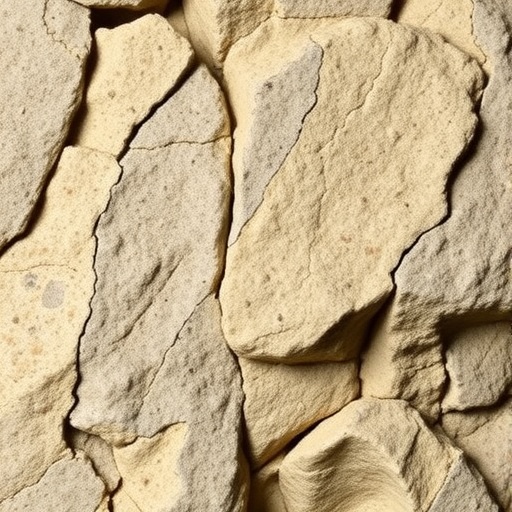
In a groundbreaking study that promises to reshape our understanding of geological formations, researchers have unveiled the profound effects of fracture development on the mechanical behavior of silty mudstone under triaxial stress conditions. Silty mudstone, a sedimentary rock prevalent in many subsurface environments, often acts as a critical barrier or host rock in a variety of engineering and environmental contexts. The intricate interplay between its microstructure and external stressors has long posed challenges to geotechnical engineers, yet recent experiments have shed new light on how fractures fundamentally alter its strength, deformability, and failure mechanisms.
The focus of this research lies in characterizing the mechanical variations induced by fracture propagation within silty mudstone samples when subjected to triaxial stress — a stress state that simulates the complex pressure conditions rocks experience deep beneath the Earth’s surface. Such multi-axial loading is representative of many natural and anthropogenic processes, including tectonic movements, underground excavations, and fluid injections. The study meticulously applies controlled stress paths to pre-fractured and intact mudstone specimens, providing quantitative data that markedly contrasts the responses of fractured and unfractured rock masses.
Central to the findings is the observation that the initiation and evolution of fractures within silty mudstone drastically diminish its peak strength, resulting in a nonlinear decrease that correlates with fracture density and orientation. This phenomenon is attributed to the disruption of the rock matrix and the consequent redistribution of stresses along crack surfaces. As fractures propagate, stress concentrations at crack tips promote further microcracking, leading to a cascade effect that culminates in premature failure under lesser load levels than previously assumed, thereby challenging established predictive models used in rock mechanics.
Beyond mere strength reduction, fractured silty mudstone exhibits enhanced deformability, with elastic modulus values decreasing as fracture networks become more complex. This softening behavior has significant implications for the stability assessments of slopes, tunnel linings, and wellbore integrity. Researchers note that traditional elastic-brittle frameworks are inadequate in capturing such progressive damage, necessitating the incorporation of fracture mechanics and continuum damage models to accurately forecast rock behavior under real-world stress states.
The experimental procedures employed in the study incorporated advanced loading apparatus capable of exerting independent axial and confining pressures, while simultaneous acoustic emission monitoring allowed real-time detection of crack initiation and coalescence. This coupling of mechanical testing with acoustic diagnostics provides unprecedented resolution into the temporal sequence of microfracture events, revealing that early fracture development plays a pivotal role in weakening silty mudstone long before visible macroscopic failure occurs.
Moreover, microstructural analyses post-testing via scanning electron microscopy and X-ray computed tomography illuminated the spatial distribution and morphology of fractures. Results pinpoint a transition from predominantly tensile mode cracks in low confinement scenarios to shear-dominated fracture patterns under higher confining pressures. This transition not only influences failure modes but also impacts fluid migration pathways—a factor critical for hydrogeological assessments and underground storage applications.
The study’s implications extend to the modeling of induced seismicity and subsurface engineering, as fractured silty mudstone layers are often involved in earthquake nucleation zones and human activities such as hydraulic fracturing and geothermal energy extraction. Understanding how fractures compromise mechanical stability provides essential parameters for risk mitigation strategies, especially in regions susceptible to seismic hazards or infrastructural failures.
Of particular novelty is the research’s quantified relationship between fracture connectivity and mechanical anisotropy. As fractures form and intersect preferentially along certain planes, the rock’s directional strength and stiffness become markedly heterogeneous. This anisotropy complicates engineering designs, demanding site-specific investigations rather than generic assumptions. Consequently, the study advocates for integrating fracture characterization into geomechanical modeling to enhance predictive accuracy and safety margins.
The methodology also emphasized reproducibility and scalability, performing tests across a spectrum of confining pressures and strain rates, thereby simulating diverse geological environments from shallow to deep crustal levels. This comprehensive dataset paves the way for calibrating numerical models that can incorporate fracture networks dynamically evolving under triaxial stress, ultimately advancing the fidelity of large-scale geotechnical simulations.
Furthermore, the findings suggest potential avenues for engineered manipulation of rock properties by controlled fracturing. In resource recovery or carbon sequestration contexts, deliberately inducing fracture networks could optimize permeability without significantly compromising mechanical integrity, balancing extraction efficiency with structural safety. Such nuanced control underscores the importance of detailed mechanical characterizations exemplified by this study.
The research also underscores the delicate balance between fracture healing and degradation processes in silty mudstone. While natural mineral precipitation within fractures may restore some strength over geologic timescales, the immediate mechanical penalty post-fracturing is substantial, as verified by the experimental timelines. This temporal aspect is critical for engineering projects with short to medium-term horizons, necessitating consideration of fracture-induced weakening during design phases.
In synthesizing these multifaceted insights, the study by Zhang, H., Qi, S., Bian, H., and colleagues delivers a transformative perspective on the mechanical evolution of fractured silty mudstone under complex stress states. Their work not only bridges gaps in theoretical models and experimental evidence but also provides actionable knowledge for disciplines as varied as civil engineering, earthquake science, and environmental geoscience.
Ultimately, this research heralds a paradigm shift in how fractures are conceptualized within sedimentary rocks, urging a departure from static rock mass assumptions towards dynamic, fracture-informed frameworks. As industries and governments increasingly rely on subsurface resources and infrastructure, such nuanced understanding becomes indispensable. Future investigations building on these foundational insights are expected to unravel further complexities in rock mechanics, driving innovation and safety in subsurface endeavors worldwide.
Cite Scienmag News
Violet Maxwell. (May 29, 2025). Fractures Alter Silty Mudstone Strength Under Triaxial Stress. Scienmag. https://scienmag.com/fractures-alter-silty-mudstone-strength-under-triaxial-stress/
Violet Maxwell. "Fractures Alter Silty Mudstone Strength Under Triaxial Stress." Scienmag, 29 May 2025, https://scienmag.com/fractures-alter-silty-mudstone-strength-under-triaxial-stress/. Accessed 4 September 2026.
Violet Maxwell. "Fractures Alter Silty Mudstone Strength Under Triaxial Stress." Scienmag. May 29, 2025. https://scienmag.com/fractures-alter-silty-mudstone-strength-under-triaxial-stress/


