


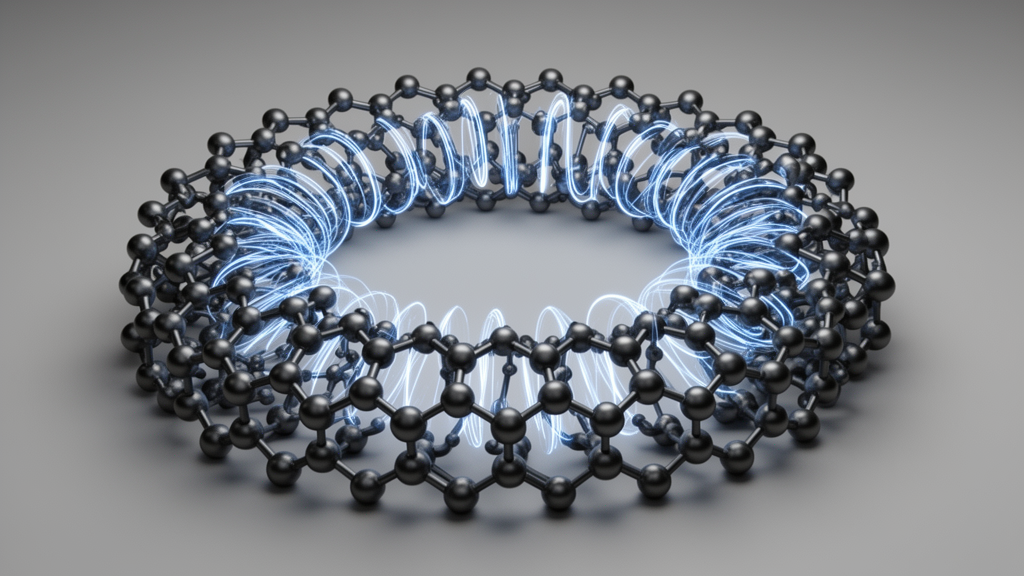
Physicists in Brazil have drawn up theoretical blueprints for a new family of carbon-based nanostructures in which the geometry itself is a fractal: rings and chains built from Koch snowflake-like quantum corrals, and molecular corrals assembled from triangular Sierpinski units. The study, published in Frontiers in Carbon, shows through detailed simulations that these quasi-one-dimensional fractal lattices host highly degenerate localized states, self-similar band structures, and conducting channels whose existence depends sensitively on how many atomic neighbors the model includes. The work offers a practical guide for chemists seeking to functionalize fractal molecules for selective transport nanodevices.
Quantum corrals, first created in 1993 by arranging atoms on a metal surface, have long served as laboratories for studying electron confinement and resonant states. In recent years, bottom-up synthesis with atomic precision has made covalently linked organic corrals possible, revealing flat bands and highly degenerate localized states that are of intense interest in condensed matter physics. Fractals, meanwhile, occupy non-integer Hausdorff dimensions, and experimental techniques such as self-assembly and electrostatic attraction now allow finite fractal molecules to be synthesized, letting researchers probe how electrons and photons moving through such lattices reveal self-similar patterns in their band structures, density of states, and conductance.
The research team, L. L. Lage and A. Latgé of the Universidade Federal Fluminense, focused on two annular Koch geometries: triangular Koch rings, named TK-G(n), and square Koch rings, named SK-G(n). These decorated rings are obtained by particular rotations of the Koch lines, resulting in C3v and C4v symmetries respectively. The Koch chain fractal dimension follows from D = log(N)/log(L), where N is the number of lines between each corner and L the proportional length-fraction of each line relative to the first generation, giving D = log(4)/log(3) = log(16)/log(9) = log(64)/log(27), approximately 1.26 for the first, second, and third generations. The same dimension applies to the triangular and square Koch snowflakes.
Technically, the systems are described with a single-orbital tight-binding Hamiltonian, in which each atom carries an on-site energy and electrons hop between nearest neighbors with energy t, and optionally between second-nearest neighbors with energy t′. The electronic properties are derived from the eigenfunctions and eigenenergies, and the local density of states is computed by smearing each electronic state with a Lorentzian function centered at the relevant atomic site. Transport properties are calculated using the Landauer approach, in which the system is decoupled into a central conductor flanked by left and right leads. Semi-infinite Koch chains serve as leads that perfectly match the central scattering region, and Green function formalism yields the energy-dependent transmission from which the conductance follows.
A central technical question is whether second-neighbor hopping must be included. The authors compared eigenenergies of second-generation triangular and square Koch corrals under first-neighbor and second-neighbor models, with t′ = 0.5t chosen to highlight the effects, even though this value may overestimate the smaller parameter usually adopted for graphene-based lattices, t′ = 0.1t. Remarkably, the two fractal arrangements have similar energy spectra despite different numbers of atoms. For the first-neighbor model, the Fermi level falls in an energy gap of magnitude t, a semiconducting-like feature, whereas states cross the Fermi level in the second-neighbor description. First-neighbor results also show six- and twelve-fold degeneracies at E = −t for the triangular and square corrals, producing sharp peaks in the density of states.
The spatial charge distributions reveal how the neighbor model changes the physics. At E = −t, the first-neighbor model localizes the electronic density in a dimer-like charge distribution, while the second-neighbor model spreads the charge around all the corral sites, because the inclusion of second-neighbor interactions lifts the degeneracy and forms a bonding state. At E = −1.64t, the dimer-like feature is preserved in the first-neighbor case, rotated spatially and preferring the external positions, whereas in the second-neighbor case the charge is more pronounced at the internal sites of the corral. Although triangular and square corrals share similar spectra, the charges distribute according to each symmetry, and these effects persist in molecular chains of corrals.
Because synthesized corrals are often displayed in lines close to each other, or sometimes physically connected, the authors proposed tight-binding models connecting Koch corrals into molecular chains with periodic boundary conditions along one direction. Comparing the electronic band structures of three successive generations, G(2), G(3), and G(4), they identified self-similar allusions between the band structures, highlighted at narrower energy ranges as the Koch order increases, a fundamental manifestation of the fractal nature of the electronic properties. The authors note that real self-similarity patterns would require perfect fractal geometries, such as triangular Sierpinski lattices, and that the interfaces between fractal units in the chains break the ideal fractal symmetry of the single flakes.
The transport consequences are striking. For the triangular Koch G(2) chain, the first-neighbor model exhibits almost flat bands in the negative energy spectrum, a signature of highly localized states, and the conductance response is mostly null in that energy range. In the more realistic second-neighbor model, the spectrum is more dispersed, and the number of available conducting channels increases markedly due to non-zero electronic group velocities in the energy interval from −1.2t to zero. The charge distribution at E = −t concentrates around particular sites in the first-neighbor model, with wavefunctions that do not spread along neighboring unit cells, suppressing transport at that energy, while the second-neighbor model delocalizes the state through the chain.
The study also proposes effective molecular quantum corrals based on hexagonal symmetries, constructed as hexagonal triangular Sierpinski corrals of different orders, generated by repeating Sierpinski triangles connected to form self-similar objects. Using the box-counting method, the authors estimated a fractal dimension D ≈ 1.63, consistent with the reported hexagonal gasket version where D = log(6)/log(3). The energy spectrum of the first four generations shows enormous degeneracies, with 6, 42, 258, and 1,554 degenerate states at E = −2t across G(1) to G(4). To mimic real synthesized molecules containing elements other than carbon, the authors assigned different on-site energies to carbon, iron, and ruthenium sites, and found that states near the Fermi level draw their main contributions from iron and carbon sites in the internal hexagonal region, while at E = −1.3t the highest local density of states comes from the ruthenium positions.
The authors emphasize that higher-generation lattices would help identify possible self-similarity manifestations in the electronic properties, and that more sophisticated descriptions within the same tight-binding framework, incorporating spin-orbit coupling mainly at the metallic sites and electron-electron correlations, could better describe complex molecular systems with transition metals. They believe the research can guide the synthesis of real fractal molecular nanostructures, highlighting particular symmetries and possibilities for new functionalization procedures, and opening routes to selective transport nanodevices engineered through the fractal peculiarities of carbon-based lattices.
Subject of Research: Carbon-based fractal lattices and their electronic transport properties
Article Title: Quasi-one-dimensional carbon-based fractal lattices
Article References: Lage, L. L., & Latgé, A. (2023). Quasi-one-dimensional carbon-based fractal lattices. Frontiers in Carbon, 2, Article 1305515. https://doi.org/10.3389/frcrb.2023.1305515
Image Credits: AI Generated
DOI: 10.3389/frcrb.2023.1305515
Keywords: fractals, quantum corrals, carbon nanostructures, tight-binding models, electronic transport, Koch snowflake, Sierpinski triangle, nanotechnology, Quasi-one-dimensional, carbon-based, fractal, lattices
Cite Scienmag News
Katie Riggs. (October 17, 2026). Fractal carbon rings could steer electrons through nanoscale mazes. Scienmag. https://scienmag.com/fractal-carbon-rings-could-steer-electrons-through-nanoscale-mazes/
Katie Riggs. "Fractal carbon rings could steer electrons through nanoscale mazes." Scienmag, 17 October 2026, https://scienmag.com/fractal-carbon-rings-could-steer-electrons-through-nanoscale-mazes/. Accessed 17 October 2026.
Katie Riggs. "Fractal carbon rings could steer electrons through nanoscale mazes." Scienmag. October 17, 2026. https://scienmag.com/fractal-carbon-rings-could-steer-electrons-through-nanoscale-mazes/


