


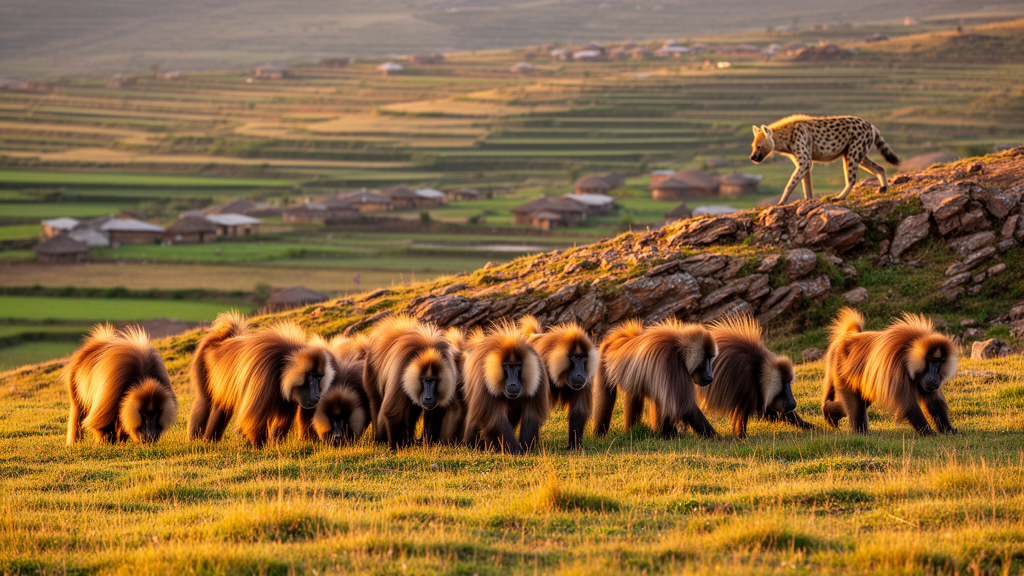
In the rolling woodlands and montane forests of southwestern Ethiopia, a remarkable conservation story is unfolding—one that defies the grim headlines that usually accompany human–wildlife conflict across Africa. A new study from Konta Special District reveals that despite losing crops to marauding baboons and livestock to prowling hyenas, an overwhelming 91.6 percent of local residents still support wildlife conservation. The findings, published in the journal BioRisk, offer a rare glimmer of hope for conservationists grappling with one of the field’s most stubborn challenges: how to sustain local goodwill when wild animals keep eating the harvest.
The research team, led by scientists surveying communities across two administrative units known as kebeles, interviewed 95 randomly selected households between February and March 2021. Using systematic random sampling from registered household lists, pre-tested questionnaires translated into the local Konta language, and focus group discussions with women, religious leaders, elders, and youths, the researchers built a detailed picture of how subsistence farming communities coexist—or fail to coexist—with their wild neighbors. The district, home to roughly 115,898 people, sits at elevations between 1,200 and 1,640 meters and harbors an impressive faunal cast: lions, spotted hyenas, leopards, African elephants, buffalo, greater kudu, and the endemic and vulnerable subspecies of blue monkey.
The conflict itself follows a pattern familiar across the Ethiopian highlands and beyond. More than half of respondents—51.6 percent—reported suffering both crop damage and livestock depredation simultaneously, while only 2.1 percent cited direct attacks on humans. The olive baboon emerged as the undisputed chief antagonist, ranked as the principal problem animal by a striking 95.8 percent of households. Vervet monkeys came second at 65.3 percent, followed by wild pigs, porcupines, and hyenas. Focus group participants offered a telling behavioral insight: baboons and monkeys, being sophisticated social animals that do not fear humans, are particularly difficult for women and children to drive away from crops, forcing older males to spend their days guarding farmland instead of pursuing other livelihoods.
The technical details of depredation reveal fascinating ecological dynamics. Hyenas, with their flexible foraging behavior and ability to kill all types of livestock during both day and night, were identified as the most troublesome predators in the area. By contrast, only a few respondents blamed lions—a pattern the researchers attribute to lions’ tendency to target livestock primarily when wild prey is absent from their vicinity. This finding aligns with research from Zimbabwe’s Sengwa Wildlife Research Area, where low prey abundance drove carnivores toward domestic targets. Cultural norms also shape local opinions about lion conservation, mirroring observations around Ethiopia’s Kafa Biosphere Reserve, where communities expressed positive attitudes toward lions due to cultural values.
Perhaps the most counterintuitive result concerns wildlife population trends. A majority of respondents—61.1 percent—believed that wild animal populations in their vicinity were increasing. Yet during field visits, the researchers observed wildlife habitats being actively destroyed by anthropogenic activities, including fires set to clear land for agriculture and settlement, expanding road construction, and hydropower dam development. The apparent population boom, the team suggests, is likely an artifact of proximity: as habitats shrink, animals are pushed into agricultural areas and human settlements in search of food and breeding space, creating more frequent encounters that residents misread as growing numbers. This perceptual trap has been documented elsewhere in Ethiopia and underscores how easily conflict frequency can distort ecological perception.
The threat hierarchy reported by communities is sobering. Habitat loss topped the list at 75.6 percent, followed by illegal hunting at 17.9 percent and human–wildlife conflict itself at 6.3 percent. Among the five major threats catalogued by the IUCN for species status assessments, habitat destruction stands as the principal driver of extinction across taxa, ecosystems, and locations. In Konta, the destruction is multifaceted: human-induced fires for land clearance, firewood and wild honey collection, road construction slicing through forest corridors, and hydropower development flooding valleys. The researchers documented active fires burning in wildlife habitats during their fieldwork, alongside the visible scars of infrastructure projects that ultimately fragment and eliminate the Combretum–Terminalia woodland, savanna grassland, and dry evergreen montane forest that define the district.
What makes the Konta findings genuinely viral-worthy is the attitude paradox. Despite bearing the costs of conservation—destroyed crops, killed livestock, restricted resource access—91.6 percent of respondents expressed positive attitudes toward wildlife conservation. Statistical analysis confirmed this goodwill cuts across demographic lines: there was no significant difference between kebeles, sexes, or educational backgrounds. The chi-square tests returned values well above the 0.05 threshold for all comparisons, meaning the positivity is remarkably uniform rather than concentrated among any particular group. Even the 73.7 percent of respondents who were uneducated shared the same favorable outlook as their literate neighbors—a contrast with studies from Cameroon, where more than 76 percent of educated respondents supported chimpanzee conservation, suggesting education is not a prerequisite for conservation goodwill.
The justifications residents offered for their positivity are as diverse as they are pragmatic. Respondents noted that wild animals serve as tourist attractions, that some species and their products are used in traditional medicine, and that wildlife habitats provide wild honey, wild coffee, and spices—supplementary income sources woven into the local economy. Furthermore, participants believed that conservation restricts the movements of wild animals, minimizes the frequency of human–wildlife contact, and reduces damage. This utilitarian logic echoes findings from Ghana’s Mole National Park, where 90 percent of adjacent communities expressed willingness to coexist with monkeys despite their destructive behavior. Religion and culture also play their part: communities living near Ethiopian Orthodox Tewahedo Churches refrain from killing wild animals because they believe killing is a sin—a spiritual safeguard that has quietly protected biodiversity for centuries.
The mitigation methods communities deploy are almost entirely traditional and labor-intensive. Guarding day and night—using dogs, shouting at animals, and burning fires around croplands—was reported by 75.8 percent of households as the dominant strategy. Scarecrows, smoking fires, plastic, and clothes accounted for another 16.8 percent, while 7.4 percent of household heads acknowledged retaliatory killing of problematic animals. The reliance on human guarding, particularly for baboon and monkey raids, extracts a heavy toll on household labor and reinforces the gender dynamics that push older males into full-time crop defense. Without compensation schemes or more effective technical interventions, these traditional methods risk escalating into retaliatory killing, a pattern documented in Tanzania’s Tarangire–Manyara Ecosystem and around Ethiopia’s Gambella National Park.
The study’s recommendations chart a path toward sustainable coexistence that could resonate far beyond Konta. The researchers call for compensation schemes to offset losses, regular awareness training about conflict mitigation and the biodiversity effects of uncontrolled fires, and alternative livelihoods including ecotourism, beekeeping, and livestock fattening to reduce dependence on conflict-prone agriculture. Crucially, they insist that development activities—hydropower dams, roads, agricultural expansion—should not compromise biodiversity conservation goals. Field observations confirmed that Konta is endowed with wildlife resources of national and international conservation relevance, yet these resources face severe and mounting threats demanding urgent measures. In an era when conservation success is unlikely without local community empowerment and involvement, the Konta paradox offers a powerful lesson: goodwill, once earned and sustained, may be the most valuable conservation asset of all.
Subject of Research: Human–wildlife conflict and local community attitudes towards wildlife conservation in Konta Special District, southwest Ethiopia
Article Title: Human–wildlife conflict and local community attitudes towards wildlife conservation in Konta Special District, southwest Ethiopia
Article References: Temesgen, Z., Biru, Y., Gibru, A., & Hundie, K. (2025). Human–wildlife conflict and local community attitudes towards wildlife conservation in Konta Special District, southwest Ethiopia. BioRisk, 23, 63-77. https://doi.org/10.3897/biorisk.23.163073
Image Credits: AI Generated
DOI: 10.3897/biorisk.23.163073
Keywords: Human, wildlife, conflict, local, community, attitudes, towards, conservation, Konta, Special, District, southwest
Cite Scienmag News
Margaret Porter. (October 17, 2026). Baboons, Hyenas and Hope: Ethiopia’s Konta District Reveals a Conservation Paradox. Scienmag. https://scienmag.com/baboons-hyenas-and-hope-ethiopias-konta-district-reveals-a-conservation-paradox/
Margaret Porter. "Baboons, Hyenas and Hope: Ethiopia’s Konta District Reveals a Conservation Paradox." Scienmag, 17 October 2026, https://scienmag.com/baboons-hyenas-and-hope-ethiopias-konta-district-reveals-a-conservation-paradox/. Accessed 17 October 2026.
Margaret Porter. "Baboons, Hyenas and Hope: Ethiopia’s Konta District Reveals a Conservation Paradox." Scienmag. October 17, 2026. https://scienmag.com/baboons-hyenas-and-hope-ethiopias-konta-district-reveals-a-conservation-paradox/


