


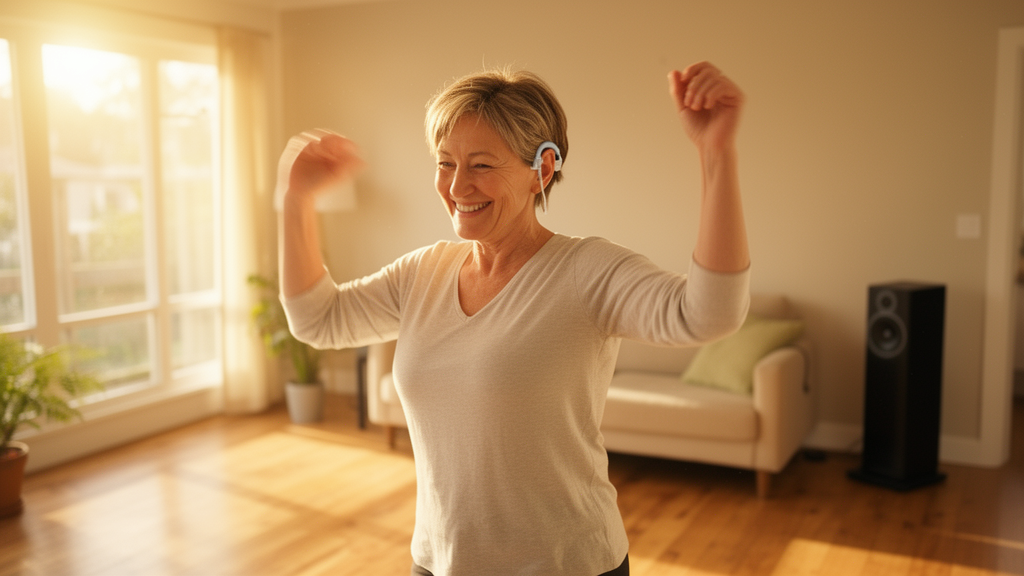
When a drum groove hits just right, it produces something scientists call the pleasurable urge to move to music, or PLUMM — that irresistible itch to nod your head, tap your foot, or get up and dance. For decades, researchers assumed this sensation was largely out of reach for cochlear implant users, whose devices excel at restoring speech but struggle to convey the pitch and timbre that make music enjoyable. Now, a new study from the Center for Music in the Brain at Aarhus University suggests otherwise. Published in Frontiers in Audiology and Otology, the research reveals that cochlear implant users experience groove in much the same way as normally hearing listeners — and that the perceptual machinery underlying the urge to move remains fully intact.
The cochlear implant works by bypassing the outer and middle ear entirely, using an electrode array inserted into the cochlea to directly stimulate the auditory nerve fibers. But here’s the technical problem: the array contains a maximum of 22 electrodes, tasked with replicating the function of roughly 3,500 hair cells in a healthy inner ear. This dramatic reduction in stimulation sites, combined with current spread between electrodes and poor encoding of temporal fine structure, makes it extraordinarily difficult to transmit pitch and timbre — two features crucial for music perception. Add to that the implant’s limited dynamic range and obligatory compression of incoming signals, which flattens loudness variations and can introduce distortion, and it’s easy to see why many CI users report dissatisfaction with their musical experience after implantation.
Yet rhythm is a different story. Previous research has consistently shown that cochlear implant users perform at the same level as normally hearing listeners on tasks involving simple rhythmic stimuli. What remained unknown was whether they could perceive and enjoy more complex musical rhythms — the kind built from multiple rhythmic layers playing simultaneously, like the bass drum, snare drum, and hi-hat that form the backbone of most Western popular music. This matters enormously, because groove isn’t just about pleasure. It facilitates social bonding, and many cultural and social events center around music and moving to it. Missing out on groove could have real implications for CI users’ wellbeing.
To investigate, the research team — led by Alberte B. Seeberg, Tomas E. Matthews, Andreas Højlund, Peter Vuust, and Bjørn Petersen — conducted an online study with 29 cochlear implant users and 31 normally hearing listeners. Participants came from five continents, with the majority from Europe and North America. Fifteen of the CI users were bilaterally implanted, and 14 unilaterally, nine of whom also used a hearing aid on the opposite ear. Twenty of the 29 CI users streamed sound directly to their implants during the experiment. The study was approved by the Institutional Review Board of the Danish Neuroscience Center at Aarhus University.
The stimuli were carefully engineered drum patterns drawn from a set of nine rhythms that varied in their degree of syncopation — a measure of rhythmic complexity where a note falls on a relatively weak beat before a rest on a relatively strong beat, violating the listener’s rhythmic expectations. Each rhythm was presented in four different layer versions: snare only, snare plus hi-hat, snare plus bass drum, and the full three-layer combination of snare, bass drum, and hi-hat. That produced 36 distinct eight-second stimuli. The drum kit sounds came from the Groove Agent SE5 virtual drum machine in Cubase 10.5, chosen specifically to ensure they fell within the perceptible ranges of CI users — a fact confirmed by creating electrodograms for each drum sound and by having a CI user identify how many different drum sounds were present.
Crucially, the researchers maintained an equal number of onsets across all versions of each rhythm, converting bass drum onsets into snare onsets for versions without the bass drum. This was essential because event density is a strong predictor of the urge to move — musicians intentionally increase it when seeking to drive listeners onto the dance floor. By controlling density, the team could isolate the effects of rhythmic layers and syncopation. Participants rated each pattern on continuous slider scales from 0 to 100 for both wanting to move and experienced pleasure. The two ratings correlated highly — r(1,014) = 0.90 for CI users and r(1,084) = 0.83 for NH listeners — so they were averaged into a single PLUMM rating for analysis.
The results defied the researchers’ hypotheses. Both groups preferred rhythmic patterns of medium complexity, producing the classic inverted U-shaped relationship between syncopation and groove ratings — the so-called sweet spot between predictability and surprise. Even more striking, both CI users and NH listeners showed a strong preference for rhythms with more layers, with the highest ratings and most prominent inverted U-shapes for the full three-layer versions containing snare, bass drum, and hi-hat. The single-layer snare-only versions showed almost no effect of syncopation in either group. Statistical analysis using linear mixed-effects models revealed no significant differences in PLUMM ratings between the two groups, except for a slightly bigger difference between snare-only and snare-plus-hi-hat versions in CI users, reflected by a flatter curve for the snare-only condition.
This finding carries real weight. The bass drum plays a central role in driving groove for normally hearing listeners, and CI users typically experience reduced low-frequency stimulation because most manufacturers set default cutoff settings between 100 and 250 Hz. Yet CI users in this study still preferred versions containing the bass drum, suggesting they can perceive and enjoy low-frequency rhythmic components — at least when those sounds are engineered to fall within the implant’s perceptible range. The researchers note that much other music contains lower bass frequencies that are not perceptible with CIs, which could substantially affect real-world groove experiences. They suggest that advancing bass frequency representation through technological development, personalized mappings for music listening, or even vibrotactile stimulation could further enrich CI users’ musical lives.
The study’s implications extend beyond music appreciation. Musical rhythm perception is closely linked to language processing skills, affecting phonological awareness and literacy development — children with developmental dyslexia perform poorly on tasks requiring temporal processing and rhythm perception. Targeted rhythm training in hearing-impaired listeners has been found to affect language skills, and it may also enhance CI users’ musical experiences, especially if such training spans a wide range of rhythmic complexities. The researchers also point to the need for caution: while the drum patterns used here contained several layers, the overlap of events from different streams was relatively limited, making it easier to extract information from each layer. In naturalistic music, where drums are accompanied by instruments providing distinct variations in pitch and timbre, the limitations of cochlear implants become more apparent as complexity increases.
Ultimately, the study demonstrates that the perceptual mechanisms underlying the pleasurable urge to move to music remain intact in cochlear implant users. Despite the well-documented technical limitations in pitch and timbre perception, CI users can still appreciate and respond to rhythmic and temporal patterns — the elements that CIs transmit effectively. The findings suggest that groove is primarily driven by rhythmic structure rather than by the spectral richness that implants struggle to convey. For the roughly one million people worldwide who rely on cochlear implants, this is welcome news: the dance floor, it turns out, is not off limits after all.
Subject of Research: Neuroscience
Article Title: The pleasurable urge to move to music is maintained in cochlear implant users
Article References: Seeberg, A. B., Matthews, T. E., Højlund, A., Vuust, P., & Petersen, B. (2026). The pleasurable urge to move to music is maintained in cochlear implant users. Frontiers in Audiology and Otology, 4, Article 1913765. https://doi.org/10.3389/fauot.2026.1913765
Image Credits: AI Generated
DOI: 10.3389/fauot.2026.1913765
Keywords: cochlear implants, groove, music perception, rhythm, PLUMM, syncopation, hearing loss, neuroscience, auditory implants, drum patterns, pleasurable, urge
Cite Scienmag News
Cassandra Pierce. (October 17, 2026). Cochlear implant users still feel the groove, study finds. Scienmag. https://scienmag.com/cochlear-implant-users-still-feel-the-groove-study-finds/
Cassandra Pierce. "Cochlear implant users still feel the groove, study finds." Scienmag, 17 October 2026, https://scienmag.com/cochlear-implant-users-still-feel-the-groove-study-finds/. Accessed 17 October 2026.
Cassandra Pierce. "Cochlear implant users still feel the groove, study finds." Scienmag. October 17, 2026. https://scienmag.com/cochlear-implant-users-still-feel-the-groove-study-finds/


