


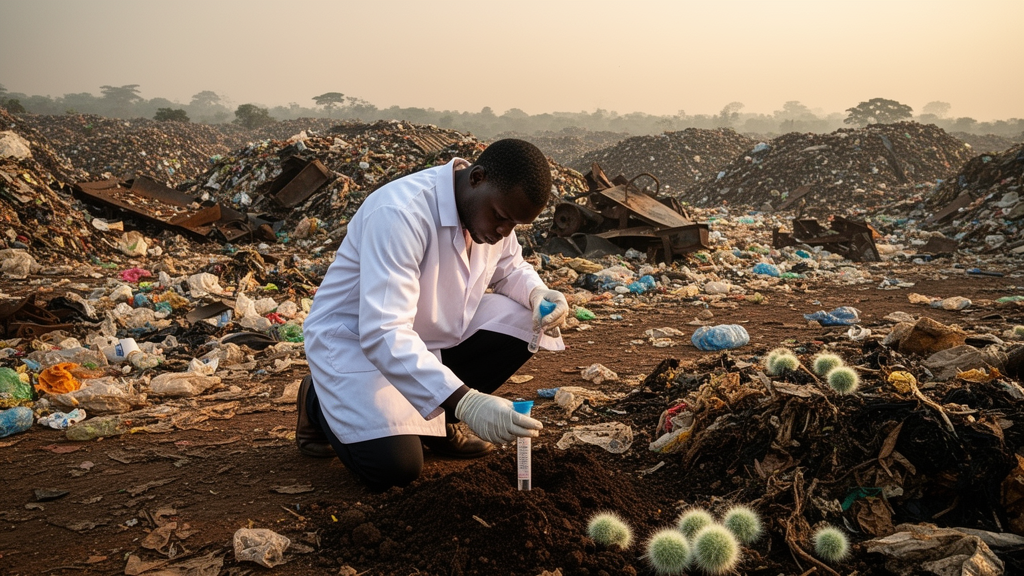
Deep in the highlands of southwestern Uganda, close to the border with Rwanda, the town of Kabale has a problem shared by countless fast-growing towns across sub-Saharan Africa: what to do with its waste. Household refuse, market scraps, and organic junk pile up in open dumpsites scattered through mixed agricultural and residential neighborhoods. These heaps are more than an eyesore. They are living ecosystems, teeming with microorganisms that feed on the waste and, in the process, can either detoxify it or turn it into a reservoir of disease. Now, a new study has pulled back the curtain on one of the least visible members of that ecosystem: the fungi.
Researchers from Bishop Barham University College in Uganda and Aix Marseille University in France set out to map the fungal communities living in the topsoil of fifteen different dumpsites in Kabale. Their findings, published in Frontiers in Fungal Biology, reveal a surprisingly rich and medically relevant fungal world, including opportunistic pathogens and species with worrying antifungal profiles. The work is among the first detailed investigations of dumpsite fungi in Uganda, where waste management remains a perennial challenge with no clearly safe solution in sight.
The team chose a technique called culturomics, a high-throughput culturing method designed to capture as many viable microorganisms as possible. It is a deliberate alternative to metagenomics, the current darling of environmental microbiology. Metagenomics reads genetic material directly from soil, but it struggles with fungi: fungal species are genetically heterogeneous, many fungal sequences are absent from reference databases, and the method detects DNA from dead organisms that may never have been alive in that soil at all. Culturomics, by contrast, grows the living fungi, allowing researchers to isolate, purify, and identify them one by one.
The technical execution was meticulous. Soil was collected with a soil auger from the top ten centimeters, the biologically active zone, at each of the fifteen dumpsites, using a composite sampling approach. Back in the lab, five grams of soil from each duplicate were suspended in phosphate-buffered saline, serially diluted, and plated onto five different culture media: Sabouraud Dextrose Agar, Potato Dextrose Agar, Malt Extract Agar, ChromAgar, and a relatively new medium called FastFung. Chloramphenicol was added to suppress bacterial growth, and plates were incubated at thirty degrees Celsius. Purified fungal colonies were then identified by sequencing the ITS region of the ribosomal RNA gene, the standard barcode for fungi, with additional beta-tubulin and Tef gene amplification used to confirm Penicillium and Fusarium isolates.
The results were striking. Fifty-four different fungal species were recovered, and FastFung emerged as the clear champion, yielding the highest number of isolates and supporting growth in almost all species. It outperformed the conventional workhorses Sabouraud and Potato Dextrose Agar, followed by Malt Extract Agar and ChromAgar. FastFung is based on Schaedler agar, enriched with essential elements for fastidious fungi and containing specific antibacterial ingredients to inhibit contaminant bacteria. Its superior performance here supports emerging evidence that media composition significantly influences fungal recovery, and that enriched media can coax out slow-growing or fastidious taxa that conventional media miss entirely.
Who lives in these dumpsite soils? The most prevalent genera were Trichoderma, Fusarium, and Aspergillus, three names that carry serious weight in both ecology and medicine. Phylogenetic analysis showed that the families Aspergillaceae, Hypocreaceae, and Nectriaceae were the most represented across all media types. Network analysis revealed that some Aspergillus species, including A. clavatus, A. flavipes, A. flavus, and A. niger, were generalists capable of growing on every medium tested, while others like A. parasiticus showed far more specialized growth requirements. The minimal overlap among media in the Venn analysis demonstrated strong selectivity, underscoring the importance of using multiple media to capture the full diversity of fungi in any environment.
The medical relevance of the findings is hard to ignore. Alongside the dominant genera, the researchers isolated pathogenic and opportunistic fungi such as Simplicillium lamellicola, Mortierella multispora, and Torulaspora delbrueckii. Aspergillus species are well-recognized opportunistic pathogens associated with respiratory infections and allergic responses, particularly in immunocompromised individuals. Fusarium species are known producers of mycotoxins, including trichothecenes, fumonisins, and zearalenones, which are toxic and carcinogenic to animals and have been associated with human esophageal cancer and birth defects. Even Trichoderma, often celebrated as a beneficial biocontrol agent, contains species that can cause lethal infections in patients with leukemia, HIV, or transplants, and infections caused by these fungi are typically diagnosed late and exhibit low sensitivity to commonly applied antifungal drugs.
To probe the clinical dimension further, the team screened all Aspergillus isolates for susceptibility to common antifungal agents using E-test strips, following Clinical and Laboratory Standards Institute guidelines. The good news: no resistance was detected, with all minimum inhibitory concentration values below established resistance thresholds. The more nuanced news: A. clavatus stood out as the least susceptible isolate, showing the highest MICs for several drugs, including caspofungin at 1.5 micrograms per milliliter and voriconazole at 0.75 micrograms per milliliter. By contrast, A. flavus and A. niger appeared highly susceptible to caspofungin, with extraordinarily low MICs of 0.0094 and 0.016 micrograms per milliliter respectively. The authors note that the broader problem of environmental antifungal resistance is growing, with widespread agricultural azole fungicides increasingly implicated in cross-resistance in clinically relevant fungi such as Aspergillus fumigatus.
Beyond the pathogens, the dumpsites also harbor fungi with genuine promise. Trichoderma species can detoxify toxic compounds and accelerate the degradation of organic material, making them candidates for bioremediation, a far better alternative than burning refuse and polluting the air. Ascomycota, the dominant phylum in these soils, are essential for cycling soil nutrients and breaking down organic materials. The isolation of Uromyces vignae, a rust fungus that infects beans, quietly reflects the centrality of beans as a staple food in Uganda. The dumpsites, in other words, are not just hazards; they are complex fungal communities with both ecological and biotechnological value waiting to be understood.
The researchers emphasize that dumpsites can serve as reservoirs of medically important fungi, and that leachate from waste sites can transport microbial contaminants into surrounding water bodies, potentially causing health hazards to local populations. When contaminated water is used for drinking, cooking, and washing, it becomes an exposure pathway for at-risk infections, especially among vulnerable groups. The study provides baseline data on the diversity, distribution, and potential functional roles of culturable fungal communities in Kabale’s dumpsite soils, and the authors call for regular mycological monitoring of dumpsites, better waste management strategies, and frequent water quality testing in surrounding areas. Future studies integrating culture-independent methods will be essential to fully characterize these communities, but the message is already clear: the fungi beneath our feet in the world’s dumpsites deserve far more attention than they have ever received.
Subject of Research: Unravelling soil fungal communities in dumpsites in Kabale, Western Uganda using culturomics
Article Title: Unravelling soil fungal communities in dumpsites in Kabale, Western Uganda using culturomics
Article References: Odebode, A., & Ranque, S. (2026). Unravelling soil fungal communities in dumpsites in Kabale, Western Uganda using culturomics. Frontiers in Fungal Biology, 7, Article 1823753. https://doi.org/10.3389/ffunb.2026.1823753
Image Credits: AI Generated
DOI: 10.3389/ffunb.2026.1823753
Keywords: Unravelling, soil, fungal, communities, dumpsites, Kabale, Western, Uganda, culturomics, scientific research
Cite Scienmag News
Phoebe Ingram. (October 17, 2026). Dumpsites in Uganda Reveal Hidden Fungal Communities With Public Health Stakes. Scienmag. https://scienmag.com/dumpsites-in-uganda-reveal-hidden-fungal-communities-with-public-health-stakes/
Phoebe Ingram. "Dumpsites in Uganda Reveal Hidden Fungal Communities With Public Health Stakes." Scienmag, 17 October 2026, https://scienmag.com/dumpsites-in-uganda-reveal-hidden-fungal-communities-with-public-health-stakes/. Accessed 17 October 2026.
Phoebe Ingram. "Dumpsites in Uganda Reveal Hidden Fungal Communities With Public Health Stakes." Scienmag. October 17, 2026. https://scienmag.com/dumpsites-in-uganda-reveal-hidden-fungal-communities-with-public-health-stakes/


