


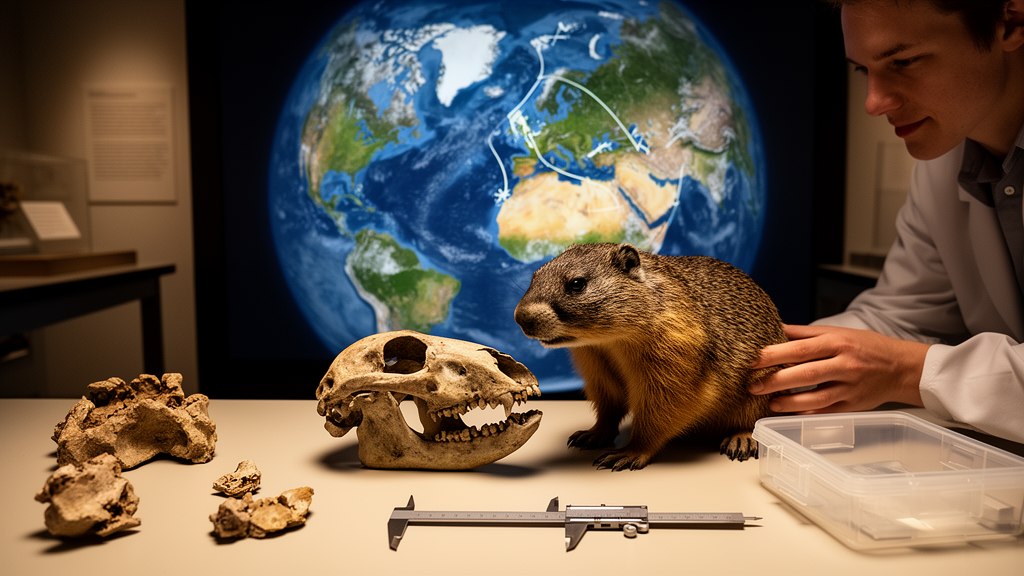
A study integrating fossil records, modern geographic occurrences and molecular data indicates that the genus Marmota originated in North America before dispersing into Eurasia through repeated intercontinental movements. Researchers identified North America as the most likely ancestral range and reconstructed four major dispersal events: two from North America to Asia, one from North America to Europe and one from Asia to Europe. Their analysis also links marmot diversification to changing climates, expanding grasslands, mountain uplift and the repeated opening and fragmentation of habitats during the Pleistocene.
The study, published in the peer-reviewed Journal of Systematics and Evolution, was led by Qiujin Wei and colleagues from the Institute of Zoology at the Chinese Academy of Sciences, with researchers from Xinjiang University, Shenyang Agricultural University and institutions of the Russian Academy of Sciences. It examined the evolutionary history of marmots, a group of burrowing mammals now found in grasslands and alpine meadows across North America and Eurasia. Because the genus’s present distribution does not directly reveal its geographic origin or migration history, the team combined several lines of evidence to reconstruct its broader trajectory.
For the fossil component, the researchers compiled 965 reliably identified marmot records. They added 155,603 occurrence records for living species and sequenced 19 tissue samples, then combined the new genetic information with publicly available data. Their molecular analysis covered all 13 mitochondrial protein-coding genes from 58 individuals. Together with the fossils and distributional records, molecular-phylogenetic analysis and Bayesian ancestral-range reconstruction supported North America as the genus’s most probable place of origin. The earliest known marmot fossil reported in the study comes from North America and dates to approximately 16.3 million years ago.
Molecular-clock analysis placed the beginning of diversification among living marmots at about 6.09 million years ago, followed by divergence into the subgenera Marmota and Petromarmota. The reconstructed dispersal history identifies the Bering region as an important corridor between North America and Eurasia. The findings show that the Bering Land Bridge functioned not merely as a single geographic connection but as a repeatedly available route through which marmots could enter new environments and expand their ranges. After entering Eurasia, marmots spread westward into Europe and diversified across the mountain systems, steppes and alpine meadows of Central and northern Asia.
The evidence associates relatively high speciation during the Late Miocene and Pliocene with global cooling, the expansion of C4 grasslands and the emergence of the Bering Land Bridge. The researchers also found that subsequent mountain uplift produced geographic barriers that promoted regional adaptation and allopatric speciation, in which isolated populations evolve separately. Around one million years ago, speciation and extinction rates rose at the same time, producing only a modest increase in net diversification. This simultaneous rise was associated with strong Pleistocene glacial–interglacial oscillations that repeatedly fragmented habitats while also creating opportunities for isolated populations to diverge. The study therefore portrays marmot diversity as the result of interacting dispersal routes, climatic shifts and topographic change, rather than of any single environmental factor. Its conclusions are based on reconstructions that integrate fossil, geographic and molecular evidence, with the timing of events and their environmental associations remaining dependent on those analytical methods.
Subject of Research: Evolutionary origins, dispersal and diversification of the marmot genus Marmota
Article Title: From North America to Eurasia: the evolutionary history of marmots
Article References: From North America to Eurasia: the evolutionary history of marmots. Original publication (Bibliographic details unavailable.)
Image Credits: AI Generated
DOI: Not provided
Keywords: marmots, Marmota, fossil records, historical biogeography, molecular clock, ancestral-range reconstruction, Bering Land Bridge, Pleistocene climate, allopatric speciation, net diversification, North, America
Cite Scienmag News
Gavin Prescott. (October 26, 2026). Fossil and molecular study traces marmot evolution from North America to Eurasia. Scienmag. https://scienmag.com/fossil-and-molecular-study-traces-marmot-evolution-from-north-america-to-eurasia/
Gavin Prescott. "Fossil and molecular study traces marmot evolution from North America to Eurasia." Scienmag, 26 October 2026, https://scienmag.com/fossil-and-molecular-study-traces-marmot-evolution-from-north-america-to-eurasia/. Accessed 26 October 2026.
Gavin Prescott. "Fossil and molecular study traces marmot evolution from North America to Eurasia." Scienmag. October 26, 2026. https://scienmag.com/fossil-and-molecular-study-traces-marmot-evolution-from-north-america-to-eurasia/


