


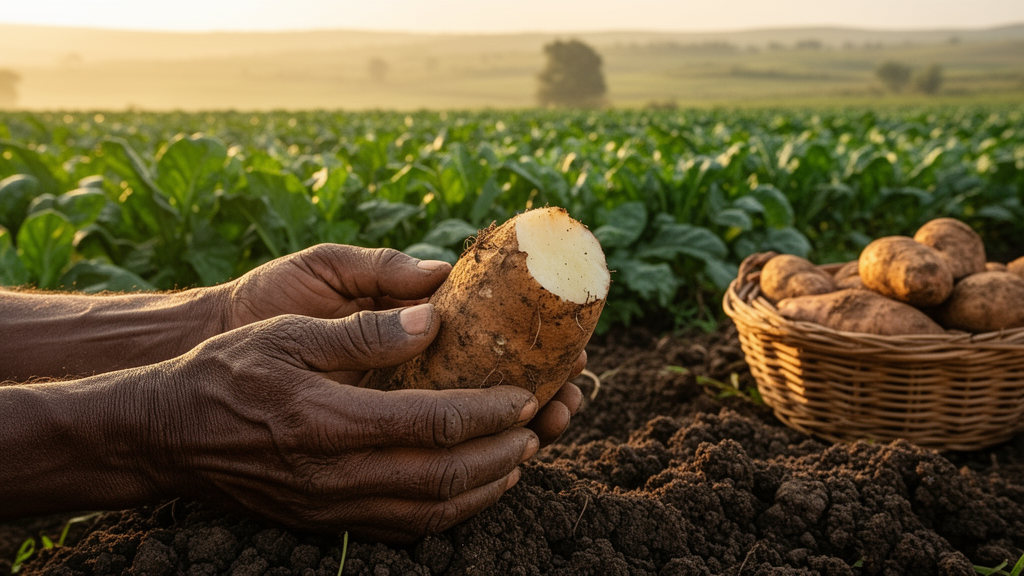
High in the Gamo highlands of southern Ethiopia, along the western escarpment of the Great Rift Valley, a strange and little-known plant has quietly fed generations of farmers. Arisaema schimperianum, a member of the arum family with palmately compound leaves and an underground corm rich in starch, is one of the world’s most underutilized food crops. A new ethnobotanical study, published in the journal BioRisk, documents for the first time in detail how local communities in the Chencha and Dita districts name, cultivate, harvest, detoxify, and eat this crop, and reveals how fragile that knowledge has become. Drawing on interviews with 357 informants, the research paints a vivid picture of an indigenous knowledge system that transforms a potentially toxic wild herb into a staple food, and warns that social stigma and generational change are pushing both the crop and its culture toward the margins.
The research team, working between February 2024 and October 2025, combined purposive, random, and snowball sampling to capture knowledge across the community. Six kebeles, or villages, were selected for their intense cultivation of the plant, and 318 household heads answered semi-structured interviews, while 30 people took part in focus group discussions and nine knowledgeable elders served as key informants. Respondents ranged from 18 to 91 years old, and nearly 88 percent relied on subsistence agriculture on plots smaller than one hectare. The researchers tested knowledge directly, presenting live specimens of the crop’s landraces and asking informants to match folk names to morphological features, a method that grounded the survey in the plants themselves rather than in abstract recall.
What emerged is a sophisticated folk taxonomy built on close observation. Local farmers distinguish landraces using seedling sheath color, petiole and fruit color, corm traits, leaflet shape and curling pattern, peduncle length, and plant height, as well as yield qualities such as palatability, moisture content, and toxicity. The landrace called Bangayo, for example, has bright green seedling sheaths, broad curled-down leaflets, and red fruit; Dasharo shows whitish spots on a purple sheath and horseshoe-shaped leaflets; and Malao carries purple sheaths, narrow leaflets, and the longest flowering stalk. Informants cited between one and thirteen folk names, including Gistaqo, Etera, Kafo Tsugunta, and Wodala, though the analysis revealed taxonomic overlap, with names sharing prefixes but differing suffixes likely describing the same varieties, and single landraces carrying different names in different villages.
Recognition of this diversity was strikingly uneven. More than one-third of respondents could not distinguish any landrace at all, referring to the plant only by its collective Gamo name, Qolxo, while roughly one-quarter correctly identified all three test landraces. Key informants explained that landraces fall into two broad groups, Adde Qolxo and Macca Qolxo, literally male and female, a classification based on biochemical and culinary properties rather than plant sex. The so-called female types are palatable, low in toxicity, and rich in starch, while male types are bitter, moist, and hard to process. Farmers deliberately conserve both: the starchy varieties for everyday meals and the less palatable ones as insurance against food scarcity, a practice that doubles as on-farm conservation of the crop’s genetic reservoir.
The crop’s agronomy is equally distinctive. Growers harvest corms from late June to August and split each one into two unequal sections in a 75:25 ratio. The larger basal portion, packed with starch, goes to the kitchen, while the apical quarter, containing the buds and active meristematic tissue, is reserved as planting material and buried 30 to 40 centimeters deep. The propagule then lies dormant for four to five months before sprouting. Individual plants need three to five years to mature, but because fields hold mixed populations at different growth stages, farmers harvest mature corms continuously each year while younger plants keep growing. During dormancy, they practice careful shallow tillage, minimal disturbance, and organic fertilization, and they intercrop cereals over the dormant beds, a low-input, shade-tolerant system the study describes as environmentally friendly agriculture refined over centuries.
Turning the corm into food is where the knowledge becomes truly remarkable. Raw corms contain irritating compounds and a delicate mucilage that burns the skin, so the Gamo have developed a processing chain that renders them safe and nutritious. The basal corm is soaked repeatedly to strip away waxy coatings, crushed with a traditional mill called a Wotsa, and then fermented for three to five days in an underground pit. The resulting product, known as Zantsa, is wrapped in enset leaves and pressed with stones to drain moisture. From it, women prepare prestigious cultural dishes: a porridge called Shendera served to household heads, guests, and elders; a bread called Kitta eaten with raw meat during the Meskel New Year festival; and Inchilla, a durable dish carried as portable food, or sinq, by travelers and laborers because it resists mold for days.
Every stage of this chain is gendered, and women emerge as the system’s central custodians. They collect and plant seedlings, fertilize gardens, harvest, clean, mill, ferment, cook, and market the products. A key informant from Lisha kebele captured this in a Gamogna saying, Maccasi baynako Qolxoy sharaffako, translated as, without women’s contribution, Arisaema schimperianum might be a rubbish weed with no food value. The regression analysis backed this up statistically: gender significantly predicted landrace knowledge, with women citing more varieties than men, a pattern reinforced by men’s seasonal out-migration for the region’s famous Shema cotton weaving, which leaves women managing entire farms.
The statistical model, which explained 57.4 percent of the variance in knowledge scores, also exposed a troubling generational and educational divide. Age showed a strong positive association with landrace identification, while education was negatively correlated: informants with no formal schooling named far more varieties than educated respondents, suggesting that schooling does little to support, and may actively erode, indigenous crop knowledge. Family size, marital status, and occupation also mattered, pointing to knowledge embedded in household responsibility and livelihood practice rather than in formal institutions. Overall, the findings echo a pattern seen across Ethiopia’s underutilized crops, from enset to Plectranthus edulis, where ethnobotanical expertise concentrates among older, less formally educated community members.
That concentration makes the knowledge system vulnerable. In pairwise ranking exercises, key informants identified social stigmatization as the single greatest threat to the crop’s future, ahead of tedious food processing, changing land use, lack of research and promotion, and the crop’s prolonged maturation period. Younger people increasingly dismiss the plant as poor people’s food, disliking its taste and rejecting the laborious manual processing it demands. At the same time, the shift from diversified, shade-based traditional farming to monoculture has removed the canopy plants the species depends on, and agricultural extension programs, focused almost entirely on cereals, have never offered growers training or support for this crop.
The study’s authors argue that saving Arisaema schimperianum will require integrated action: on-farm conservation of its landraces, systematic documentation of folk naming and culinary traditions, support for the women who hold the deepest knowledge, improved postharvest technologies that respect cultural values, and stronger links between researchers and farmers. In a world facing persistent food insecurity and narrowing crop diversity, the Gamo highlands offer a quiet lesson. A plant that most of the world has never heard of, rendered edible through centuries of accumulated ingenuity, demonstrates how indigenous science can unlock nutrition from the most unlikely resources, and how quickly that inheritance can vanish when the generations who hold it are no longer connected to it.
Subject of Research: Ethnobotanical knowledge and utilization of the underutilized crop Arisaema schimperianum in the Gamo highlands of South Ethiopia
Article Title: Ethnobotanical knowledge and utilization of Arisaema schimperianum (Schott) in the Gamo highlands of South Ethiopia
Article References: Fekede, F., Asefa, D., & Uncha, A. (2026). Ethnobotanical knowledge and utilization of Arisaema schimperianum (Schott) in the Gamo highlands of South Ethiopia. BioRisk, 24, 205-222. https://doi.org/10.3897/biorisk.24.206801
Image Credits: AI Generated
DOI: 10.3897/biorisk.24.206801
Keywords: Arisaema schimperianum, ethnobotany, Gamo highlands, Ethiopia, underutilized crops, indigenous knowledge, food security, fermentation, landraces, agrobiodiversity, women farmers, folk taxonomy
Cite Scienmag News
Alan Morgan. (October 15, 2026). Forgotten Ethiopian Root Crop Holds Clues to Food Security, New Study Finds. Scienmag. https://scienmag.com/forgotten-ethiopian-root-crop-holds-clues-to-food-security-new-study-finds/
Alan Morgan. "Forgotten Ethiopian Root Crop Holds Clues to Food Security, New Study Finds." Scienmag, 15 October 2026, https://scienmag.com/forgotten-ethiopian-root-crop-holds-clues-to-food-security-new-study-finds/. Accessed 15 October 2026.
Alan Morgan. "Forgotten Ethiopian Root Crop Holds Clues to Food Security, New Study Finds." Scienmag. October 15, 2026. https://scienmag.com/forgotten-ethiopian-root-crop-holds-clues-to-food-security-new-study-finds/


