


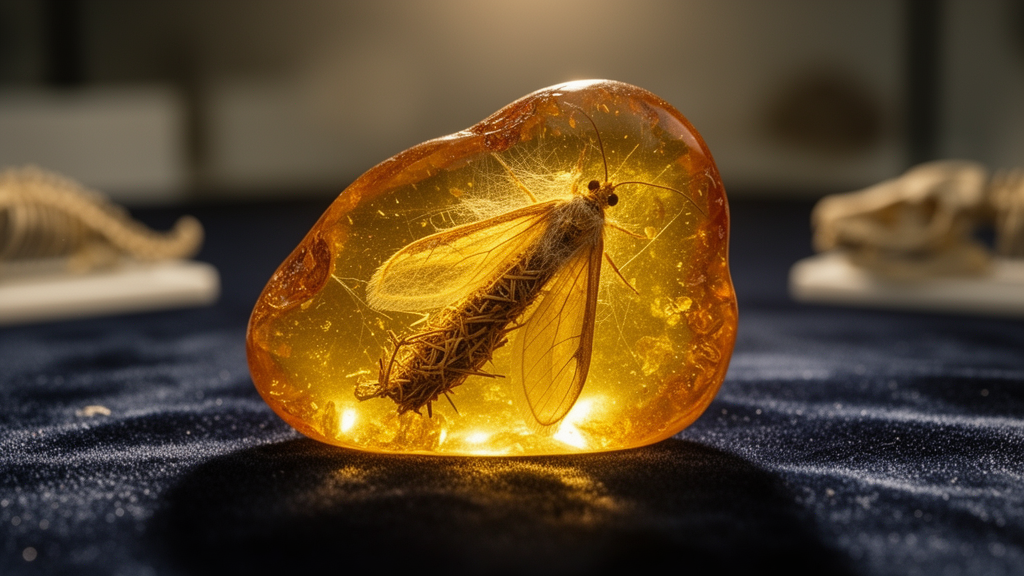
Deep inside two pieces of golden Ukrainian amber and one fragment of Baltic amber, scientists have identified something that has never been seen before in fossil resin: fully winged adult male bagworm moths. The three specimens, preserved for roughly 40 million years since the Eocene epoch, represent the first adult males of the moth family Psychidae ever recovered from succinite, the collective term for Baltic, Bitterfeld and Ukrainian ambers. Until now, the fossil record of these remarkable insects consisted almost entirely of their portable silk cases, the larval bags that give the family its common name, while the short-lived winged adults remained completely absent from the amber record. The new study, published in the journal Zitteliana, describes two of the specimens as new species assigned to the extant genus Proutia, and in doing so closes a long-standing gap between the abundant fossil larvae and their never-before-seen adult counterparts.
Bagworm moths are among the strangest members of the Lepidoptera, the order that includes butterflies and moths. The family belongs to the basal ditrysian lineage within the superfamily Tineoidea and comprises roughly a thousand species distributed across the globe. In most subfamilies, the females are flightless, with reduced, rudimentary or entirely absent wings, and in several species they spend their entire lives inside the larval bag they constructed as caterpillars. The bags themselves are architectural marvels of silk, camouflaged with exogenous materials such as plant fragments, bark, lichens, sand grains or faecal particles. The caterpillars are polyphagous defoliators that feed on a broad spectrum of host plants, and in the subfamily Oiketicinae even omnivory occurs. Adding to their biological oddity, Psychidae are one of the very few moth families in which parthenogenesis has been established, with several European and Asian species reproducing without males altogether.
The adult males, by contrast, lead brief and frantic lives. They survive for only one to two days, do not feed at all, and their mouthparts, including the proboscis and the maxillary and labial palps, are reduced to useless rudiments. Their entire existence is devoted to locating females, which release pheromones to attract them. This task is made possible by their distinctive antennae, which are bipectinate, meaning each segment carries comb-like branches on both sides that dramatically increase the sensory surface available for detecting the chemical signals of potential mates. It was precisely this combination of bipectinate antennae and strongly reduced mouthparts that first alerted the researchers that the three amber specimens were something special, because these features distinguish psychid males from the superficially similar tineid moths that dominate the amber moth fauna.
The identification process was a painstaking exercise in comparative morphology. The team screened all lepidopteran families in which bipectinate antennae have been reported, systematically eliminating candidates such as Cossidae, Zygaenidae, Geometridae, Incurvariidae, Prodoxidae and Eriocottidae on the basis of body size, palpal structure, eye dimensions and the shape of the antennal branches. Only Psychidae matched the observed combination of characters. The analysis then descended to the subfamily level, focusing on those subfamilies previously reported from Baltic amber through their larval bags. Comparison with male specimens of extant genera held in the Bavarian State Collection of Natural History pointed decisively to the subfamily Psychinae, and within that group, to the genus Proutia, a conclusion reinforced by the earlier description of a Proutia-type larval bag from Baltic amber.
The first new species, named Proutia damzeni in honour of Jonas Damzen, the collector who found and donated the rare specimen, comes from Eocene Ukrainian amber of the Rovno locality. The holotype, a male imago measuring 5.4 millimetres in length, is preserved in a polished cabochon of amber 27 by 12 by 4 millimetres in size, with only shed scales as syninclusions. Its head is roughly hairy, the frons and vertex covered with broad lanceolate scales, and it lacks ocelli, the accessory eyes present in many insects. Its bipectinate antennae reach nearly two-thirds of the forewing costa length and bear 29 segments, with the comb branches of the proximal segments reaching one and a half times the segment length. The slender, semi-hyaline forewings stretch 4.4 millimetres and appear to carry nine veins from the discal cell, while the legs display the characteristic psychid armature: a tibial epiphysis on the forelegs, apical spurs on the midlegs and paired apical and medial spurs on the hindlegs, the inner spur of each pair slightly shorter.
The second new species, Proutia altera, whose Latin name means the other, also hails from Rovno amber and is slightly larger at 6.5 millimetres. It differs from its congener in several telling details. The distance between its eyes is only 0.83 times the eye height, compared with 1.25 in P. damzeni, and its antennae carry approximately 32 segments, with the tip of the antenna showing a distinctive compression of segments and shortened comb teeth in the last five segments. Its labial palps are thick, short and upward-pointing, densely covered with scales, and no other mouthparts are present at all. Its legs are clothed in small, stretched, mostly lanceolate scales, and the femurs bear very long slender scales directed distally. Both species differ markedly from the only relevant extant species in the same geographical region today, Proutia betulina, which averages only 20 to 25 antennal segments. The third specimen, from Baltic amber, is recognisably a psychid but too incompletely preserved for subfamily assignment, preserved alongside chironomid midges, a mite and oak-type trichomes.
Alongside the adult males, the study reports three new specimens of Proutia-type larval bags with caterpillars inside from Baltic amber, measuring 8, 7 and 15 millimetres in length. The contrast in fossil abundance between the life stages is striking, and the authors explain it through taphonomy, the science of how organisms become fossils. Bags are durable structures, often fixed to tree bark, and their polyphagous caterpillars crawl across diverse plants, making them highly predisposed to being engulfed by dripping resin. Males, in contrast, are short-lived and mobile, giving them a far lower likelihood of encountering sticky resin. Moreover, the caterpillars overwinter as late instars and emerge as adults in late spring, a season that may not have coincided with peak resin production, further diminishing the chances of male capture. The bipectinate antennae of the fossil males suggest that, just as in their modern relatives, Eocene females used pheromones to attract searching males, and capture in resin may even have occurred during courtship at the bark of resin-producing trees, although no fossil pair of female and male has yet been found together.
Perhaps the most significant implication of the discovery concerns the tempo of evolution in this lineage. The morphology and, by inference, the life habits of Proutia appear strikingly conservative: the Eocene males match their extant counterparts in antennal structure, wing venation, leg armature and scale characters so closely that assignment to the same genus is plausible, if provisionally held. Previous work had already shown that larval bags of the psychid genus Dahlica from Baltic amber are indistinguishable from those of the extant species Dahlica triquetrella, so much so that they were given the extant species name, an unusual step in amber palaeontology. The new findings extend this pattern of stasis to the adult stage and indicate that the extreme sexual dimorphism and distinctive mode of living that define bagworm moths today were already fully evolved some 40 million years ago, in the Eocene forests of Europe.
The authors emphasise that the classification of the two new species within Proutia remains provisional, pending further discoveries, and that some diagnostic characters, such as the intercalary cell in the divided media of the forewing, are difficult or impossible to observe through the amber. They also note that male psychids are easily mistaken for tineid moths, which account for some thirty percent of all adult moths in Baltic amber, and that a similar bias against psychids exists even in collections of modern moths. This suggests that more male bagworms may be hiding in plain sight among the abundant tineid-like specimens in amber collections worldwide. The two Ukrainian amber specimens will be transferred to the Bavarian State Collection of Natural History upon publication, where they join the growing record of Eocene life. Future research, the authors argue, should focus both on recognising additional male psychid imagos among the amber tineids and on the still-elusive quest for their flightless female counterparts, which would complete the picture of an ancient and bizarre lineage of moths frozen in time.
Subject of Research: First fossil adult male bagworm moths of the genus Proutia described from Eocene Ukrainian and Baltic amber
Article Title: Adult male bagworm moths from Ukrainian and Baltic Eocene amber ( Psychidae , Lepidoptera )
Article References: Arnscheid, W. R., Hausmann, A., Gröhn, C., & Fischer, T. C. (2026). Adult male bagworm moths from Ukrainian and Baltic Eocene amber (Psychidae, Lepidoptera). Zitteliana, 100, 117-127. https://doi.org/10.3897/zitteliana.100.197055
Image Credits: AI Generated
DOI: 10.3897/zitteliana.100.197055
Keywords: bagworm moths, Psychidae, Proutia, Eocene amber, Ukrainian amber, Baltic amber, fossil Lepidoptera, taphonomy, sexual dimorphism, bipectinate antennae, new species, Psychinae
Cite Scienmag News
Gavin Prescott. (October 15, 2026). Eocene Amber Reveals First Adult Male Bagworm Moths Ever Found. Scienmag. https://scienmag.com/eocene-amber-reveals-first-adult-male-bagworm-moths-ever-found/
Gavin Prescott. "Eocene Amber Reveals First Adult Male Bagworm Moths Ever Found." Scienmag, 15 October 2026, https://scienmag.com/eocene-amber-reveals-first-adult-male-bagworm-moths-ever-found/. Accessed 15 October 2026.
Gavin Prescott. "Eocene Amber Reveals First Adult Male Bagworm Moths Ever Found." Scienmag. October 15, 2026. https://scienmag.com/eocene-amber-reveals-first-adult-male-bagworm-moths-ever-found/


