


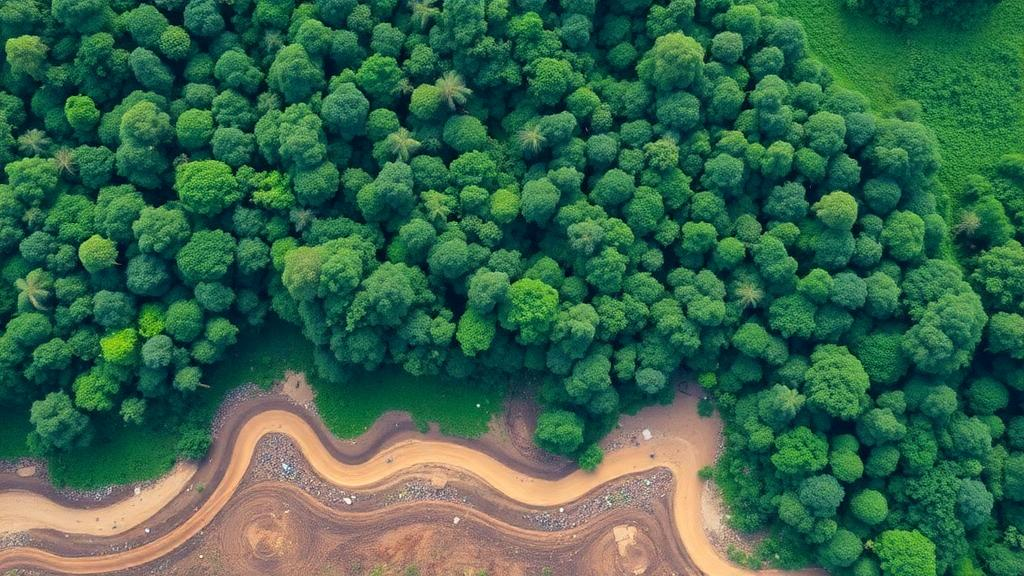
The race to harness hydroelectric power in rural Malaysia is transforming some of the country’s most biologically rich landscapes, and a new 24-month field study from the Nenggiri hydroelectric dam catchment in Kelantan offers one of the most detailed pictures yet of what happens to bird communities while the bulldozers are still working. Researchers surveyed six sites spanning recently disturbed forests, agricultural-forest patches and mosaic habitats fragmented by logging roads and land clearing, and their findings carry a surprise with real conservation weight: the remnant forest patches woven into agricultural land, not the larger but heavily degraded forest blocks, held the greatest bird diversity of all.
The Nenggiri dam, currently under construction in Gua Musang District in central-eastern Peninsular Malaysia, is part of a broader national push to bring reliable electricity to rural areas while generating renewable energy and reducing flood risk. Yet dam projects trigger a cascade of environmental changes long before any reservoir fills. Logging road networks, construction zones, worker settlements and vast cleared areas designated for inundation fragment and isolate the habitats that remain, obstructing feeding and breeding grounds and interfering with the dispersal of vertebrate populations across the landscape. Habitat loss alters competitive and predator-prey dynamics in ways that typically favour generalist species, potentially undermining the long-term stability of natural communities.
Birds are particularly sensitive sentinels of these changes. Many avian species respond to anthropogenic disturbance with immediate declines in abundance and species richness, making them reliable indicators of forest habitat quality and important players in maintaining ecological balance. Despite this, most Malaysian dam projects that emphasise sustainability in wildlife monitoring have lacked studies conducted during the actual development phase, and detailed assessments of bird communities within areas designated for hydroelectric construction have been especially scarce. The new research set out to fill that gap by comparing species richness and abundance across habitat types, assessing variation in species composition, and identifying species of conservation concern vulnerable to disturbance.
The study area encompassed a heterogeneous tropical rainforest landscape ranging from pristine and recently disturbed forest to agricultural-forestry patches, oil palm and rubber plantations, orchards, human settlements and barren land. Recently disturbed forest sites had been fragmented by dam-related development beginning around mid-2022, with deforestation and logging reducing forest size and creating pronounced edge effects. Agricultural-forest patches represented a buffer transition between natural forest and adjacent oil palm plantations, retaining native tree species characteristic of the original ecosystem. Mosaic habitats mixed natural forest with rubber, durian and cocoa cultivation. Site selection was guided by dominant tree composition, drone imagery, land-use maps and digitised 2024 Landsat imagery, with all sampling sites located within a five-kilometre radius of logging zones and construction sites.
Fieldwork combined two complementary survey techniques from July 2022 to July 2024, covering both the dry and wet seasons typical of Malaysia’s tropical rainforest climate. Point counts recorded all birds detected visually or aurally at five stations per site, spaced 200 metres apart, with 20-minute counts conducted between 0700 and 1000 hours and 1600 to 1900 hours to coincide with peak activity. Mist-netting deployed ten nets per site from 0700 to 1900 hours over five consecutive days per session, with captured birds fitted with numbered aluminium rings to prevent double counting, photographed and released unharmed. The total mist-netting effort amounted to 3,600 net-hours, and observations were made using binoculars with species identifications following established regional taxonomy.
The results were striking. Across the study area, researchers logged 727 bird observations representing 120 species and 40 families. Agricultural-forest patches proved the most species-rich habitat, hosting 78 species, or 39 percent of the total, followed by recently disturbed forests with 65 species and mosaic habitats with 57. Recently disturbed forests held the highest abundance at 279 individuals, but fewer species, and their diversity estimates indicated a community increasingly dominated by a handful of species. The Chao 1 richness estimator, which accounts for undetected species, suggested even greater richness lurking in agricultural-forest patches at an estimated 144 species, compared with 132 in recently disturbed forests and just 84 in mosaics. Bulbuls of the family Pycnonotidae and flycatchers of the family Muscicapidae each contributed 12 species, while the most abundant mist-netted species included the Little Spiderhunter, Asian Emerald Dove and Yellow-bellied Bulbul.
The statistical analysis confirmed these patterns were not chance artefacts. Pearson’s Chi-squared test revealed significant differences in bird species diversity among the three habitats, and pairwise Bonferroni analysis showed agricultural-forest patches differed significantly from mosaic habitats. Hill numbers analysis, a family of diversity metrics distinguished by an order parameter q, showed agricultural-forest patches had the highest estimated diversity at all scales, from raw species richness at q = 0 through Shannon diversity at q = 1 to Simpson diversity at q = 2, indicating a balanced distribution of bird populations. Non-metric multidimensional scaling with the Bray-Curtis index further showed that species composition varied significantly among observation points, with agricultural-forest patches appearing more distinct from the other two habitats, which resembled each other more closely.
Perhaps the most consequential finding concerns forest-dependent birds, which accounted for 75 percent of total species richness. Agricultural-forest patches supported the highest number of forest-dependent species at 62, compared with 42 each in recently disturbed forests and mosaic habitats. Among the recorded species, the Greater Green Leafbird was categorised as Endangered on the IUCN Red List, while five species were listed as Vulnerable: the Brown-chested Jungle Flycatcher, Grey-cheeked Bulbul, Javan Myna, Rhinoceros Hornbill and Wreathed Hornbill. Another 18 species were Near Threatened. Key forest-dependent species such as the Rhinoceros Hornbill, Bushy-crested Hornbill and Greater Green Leafbird were predominantly associated with forested areas, and these species are highly sensitive to habitat fragmentation and degradation, serving as reliable indicators of primary forest integrity.
Feeding-guild patterns added another layer of interpretation. Omnivorous birds dominated agricultural-forest patches and recently disturbed forests, contributing over 40 percent of the community in each, reflecting how these habitats support generalist species capable of exploiting a wide range of food resources, including seeds, fruits, insects and human-provided food. In contrast, insectivorous birds formed the largest proportion in mosaic habitats, comprising more than 50 percent of the community, a pattern the researchers suggest may reflect suboptimal or sink habitats that temporarily support populations whose long-term persistence depends on connectivity with surrounding forests. Invasive mynas such as the Javan Myna and Common Myna were recorded within the study area, well-known opportunistic omnivores that exploit human food waste.
The implications for conservation planning are clear. The remaining forest within dam development zones potentially serves as refugia for many bird species, providing essential shelter and resources, making it vital to avoid large-scale clearing. The periphery of forest patches along the dam construction gradient is dominated by a mixture of native tree species and appears to provide suitable refuge habitat during development. The researchers emphasise that planning conservation and rescue efforts before initiating developmental activities near the hydroelectric dam area is critical, with priority based on species richness and endangered species. Sustainable plantation management should include the retention and restoration of forest patches and natural habitats, and conservation efforts should focus on enhancing habitat quality and connectivity to mitigate fragmentation effects while engaging all relevant stakeholders and local communities. The study acknowledges limitations, including only two sites per habitat type due to accessibility constraints during logging and construction, but its baseline data offer a rare window into community-level responses during the active development phase, when most biodiversity assessments in human-modified landscapes are conspicuously absent.
Subject of Research: Ecology and Conservation Biology
Article Title: Forest patches as important bird habitats in Malaysia's large-scale infrastructure development areas
Article References: Nordin, N., Khiruddin, F. Z., Ismail, N. A., Daud, U. N. S., Ali, N. B. M., Shuhaily, S. H. J., Shah, A. K. M. K., Shukor, A., Md Nor, S., & Mansor, M. S. (2025). Forest patches as important bird habitats in Malaysia's large-scale infrastructure development areas. Nature Conservation, 60, 177-194. https://doi.org/10.3897/natureconservation.60.167763
Image Credits: AI Generated
DOI: 10.3897/natureconservation.60.167763
Keywords: Malaysia, bird diversity, hydroelectric dam, habitat fragmentation, forest patches, Nenggiri, tropical rainforest, IUCN Red List, conservation, biodiversity, Forest, patches
Cite Scienmag News
Violet Maxwell. (October 19, 2026). Forest Patches Emerge as Vital Bird Refuges in Malaysia’s Dam Construction Zones. Scienmag. https://scienmag.com/forest-patches-emerge-as-vital-bird-refuges-in-malaysias-dam-construction-zones/
Violet Maxwell. "Forest Patches Emerge as Vital Bird Refuges in Malaysia’s Dam Construction Zones." Scienmag, 19 October 2026, https://scienmag.com/forest-patches-emerge-as-vital-bird-refuges-in-malaysias-dam-construction-zones/. Accessed 19 October 2026.
Violet Maxwell. "Forest Patches Emerge as Vital Bird Refuges in Malaysia’s Dam Construction Zones." Scienmag. October 19, 2026. https://scienmag.com/forest-patches-emerge-as-vital-bird-refuges-in-malaysias-dam-construction-zones/


