


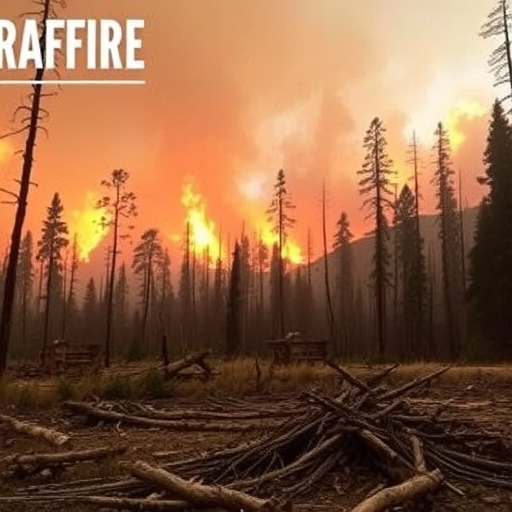
In recent years, wildfire activity in the Western United States has surged with unprecedented intensity and frequency, inflicting devastating economic, environmental, and public health damages. As climate change accelerates and human development expands into fire-prone landscapes, addressing wildfire risks has become a critical priority. A groundbreaking comprehensive study spearheaded by Frederik Strabo and colleagues sheds new light on the efficacy and cost-benefit of forest fuel-reduction treatments conducted by the U.S. Forest Service (USFS), providing robust empirical evidence supporting their vital role in mitigating wildfire impacts.
Wildfires have long been a natural and integral component of many ecosystems, shaped historically by frequent, low-intensity fires that maintained resilient landscapes and controlled vegetation buildup. Indigenous land stewardship practices often incorporated deliberate burns, effectively managing fuel loads and fostering ecological balance. However, modern fire suppression policies implemented over the past century have disrupted these processes, causing combustible vegetation to accumulate unchecked and significantly elevating the risk of high-intensity, uncontrollable wildfires. This fuel load buildup, compounded by drought and warming temperatures, has intensified wildfire behavior across millions of acres.
Fuel-reduction treatments, such as prescribed burning and mechanical thinning, aim to restore this historical balance by reducing the amount and continuity of vegetation that sustains wildfires. Despite their recognized ecological and protective benefits, these interventions have remained underutilized, partly because their long-term advantages are challenging to quantify in economic terms. Moreover, the complex and stochastic nature of wildfire dynamics has hampered attempts to gauge the net efficacy of such measures across spatial and temporal scales.
To overcome these challenges, Strabo and his research team leveraged an unprecedented high-resolution dataset comprising 285 wildfire events intersecting with USFS fuel-reduction activities in 11 Western states between 2017 and 2023. Employing advanced modeling techniques, they simulated counterfactual wildfire scenarios assuming no pre-fire treatments occurred. This approach allowed them to isolate and quantify the spatial extent and intensity of wildfires attributable to untreated fuel loads, thereby estimating avoided damages attributable to USFS interventions with unprecedented precision.
The study’s findings reveal that fuel treatments markedly diminish wildfire severity and spread. By physically reducing the volume and continuity of combustible biomass, treated landscapes experienced less intense flame fronts and lower rates of fire spread, conditions which are more amenable to direct suppression efforts by firefighting crews. Quantitatively, treated areas burned 36% less compared to untreated counterfactual scenarios over the six-year study period, underscoring the substantial protective capacity of targeted fuel management.
Crucially, the analysis extended beyond ecological metrics to incorporate a rigorous economic valuation of damage avoidance. Mapping fire impacts onto property values, public health indices related to air quality, and carbon emissions, the researchers estimated total damages prevented by USFS fuel treatments to be between $2.7 billion and $2.8 billion across the study region. This encompasses a broad spectrum of loss categories, reflecting the multifaceted consequences of wildfire disasters on society and ecosystems.
In terms of economic efficiency, the research substantiates that every dollar invested in fuel treatment yields more than three dollars in avoided damages. Remarkably, some projects demonstrated even higher rates of return on investment, suggesting that optimizing spatial targeting and treatment intensity could magnify these cost savings further. These findings provide a compelling fiscal argument for scaling up fuel-reduction programs, positioning them not only as ecological necessities but also as prudent economic strategies.
The results carry profound implications for wildfire management policy. While scientific consensus around the benefits of fuel treatments has grown, implementation has lagged due to institutional inertia, regulatory complexities, and political controversy surrounding practices like prescribed burning. Strabo et al. emphasize that realizing the full potential of these strategies demands bold policy reform that incentivizes and streamlines fuel-management interventions, integrates Indigenous stewardship principles, and fosters collaborative governance among federal, state, and tribal agencies.
Furthermore, this study challenges narratives that frame wildfire solely as a factor of climate change or fire suppression, highlighting fuel accumulation as an actionable lever to reduce catastrophic fire risk. By quantifying avoided damages at a granular level and articulating clear economic returns, it equips decision-makers with evidence-based tools to justify funding and promote proactive wildfire mitigation before fire seasons escalate into disasters.
From a broader scientific perspective, the methodology pioneered by Strabo and colleagues establishes a model for integrating observational fire data, advanced fire behavior modeling, and socioeconomic valuation. Such interdisciplinary approaches are essential for crafting adaptive natural resource policies that balance ecological resilience, community protection, and economic sustainability in an era of increasing climate volatility.
Looking ahead, scaling fuel treatments across the Western United States will entail overcoming logistical constraints, securing sustained funding, and addressing public concerns such as smoke impacts and ecosystem disturbance. Nevertheless, the demonstrated efficacy and cost-effectiveness underscore these interventions as cornerstone strategies for mitigating wildfire risks and safeguarding vulnerable landscapes and communities.
In sum, the research led by Strabo et al. represents a pivotal advancement in wildfire science and policy discourse. By empirically validating the triple-fold economic benefits of U.S. Forest Service fuel-reduction treatments and elucidating when and where such treatments deliver maximum impact, it paves the way for informed investments that can avert billions in damages, reduce carbon emissions, and protect public health. As wildfire seasons grow longer and more destructive, these findings offer both hope and a clear mandate for proactive, science-driven action.
News Publication Date: 7-May-2026
Web References: 10.1126/science.aea6463
Cite Scienmag News
Courtney Benton. (May 7, 2026). Forest Fuel Treatments Slash Wildfire Risk and Costs, Study Finds. Scienmag. https://scienmag.com/forest-fuel-treatments-slash-wildfire-risk-and-costs-study-finds/
Courtney Benton. "Forest Fuel Treatments Slash Wildfire Risk and Costs, Study Finds." Scienmag, 7 May 2026, https://scienmag.com/forest-fuel-treatments-slash-wildfire-risk-and-costs-study-finds/. Accessed 3 September 2026.
Courtney Benton. "Forest Fuel Treatments Slash Wildfire Risk and Costs, Study Finds." Scienmag. May 7, 2026. https://scienmag.com/forest-fuel-treatments-slash-wildfire-risk-and-costs-study-finds/


