

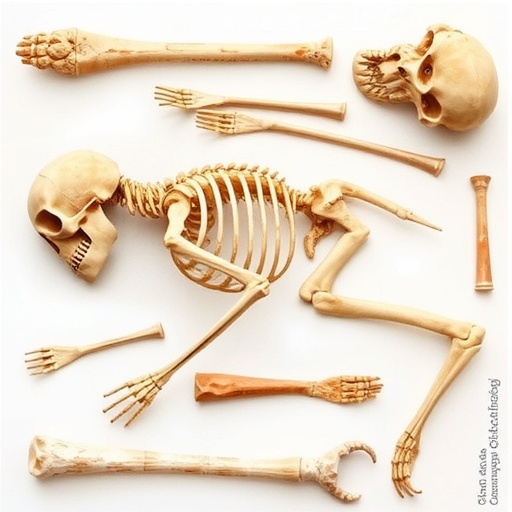
In the ever-evolving field of forensic science, understanding the transformation of human remains over time is paramount. A groundbreaking study recently published in the International Journal of Legal Medicine sheds new light on forensic taphonomy, a discipline dedicated to deciphering postmortem processes and their effects on skeletal integrity. This study, emerging from the 21st-century identified skeletal collection housed in Coimbra, Portugal, provides fresh insights that could revolutionize forensic investigations globally.
At the core of this pioneering research lies forensic taphonomy—the science that investigates the myriad physical, chemical, and biological changes that human remains undergo after death. These changes can profoundly affect how skeletal elements are preserved, altered, or degraded, influencing the interpretation of forensic and archaeological findings alike. The Coimbra skeletal collection, renowned for its rigorously documented human remains, serves as an unparalleled resource for studying these postmortem alterations in a controlled and documented environment.
What makes this study particularly compelling is its focus on skeletal integrity within a modern, historically documented collection. By leveraging detailed records alongside advanced forensic methodologies, the researchers were able to intricately map how various taphonomic agents affect bones over time. This dual approach enables both a quantitative and qualitative understanding of skeletal preservation, bridging gaps between forensic science and anthropology.
One of the pivotal revelations of the study concerns the differential impact of environmental factors such as soil composition, moisture levels, and microbial activity. These variables exhibit highly complex interactions with skeletal materials, influencing degradation rates and patterns. Contrary to previous generalized assumptions, the research identifies nuanced variations that depend heavily on microenvironmental contexts, suggesting that forensic interpretations must incorporate localized environmental data for increased accuracy.
Furthermore, the team utilized cutting-edge imaging techniques and biomechanical testing to assess the structural integrity of bones subjected to varying taphonomic processes. These technological advancements permitted an unprecedented visualization of microfractures, surface erosions, and other morphological alterations, which are often imperceptible through traditional examination methods. Such meticulous analysis aids in distinguishing postmortem damage from antemortem trauma, a critical differentiation in forensic casework.
Crucially, the study also addresses the temporal dynamics of decomposition and skeletal alteration, offering a refined timeline of taphonomic changes. By examining remains with known postmortem intervals, the researchers constructed a detailed chronology of degradation phases. This temporal framework holds immense potential for pinpointing time since death with higher precision, enhancing the accuracy of forensic timelines in criminal investigations.
Moreover, the integration of modern molecular techniques enabled the characterization of microbial communities responsible for bone degradation. Understanding these biotic agents introduces a new dimension to forensic taphonomy, revealing how specific microbial assemblages correlate with varied decomposition pathways and patterns of skeletal preservation. This insight opens avenues for microbial forensic applications, enriching the toolkit available for postmortem interval estimation and environmental context interpretation.
The paper also delves into the forensic implications of skeletal fragmentation and displacement resulting from natural and anthropogenic forces. By analyzing patterns of bone dispersal and breakage, the study informs reconstruction efforts vital for victim identification and trauma analysis. Recognizing distinct fragmentation signatures enhances the ability to interpret postmortem disturbances, whether from scavengers, mechanical impact, or environmental shifts.
Importantly, the researchers highlight the significance of comprehensive databases like the Coimbra collection in advancing forensic taphonomy. Such repositories, with well-documented life histories and postmortem contexts, provide invaluable baselines for comparative studies. The detailed demographic, pathological, and contextual information accompanying these skeletal remains adds depth to interpretations, allowing for multifaceted analyses that surpass traditional bone examination.
Beyond forensic science, the findings bear relevance for archaeological practice, especially in understanding the preservation biases affecting human remains over centuries and millennia. Interpreting skeletal assemblages with an informed taphonomic perspective mitigates misrepresentations of past populations and behaviors, enhancing the fidelity of archaeological reconstructions.
From an applied perspective, the enhanced knowledge of skeletal integrity and degradation processes promises to improve forensic case outcomes. By refining protocols for evidence recovery, preservation, and analysis, this research contributes to more robust and reliable forensic conclusions. Enhanced interpretation of skeletal evidence directly supports judicial proceedings, aiding the pursuit of justice.
Reflecting on the broader scientific landscape, this study exemplifies the power of interdisciplinary collaboration—melding expertise from forensic pathology, anthropology, microbiology, and materials science. Such synergy drives innovation and fosters deeper comprehension of complex postmortem phenomena that single disciplines might overlook.
Furthermore, the meticulous methodological approach adopted by the authors establishes new benchmarks for future forensic taphonomic research. Their integration of experimental, observational, and analytical techniques creates a template for rigor and reproducibility, qualities essential for the scientific community’s advancement.
Ultimately, the work emerging from Coimbra stands as a testament to the enduring value of skeletal collections in forensic science. It underscores how contemporary research can breathe new life into historical specimens, transforming them into dynamic resources that illuminate the past and solve present-day forensic challenges.
For forensic professionals and researchers worldwide, these insights offer a transformative perspective on skeletal integrity and postmortem change. As forensic taphonomy continues to evolve, studies like this pave the way for more precise, scientifically grounded interpretations of human remains, enhancing both investigative accuracy and cultural understanding.
This landmark study not only deepens our comprehension of how human remains interact with their environment after death but also exemplifies the potential of forensic science to innovate through the convergence of traditional collections and modern technology. The information unveiled here promises to ripple across forensic pathology, archaeology, and allied disciplines for years to come.
Subject of Research: Forensic taphonomy and the effects of postmortem processes on skeletal integrity using an identified 21st-century skeletal collection.
Article Title: Forensic taphonomy and skeletal integrity: insights from the 21 st century identified skeletal collection, Coimbra, Portugal.
Article References:
Cabral, D., Matos, V.M.J. & Ferreira, M.T. Forensic taphonomy and skeletal integrity: insights from the 21 st century identified skeletal collection, Coimbra, Portugal. Int J Legal Med (2025). https://doi.org/10.1007/s00414-025-03676-y
Image Credits: AI Generated


