


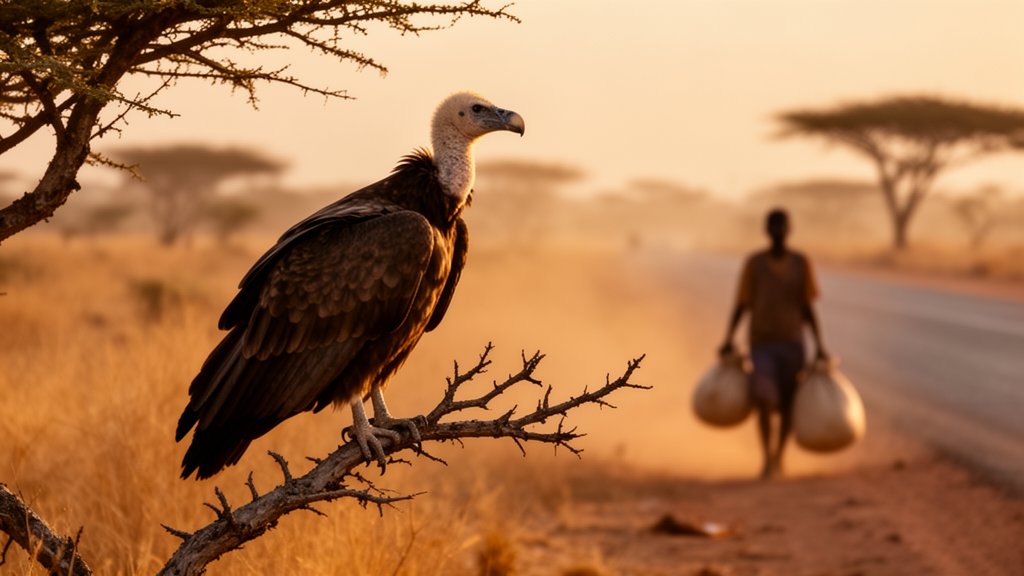
Vultures are nature’s sanitation service. By rapidly stripping animal carcasses down to bone, these obligate scavengers suppress populations of feral dogs and rats, limit the spread of zoonotic diseases, and keep rotting waste out of communities whose sanitation systems are already strained. Across Africa, however, this ecological service is collapsing. Many African vulture species have suffered steep population declines and now stand in imminent danger of global extinction, driven by habitat loss, food shortages, energy infrastructure, accidental poisoning, and deliberate persecution. Now, the first systematic survey of critically endangered vultures in Chad’s capital has produced a stark snapshot: only about 113 hooded vultures remain at the urban sites that once reliably hosted them, and more than half of the surveyed locations appear to have lost their vultures entirely.
The study, published in Frontiers in Bird Science, focused on the hooded vulture (Necrosyrtes monachus), a small, critically endangered scavenger classified on the IUCN Red List due to rapid population declines. Unlike most vultures, the hooded vulture has a long history as a human commensal, thriving around slaughterhouses, markets, and waste sites where it feeds on human-produced refuse. Researchers from the International Bird Conservation Partnership and partner institutions surveyed 11 sites in and around N’Djamena, Chad’s capital and largest city, including 10 slaughterhouses and one chicken carcass dumpsite, between August 2024 and January 2025. The sites ranged from the Farcha refrigerated slaughterhouse, the largest and first state-run facility in the city, processing up to 250 cattle daily, to small rural slaughterhouses in surrounding towns such as Dourbali, Mandelia, Kournari, and Koundoul.
The survey results were sobering. Of the 11 sites visited, six, or 55 percent, did not appear to host any vultures at the time of the visits. The remaining five sites held between two and 33 individuals each. Using a single-season N-mixture model with a Poisson mixture, implemented in the unmarked R package, the team estimated a total population of approximately 113 hooded vultures across all sites where the birds were detected, with site-level estimates ranging from 1 to 49 birds. The baseline expected abundance at mean covariate values was 2.8 birds per site. Detection probability per visit was approximately 0.39, reflecting moderate detectability. Notably, the hooded vulture was the only critically endangered vulture species observed; no evidence of white-backed, white-headed, Rüppell’s, or lappet-faced vultures was found anywhere in the study area.
The statistical modeling revealed unexpected patterns in what drives vulture abundance in this urban landscape. The team included site covariates derived from satellite data: topographic roughness and flow direction from a digital elevation model, the Normalized Difference Vegetation Index (NDVI) calculated from MODIS imagery as a proxy for landscape productivity, and human population density from the Gridded Population of the World dataset as a proxy for anthropogenic pressure. Hooded vulture abundance showed a strong positive association with vegetation greenness (β=0.421 ± 0.156, p=0.007) and flow direction (β=0.574 ± 0.171, p<0.001), suggesting that large trees near slaughterhouses provide crucial roosting and nesting sites. In contrast, human population density showed a strong negative association (β=−1.387 ± 0.441, p=0.0016). Surprisingly, vulture abundance did not correlate directly with food availability. The slaughterhouse ranked first for daily slaughter totals, Farcha, hosted no vultures, while the highest counts came from Dourbali, ranked second. Lower abundance at more densely populated sites may instead reflect disturbance and persecution.
To understand the human dimension of the crisis, the researchers conducted 93 semi-structured interviews with butchers, slaughterhouse managers and workers, herders, farmers, traditional healers, and government officials. Respondents reported familiarity with five endangered or critically endangered vulture species: the hooded vulture (55 percent), white-headed vulture (25 percent), lappet-faced vulture (15 percent), Rüppell’s vulture (4 percent), and white-backed vulture (1 percent). Encouragingly, 89 percent recognized that vultures and other birds are protected by law in Chad, 97 percent expressed a belief in the importance of protecting vultures, and 70 percent affirmed that vultures are beneficial to people.
Yet the interviews also exposed a dangerous gap between awareness and perception. Nearly half of respondents, 47 percent, reported knowledge of recent vulture poisoning incidents in their vicinity, and 15 percent were aware of poisoning events occurring at their own slaughterhouse. Strikingly, however, fewer than 1 percent considered poisoning among the key threats to vultures, and only 5 percent perceived that vulture populations have decreased in recent years. Respondents instead pointed to food scarcity (48 percent) and habitat loss from deforestation and urban expansion (44 percent) as the major causes of decline. This discrepancy may reflect the fact that the culture of ritual animal sacrifice prevalent in West African vodun and related practices appears largely absent in Chad, leaving residents aware of poisoning events but not connecting them to persecution for belief-based use.
The most alarming finding concerns cross-border trafficking. Over a third of interview respondents, 37 percent, stated that foreign poachers from countries including Nigeria, Niger, Benin, and Cameroon trap and kill vultures in Chad, reportedly using poison, including at slaughterhouses in Farcha, Dourbali, Gueli, and Mandalia, and reportedly with the complicity of certain butchers. This information was independently confirmed by five officials from the Ministry of Livestock and two from the Department of Wildlife and Protected Areas. In West Africa, vultures command some of the highest prices in a lucrative, burgeoning wildlife trade for belief-based use, in which vulture parts are sold for charms, fetishes, or ritual treatments promising protection from evil, business success, or healing. Traders at voodoo markets in Benin have reported sourcing vultures from at least 10 foreign countries, including Chad.
The pattern fits a grim regional precedent. In Nigeria, slaughterhouse workers have witnessed large numbers of hooded vultures, once frequent visitors, being killed or injured for traditional medicine, leading to the birds’ complete disappearance. In Ghana’s capital Accra, hooded vultures have precipitously declined and disappeared as a direct consequence of persecution for illegal trade, reportedly for export to Nigeria. In Togo, hooded vultures have been extirpated at multiple sites, including the Badou slaughterhouse where they once numbered 60 or more, reportedly because poachers used fishhooks embedded in bait meat to trap and remove them all. Raptor surveys in Burkina Faso, Mali, and Niger revealed 98 percent declines of large vultures outside protected areas, while hooded vulture populations remained stable in national parks.
The findings position N’Djamena as both a potential refuge and a point of vulnerability where multiple threats converge. The persistence of even small vulture numbers at some urban sites suggests that with appropriate management, urban areas can play a crucial role in species conservation. The positive correlation between vulture abundance and vegetation greenness points to concrete conservation actions: protecting and restoring urban green spaces and mature trees that provide roosting and nesting habitat. In Senegal, seven vulture species have been identified near the Great Green Wall reforestation project, the only area in the country where more than two vulture species may be observed, demonstrating the potential of habitat restoration. At the same time, improved sanitation linked to modern closed slaughterhouses may reduce food availability and displace urban vulture populations, as documented in Accra, so waste management planning must account for scavenger needs.
The researchers recommend ongoing monitoring, additional surveys across Chad and other understudied regions of Africa, and deeper investigations of wildlife trade markets and networks for which vultures are persecuted across borders. Community-based education emphasizing the ecological role of vultures in public health and environmental services could help build local support for protection and reduce persecution. Stronger enforcement and monitoring of illegal trade are needed to disrupt black market networks, particularly as mounting evidence shows that those involved in the illegal vulture trade may source birds across great distances. Protecting vulture populations in Chad, and throughout West and Central Africa, the authors conclude, demands urgent, informed, and coordinated international action, integrating wildlife ecology, human dimensions, law enforcement, public health, cultural knowledge, and cross-border collaboration before these birds vanish from yet another African skyline.
Subject of Research: Conservation Biology
Article Title: Abundance, distribution, and conservation status of critically endangered vultures in N’Djamena and environs, Chad, Central Africa
Article References: Djekadjim, D., Di Lecce, I., Chaffra, A. S., Ellis, E., Goodman, D. D. L., Soultan, A., & Arcilla, N. (2026). Abundance, distribution, and conservation status of critically endangered vultures in N’Djamena and environs, Chad, Central Africa. Frontiers in Bird Science, 5, Article 1726840. https://doi.org/10.3389/fbirs.2026.1726840
Image Credits: AI Generated
DOI: 10.3389/fbirs.2026.1726840
Keywords: vultures, hooded vulture, Chad, N'Djamena, illegal wildlife trade, belief-based use, poaching, critically endangered, conservation, Africa, Abundance, distribution
Cite Scienmag News
Margaret Porter. (October 17, 2026). Foreign Poachers Target Critically Endangered Vultures in Chad’s Capital, First Survey Reveals. Scienmag. https://scienmag.com/foreign-poachers-target-critically-endangered-vultures-in-chads-capital-first-survey-reveals/
Margaret Porter. "Foreign Poachers Target Critically Endangered Vultures in Chad’s Capital, First Survey Reveals." Scienmag, 17 October 2026, https://scienmag.com/foreign-poachers-target-critically-endangered-vultures-in-chads-capital-first-survey-reveals/. Accessed 17 October 2026.
Margaret Porter. "Foreign Poachers Target Critically Endangered Vultures in Chad’s Capital, First Survey Reveals." Scienmag. October 17, 2026. https://scienmag.com/foreign-poachers-target-critically-endangered-vultures-in-chads-capital-first-survey-reveals/


