


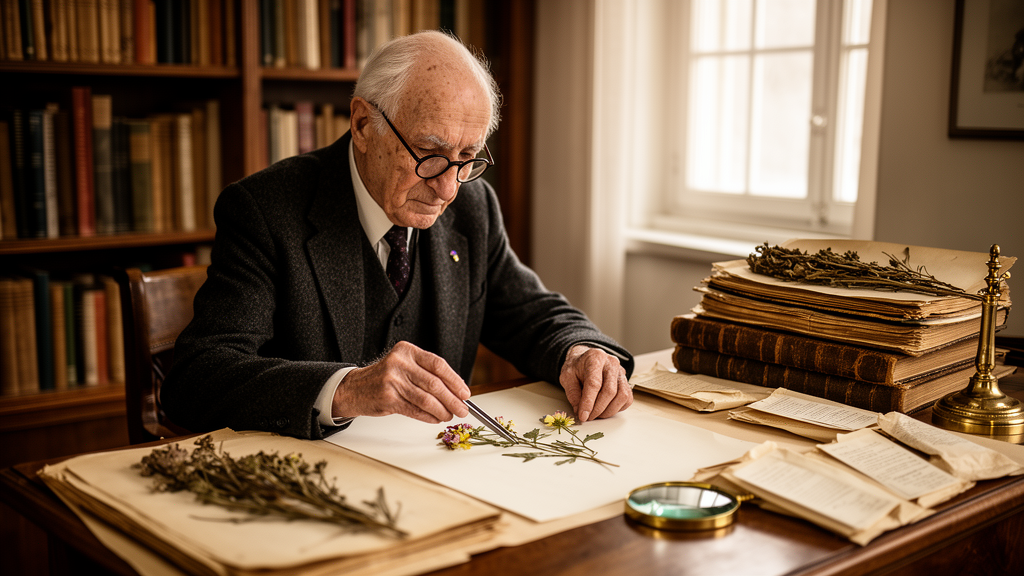
Anton Seiller (1863–1929) was an Eastern Austrian plant collector whose herbarium is well represented in the collections of the Natural History Museum Vienna (herbarium acronym W). His specimens are well prepared and easily recognizable at first glance, labelled in characteristic red ink in a rounded handwriting. Unfortunately, they are signed only with the family name, and more details were missed when the herbarium was acquired. Seiller apparently never published himself, as was common among many plant collectors and amateur botanists of his time. Therefore, his biographic details and even his full name remained enigmatic, although his herbarium is of considerable regional importance for the study of the historical flora of Vienna and Lower Austria.
To date, 1013 specimens of Seiller have been recorded in the herbarium database at W (accessed 2024-06), which probably represents only part of the total material still hidden in the collections. The specimens were collected between March 1910 and August 1928 in the federal states of Vienna (440), Lower Austria (504) and Styria (69). Most of the specimens were collected in the Vienna Woods and in the western suburbs of Vienna, and many more along the Thermenlinie south to Baden. With 309 specimens, the largest fraction was collected in the present-day cadastral community of Ober-St.-Veit in the district of Hietzing.
Based on the stamped accession numbers, the known Seiller specimens were acquisitioned between 1929 and 2019. According to the acquisition journal, the herbarium of Seiller was donated to the herbarium W in 1929 and incorporated into the collections. The journal, however, only counts 350 specimens. These bear the accession numbers 1929-0021221 to 1929-0021571 and are stamped “Herb. Seiller.” in the upper left corner (e.g. Cypripedium calceolus, W 0131727 = W 1929-0021297).
Additional specimens from Seiller were accessioned in 1950 and are part of a donation of 79 specimens with the accession numbers 1950-0016821 to 1950-0016899 (e.g. Dianthus alpinus, W 0103098 = 1950-0016867). The donation titled as “Varia” in the acquisition journal also includes material from other collectors. Further specimens from Seiller came to W via the herbarium of the Austrian botanist Georg Cufodontis (1896–1974), which was accessioned in 1968 (e.g. Orchis pallens, W 0211532 = W 1968-0007510). The remaining two thirds of Seiller’s specimens were found in 2015 and 2019 among unmounted and other materials on top of a shelf, and subsequently accessioned. As the two batches were not labelled, their provenance remains unclear, but they were most probably part of the original donation of 1929 and not immediately accessioned due to staff shortages. Duplicates from these specimens were sent on exchange and are now in other herbaria such as in Berlin (B), Madrid (MA) or even New York (NY).
The specimens of Seiller’s herbarium were originally mounted on non-standardized paper measuring 230 × 350 mm, and the collection information was written directly on the mounting paper in the lower right corner. In addition, family and species numbers were indicated in the upper left and upper right corners of the sheet using an unknown classification system (e.g. Orchis pallens, W 0211532). While the specimens accessioned in 1950 and 1968 are still preserved in their original state, other accessions have been remounted on standard herbarium format paper. In the case of the remounted specimens, the collection details written on the mounting paper were cut out and used as labels (e.g. Orchis pallens, W 0222213 = W 2019-0004877).
A peculiarity of Seiller’s herbarium is that the duplicates of a particular collection were regularly labelled with synonyms of the original specimens. Since such duplicates were regularly sent for exchange during the preparation of the material in W, the original situation can only be seen in a few cases in which duplicates were retained. An example are two specimens of Orchis pallens collected in April 1916 near Kalksburg (“Laubwald bei Kalksburg, NÖ”): One duplicate was labelled as Orchis pallens (W 0211532), the other with the synonymous name Orchis sulphurea (W 0222213).
The regional focus of the collections indicates that Seiller lived in Vienna, probably in or around Ober-St.-Veit. During the period in which he collected his specimens, many Austrian botanists, both amateurs and professionals, were organized in the Zoological-Botanical Society in Vienna (Zoologisch-Botanische Gesellschaft in Wien), and its proceedings (Verhandlungen der Zoologisch-Botanischen Gesellschaft in Wien) became an important outlet for publishing on the local flora. Indeed, their archives show that an amateur botanist named Anton Seiller was a member of the society between 1913 and 1929. He even acted as collection manager (“Sammlungsbetreuer”) of the society’s large herbarium, which was dissolved in 1922 in the economically difficult post-war period. After his death in 1929, he even bequeathed 200 schillings to the society.
In small advertisements in the preface to several issues of volumes 70 and 71 of the society’s proceedings, Anton Seiller offered his private herbarium for sale. The herbarium was reported as being arranged according to Schlechtendal’s Flora von Deutschland, 5th edition (Hallier 1880–1888) and comprised 4,600 specimens of 1,200 species from Styria and Lower Austria. At that time the federal state of Vienna was still included in Lower Austria and is therefore not listed separately. In issues 1–2 (June 1920) the herbarium was offered for 10,000 crowns, in issues 6–8 (July 1921) and 9–10 (September 1921) for 30,000 crowns, and in volume 71, issues 1–10 (May 1922) for 500,000 crowns, showcasing the hyperinflation and the associated economic problems in Austria at that time.
Anton Seiller’s address is given in the advertisements from 1920–1922 as “Wien, XIII/7, Geylinggasse 11, Tür 5.” in Ober-St.-Veit in Vienna. Furthermore, historical Viennese address books (Lehmann 1894–1929) give his addresses as Wiedner Hauptstraße 37, 1040 Vienna (1896–1907), Kasernengasse 6 (now Otto-Bauer-Gasse), 1060 Vienna (1908–1911), and, finally, Geylinggasse 11, 1130 Vienna (1912–1924). From 1925 onwards, he is no longer listed in the address books. Instead, another Anton Seiler [sic!], a police inspector who was probably the son of Anton Seiller, lived at the same address until 1933.
Anton Seiller’s last known address allows to locate the corresponding church register in the Ober St. Veit parish church, where the death register (03-11, fol. 415) helped to establish basic biographical details: Anton Seiller, Roman Catholic, divorced, was born in Trieste (Italy) on November 27, 1863, worked as a private civil servant (“Privatbeamter”), and died of cancer at his home address Geylinggasse 11/5 on August 24, 1929 at the age of 66. According to Lehmann (1894–1929), he probably moved to Vienna around 1896, the year in which he was first recorded as a resident. From that year until 1919, he lived together with Vinzenzia Seiller, his alleged wife, from whom he later divorced.
Anton Seiller’s address corresponds well with the geographical focus of Seiller’s herbarium collections and suggests that both are actually the same person. The few specimens preserved in their original state provide a further proof, as the family and species numbers still present on these sheets correspond to those in Hallier’s Flora von Deutschland. For example, the specimen of Orchis pallens mentioned above is labelled “Fam. 19 No. 344”, and the numbers correspond to the treatment of the same species in Hallier (1880: 219–220, tab. 344). The above-mentioned Orchis sulphurea is also listed there as a synonym explaining the odd labelling of duplicates as a way of representing these in the collection.
Taken together, these facts prove that the herbarium of Seiller in W actually originates from the same Anton Seiller, who was a member of the Zoological-Botanical Society. This makes it possible to establish some basic biographical information about the collector and his considerable herbarium.
It has recently been emphasized that historical regional herbaria such as that of Anton Seiller are of great importance as sources of information on local changes in habitats and plant diversity as well as for nature conservation (Albani Rocchetti et al. 2021; Büttner et al. 2024). His collections at the Natural History Museum Vienna will contribute to studying the historical flora of eastern Austria and its changes, and have the potential to help inform and accelerate regional nature conservation measures. Committing himself to botany until the end of his life, as shown by bequeathing his herbarium to W, this would certainly have been in Anton Seiller’s interest.
Subject of Research: Anton Seiller (1863–1929), an Eastern Austrian plant collector and his herbarium
Article Title: Anton Seiller (1863–1929), an Eastern Austrian plant collector and his herbarium
Article References: Berger, A. (2025). Anton Seiller (1863–1929), an Eastern Austrian plant collector and his herbarium. Annals of the Natural History Museum Vienna, 126, 71-74. https://doi.org/10.3897/anhmw.168806
Image Credits: AI Generated
DOI: 10.3897/anhmw.168806
Keywords: Anton Seiller, herbarium, Natural History Museum Vienna, plant collector, historical flora, Vienna, Lower Austria, Zoological-Botanical Society in Vienna, nature conservation, Anton, Seiller, Eastern
Cite Scienmag News
Margaret Porter. (October 17, 2026). Anton Seiller (1863–1929), an Eastern Austrian plant collector and his herbarium. Scienmag. https://scienmag.com/anton-seiller-1863-1929-an-eastern-austrian-plant-collector-and-his-herbarium/
Margaret Porter. "Anton Seiller (1863–1929), an Eastern Austrian plant collector and his herbarium." Scienmag, 17 October 2026, https://scienmag.com/anton-seiller-1863-1929-an-eastern-austrian-plant-collector-and-his-herbarium/. Accessed 17 October 2026.
Margaret Porter. "Anton Seiller (1863–1929), an Eastern Austrian plant collector and his herbarium." Scienmag. October 17, 2026. https://scienmag.com/anton-seiller-1863-1929-an-eastern-austrian-plant-collector-and-his-herbarium/


