


April 3, 2024

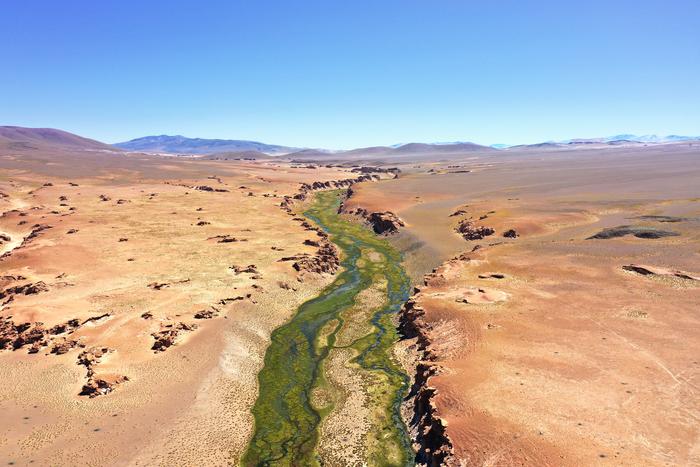
Credit: David Boutt
April 3, 2024
For Mining in Arid Regions to be Responsible, We Must Change How We Think About Water, Say UMass Amherst Researchers
In an unprecedented study of the South American “Lithium Triangle,” hydrologists discover that not all water responds the same way to environmental change and human use
AMHERST, Mass. – A research team led by the University of Massachusetts Amherst, in collaboration with the University of Alaska-Anchorage and Columbia University, has conducted the widest-ever hydrological tracer analysis of the Dry Andes region in Chile, Argentina and Bolivia, home to the majority of the world’s lithium deposits and other elements, such as copper, critical to the green energy transition away from oil and toward electricity. But the Dry Andes, as well as other hyper-arid regions, is also extremely sensitive to any activity, such a mining, that may disrupt the presence, composition and flow of both surface and subsurface water. Until now, however, there has been no reliable, comprehensive understanding of exactly how the hydrological systems in extremely arid landscapes work, which means that environmental regulators don’t have the information they need to best manage the mining industry and the transition to more environmentally sustainable future. The research appears in PLOS Water.
“We’ve been thinking about water all wrong,” says Brendan Moran, the paper’s lead author and a postdoctoral research associate in geosciences at UMass Amherst. “We typically assume that water is water, and manage all water the same way, but our research shows that there are actually two very distinct pieces of the water budget in the Dry Andes, and they respond very differently to environmental change and human usage.”
Water is especially important for lithium, the crucial component of the powerful batteries in such things as electric and hybrid cars and photovoltaic systems. Lithium doesn’t like to be in solid form and tends to occur in layers of volcanic ash— but it reacts quickly with water. When rain or snowmelt moves through the ash layers, lithium leaches into the groundwater, moving downhill until it settles in a flat basin where it remains in solution as a briny mix of water and lithium. Because this brine is very dense, it often settles beneath pockets of fresh surface water, which float on top of the lithium-rich fluid below. These fresh and brackish lagoons and wetlands often become havens for unique and fragile ecosystems and iconic species such as flamingos, and they are also composed of different kinds of water—so how does one tell types of water apart?
Moran and his co-authors, including David Boutt, professor of geosciences at UMass Amherst, a Lee Ann Munk, professor of geological sciences at the University of Alaska, had previously developed a method to determine how old any given sample of water is and trace its interaction with the landscape by using 3H, or tritium, and the ratio between the oxygen isotope 18O and the hydrogen isotope 2H. Tritium occurs naturally in rainwater and decays at a predictable rate. “This lets us get the relative age of the water,” says Moran. “Is it ‘old,’ as in, did it fall a century or more ago, or is it ‘contemporary’ water that fell a few weeks-to-years ago?”
The ratio between 18O and 2H additionally allowed the team to trace how much evaporation the water had been subject to. “The 18O/2H ratio is like a specific fingerprint, because different water sources—streams or lakes—will have different ratios. This lets us know where the water came from and how long it has been near the surface and out of the ground.”
For this new research, Moran and Boutt worked with stakeholders in the Dry Andes to sample nearly every water source in the entire region—an unprecedented feat, given how inhospitable and sparsely inhabited the Dry Andes are—and to measure their various isotopes.
“The deep, old groundwater sustains the hydrological system throughout the Dry Andes,” says Boutt. “Only 20% – 40% of the water is contemporary surface water—but that’s the water that is most sensitive to climate change, storm cycles and anthropogenic uses like mining. Scientists used to think that surface water was the most stable water because it was constantly being recharged by runoff, but in extremely arid places, like the Dry Andes, that isn’t true. And the problem is, this new understanding of how water works hasn’t been incorporated into any management system anywhere.”
The implications of this are immediate, and Moran says that among the most important is to protect the various conduits—streams, rivers, seeps etc.—by which fresh, young rainwater flows into the lagoons and wetlands that are so environmentally critical. It also means that managers need to develop different methods for managing young and old waters—there is no one-size-fits-all approach that will work.
Perhaps most importantly, Boutt points out, “What we see in the Dry Andes is representative of hydrology in all extremely arid regions—including the U.S. West. It’s not limited to lithium mining, either.”
“Water across the globe’s arid regions works the same way,” adds Moran, “and so water managers the world over need to be aware of the age and source of their waters and implement the right policies to protect their differing hydrological cycles.”
Contacts: Brendan Moran, bmoran@umass.edu
David Boutt, dboutt@umass.edu
Daegan Miller, drmiller@umass.edu
Journal
PLOS Water
Article Title
Contemporary and relic waters strongly decoupled in arid alpine environments
Article Publication Date
2-Apr-2024
Cite Scienmag News
Denise Maddox. (April 4, 2024). For mining in arid regions to be responsible, we must change how we think about water, say UMass Amherst researchers. Scienmag. https://scienmag.com/for-mining-in-arid-regions-to-be-responsible-we-must-change-how-we-think-about-water-say-umass-amherst-researchers/
Denise Maddox. "For mining in arid regions to be responsible, we must change how we think about water, say UMass Amherst researchers." Scienmag, 4 April 2024, https://scienmag.com/for-mining-in-arid-regions-to-be-responsible-we-must-change-how-we-think-about-water-say-umass-amherst-researchers/. Accessed 3 September 2026.
Denise Maddox. "For mining in arid regions to be responsible, we must change how we think about water, say UMass Amherst researchers." Scienmag. April 4, 2024. https://scienmag.com/for-mining-in-arid-regions-to-be-responsible-we-must-change-how-we-think-about-water-say-umass-amherst-researchers/

