


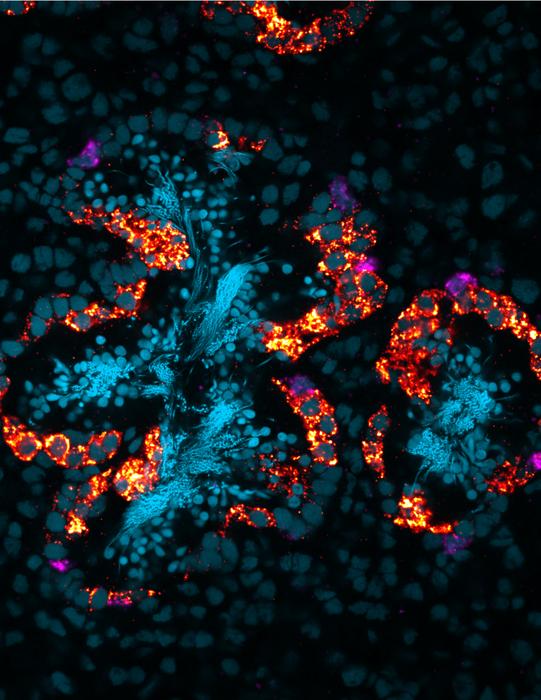
Biogenic monoamines — molecules like dopamine and serotonin — are famous for their role as the brain’s emissaries of mood, learning and memory, stress mechanisms, and fight-or-flight responses in the body.

Credit: Melanie Issigonis, Katherine Browder, and Phillip Newmark, Morgridge Institute for Research
Biogenic monoamines — molecules like dopamine and serotonin — are famous for their role as the brain’s emissaries of mood, learning and memory, stress mechanisms, and fight-or-flight responses in the body.
But these neurotransmitters existed in nature long before brains popped up in the evolutionary tree. They’re prevalent in plants, bacteria, and single-cell organisms as well, but their functions there are far less understood.
Scientists at the Morgridge Institute for Research have added another task for monoamines. They play an important role in the reproductive organs of planarian flatworms, and appear to be critical for the development of both female and male germ cells (the cells that make eggs and sperm).
Writing in today’s (June 25, 2024) issue of the journal Proceedings of the National Academy of Sciences (PNAS), a regenerative biology team at Morgridge demonstrated that such transmitters are not only signals originating from the planarian brain. They are also highly localized within the somatic gonadal cells that regulate germ cell development.
“We are excited about this because it demonstrates a new paradigm for niche-to-germ cell signaling,” says Research Investigator Melanie Issigonis, lead author of the study.
This surprising discovery began in a separate study published in 2022 by former graduate student Umair Khan and Morgridge Investigator Phil Newmark, also an investigator with the Howard Hughes Medical Institute. They set out to characterize the transcriptomes of the ovaries and testes in planarians (which are hermaphrodites) and generated a long list of genes with enriched expression in ovaries. One of the top hits came back as aromatic L-amino acid decarboxylase (AADC), an evolutionarily conserved enzyme that is important for making monoamines.
Puzzled, they assumed the samples were contaminated by surrounding brain tissue, but follow-up studies confirmed the finding. Khan then inhibited expression of the aadc gene to study its role in reproductive system development.
“When he knocked this enzyme down in sexually reproducing planarians, the phenotype was amazing,” Issigonis says. “The ovaries were gone. In fact, the entire female reproductive system was completely ablated.”
The opposite occurred in testes, Issigonis says. In normal testes, if you cut them open like a watermelon, the stem cells would be found along the periphery like the rind, but only a small number are made. “When Umair knocked down aadc, the testes were completely filled with germline stem cells,” she says. “No sperm was being made; testes were filled with germ cell tumors, essentially.”
Issigonis’ follow-up study sought to answer two questions: Which monoamine is AADC making and where is it coming from? They looked for the answer by conducting single-cell RNA sequencing of the somatic cells in the “niche” that surrounds and supports the germ cells.
In somatic niche cells, they found enriched expression of aadc and another gene, nrps, which encodes a non-ribosomal peptide synthetase (NRPS). That was striking because, unlike aadc, nrps is only expressed in the reproductive system, and not neuronally.
Then, when they knocked down nrps in sexual planarians, they found the identical phenotype observed when aadc was inhibited: complete collapse of the female system and dramatic accumulation of male germ cells.
This was an important clue that AADC and NRPS were working together. Further mass spectrometry analysis by Rui Chen and Jim Collins, colleagues from UT Southwestern, offered evidence that these two enzymes were creating β-alanyl tryptamine (BATT), consisting of β-alanine conjugated to the monoamine tryptamine. Collins’ lab discovered that in schistosomes (parasitic cousins of planarians) males produce BATT to trigger egg production in the females.
The compound is nicknamed the “BATT Signal,” after the bat-shaped skylight used to call Batman into action in the comic series. The signal is flashing clearly in planarians as well. The team found that BATT is highly abundant when planarians reach sexual maturity and have mature reproductive organs.
“We thought, wow, the sexual animals make lots of BATT,” she says. “And in fact, when we knocked down either nrps or aadc, BATT was gone. That told us we were on the right track.”
This study and that by Collins’ lab in schistosomes revealed that β-alanyl-monoamine conjugates can act as important signals. Since NRPS enzymes exist throughout the animal kingdom, this suggests that novel monoamine conjugates may be acting as signaling molecules in other animals, too. The next steps are to understand how these novel signals function.
This research was supported by the Eunice Kennedy Shriver National Institute of Child Health & Human Development of the National Institutes of Health.
Journal
Proceedings of the National Academy of Sciences
Method of Research
Experimental study
Subject of Research
Animal tissue samples
Article Title
A niche-derived nonribosomal peptide triggers planarian sexual development
Article Publication Date
25-Jun-2024
Cite Scienmag News
Drew Townsend. (June 25, 2024). Following the ‘BATT Signal:’ A new signaling pathway controlling planarian germ cells. Scienmag. https://scienmag.com/following-the-batt-signal-a-new-signaling-pathway-controlling-planarian-germ-cells/
Drew Townsend. "Following the ‘BATT Signal:’ A new signaling pathway controlling planarian germ cells." Scienmag, 25 June 2024, https://scienmag.com/following-the-batt-signal-a-new-signaling-pathway-controlling-planarian-germ-cells/. Accessed 4 September 2026.
Drew Townsend. "Following the ‘BATT Signal:’ A new signaling pathway controlling planarian germ cells." Scienmag. June 25, 2024. https://scienmag.com/following-the-batt-signal-a-new-signaling-pathway-controlling-planarian-germ-cells/

