


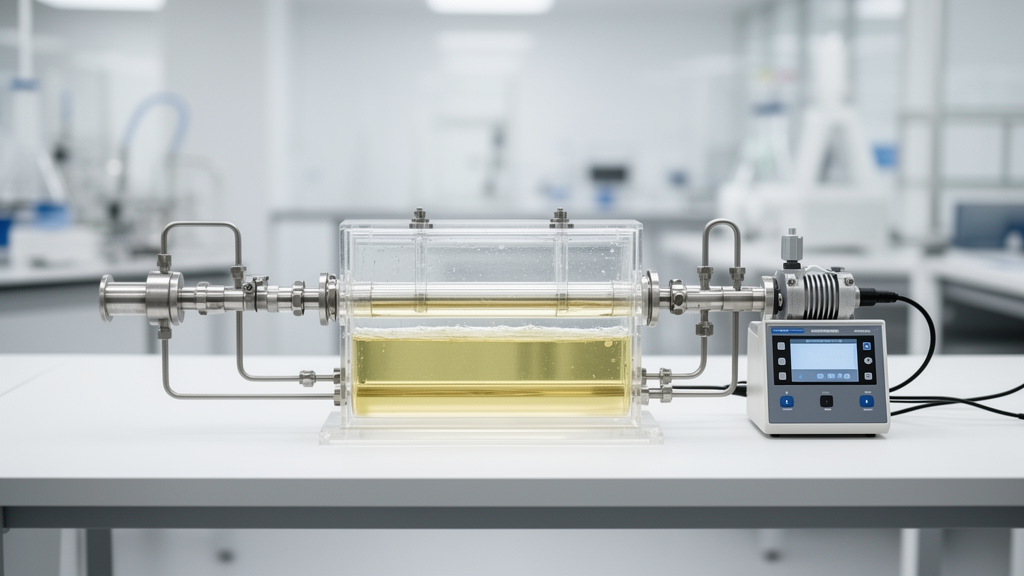
A dual-channel analyzer that first settles produced oil-well fluid and then measures its electrical properties achieved a mean absolute error of 0.47% across gravimetric water-cut standards spanning 5% to 95%. In an independent field validation involving eight heavy-oil wells and 62 paired samples, the instrument produced a mean absolute error of 1.68% and a pooled bias of 0.20 percentage points, meeting the study’s well-level field criterion of ±3.0%. The system was tested over crude-oil viscosities of 907–9,760 mPa·s, brine salinities of 5,000–200,000 ppm and in-situ gas–liquid ratios of 0.3–40 m³/m³. Its central advance lies not in a single sensor but in the integration of flow rectification, dual-frequency impedance sensing and an algorithm that treats the emulsion-rich transition layer as a distinct region.
Produced fluid from an oil well is a moving mixture of oil, water, gas and impurities whose phases rearrange rapidly inside the pipe. In horizontal lines, density can separate gas, oil and water into layers, while droplets and slugs may form at lower velocities. Vertical wells can develop a gas core surrounded by oil and water annuli, yet shear can break those layers apart as flow rises. These structures change with gas content, oil properties and time, making a single instantaneous sample vulnerable to representing only part of the pipe cross-section. The researchers argue that conventional methods often try to infer water content from a limited number of sensing points or one excitation frequency even though spatial representativeness and temporal resolution are competing requirements. The new analyzer instead creates a reproducible physical state before taking its measurement.
At the heart of the instrument is a vertical measurement section with an effective volume of 2 litres and a height of 50 cm. During normal production, fluid flows through this measurement section; the bypass conduit is used when a measurement sequence begins. Electrically actuated three-way valves then divert the flow into the bypass, trapping a slug of produced fluid while production continues through the alternative route. Gravity separates the trapped column into gas, oil, a transition layer and water. An external heater raises the fluid to a controlled temperature between 90 and 105 °C, with the target selected according to crude-oil viscosity. Heating lowers oil viscosity, encourages droplet coalescence and shrinks the persistent emulsion layer. In the reported settling sequence, the transition layer contracted from 9.7 to 4.4 cm, while the associated error declined from 4.32% after five minutes to 1.77% after 45 minutes. A pressure-relief path and check valve protect the assembly from overpressure caused by thermal expansion.
The measurement column is also designed to be flushed and reset between cycles. Filtered produced water from the oilfield’s treatment system clears the section for 30 seconds after a measurement, and the impedance of the first three probes is checked against an air baseline. A deviation below 5% indicates successful clearance, whereas a persistent deviation from the stored baseline triggers further flushing and, if necessary, a probe-contamination fault. The embedded controller aborts a cycle when differential pressure exceeds 0.5 MPa, raises an alarm if the valves do not confirm switching within three seconds, and interrupts heating with forced cooling if the temperature exceeds 110 °C. These controls address both measurement validity and unattended operation, although the settling and flushing sequence means the device is not a continuously sampling sensor in the conventional sense.
Forty coaxial capacitive probes scan the settled column at 1.25 cm intervals, allowing the instrument to resolve vertical changes rather than treating the entire mixture as homogeneous. Each probe is excited alternately at 40 kHz and 5 MHz, and the instrument measures the in-phase and quadrature components of each response. A complete scan takes 200 ms, far shorter than the roughly 30 minutes required for settling. The lower frequency is used as a real-time conductivity probe for the brine: ionic conduction dominates its phase response, allowing conductivity to be estimated and used to update the permittivity assigned to water. The 5 MHz channel provides a more sensitive measure of water-cut-induced permittivity changes and supplies the primary water-cut signal. Temperature is measured locally and incorporated into the compensation. The architecture therefore separates the jobs of the two frequencies rather than treating them as duplicate water-cut estimators.
The distinction matters because saline water can make a single-frequency capacitance reading drift substantially. In a controlled test at a fixed 80% water cut, the uncompensated 5 MHz method produced errors ranging from 0.42% at 5,000 ppm salinity to 6.87% at 200,000 ppm, with an overall mean absolute error of 2.98%. The dual-frequency method remained within ±0.45% at every tested salinity, reducing the overall mean absolute error to 0.31%. By contrast, using the 40 kHz channel alone was accurate at its 5,000 ppm calibration point but became unstable away from that value: its unclipped inversion reached 201.6% water cut at 20,000 ppm and 935.7% at 200,000 ppm. It also failed to produce a reading at 30% water cut in oil-continuous mixtures because a continuous conductive path was absent. The compensation step and its dedicated low-frequency channel were therefore complementary, and neither was sufficient alone.
A third element addresses the transition layer, where dispersed droplets and emulsion morphology produce nonlinear dielectric behavior. Rather than force this region into a uniform oil-and-water model, the system constructs a numerical database of simulated dual-frequency responses spanning 0–100% water cut in 5-percentage-point increments, three emulsion morphologies and salinities from 5,000 to 200,000 ppm. Features extracted from each probe are grouped with fuzzy C-means clustering into five clusters, and their water cuts are averaged according to cluster membership. In five transition-layer tests, this approach reduced the maximum error from ±8.0% to ±1.2% and the mean absolute error from 5.8% to 0.7%, a reduction of 87.6%. The complete analyzer assigns the region below the transition–water boundary a water cut of 100%, inverts the oil layer with a complex refractive index model and combines all local values through volume-weighted averaging.
Cumulative laboratory tests isolated the contribution of each component. A conventional flow-through, single-frequency configuration had a mean absolute error of 4.85%, a root-mean-square error of 6.12% and a maximum absolute error of 9.83%. Adding flow rectification reduced the mean absolute error to 2.31%; adding dual-frequency compensation lowered it to 1.18%; and adding the fuzzy-clustering inversion brought it to 0.47%. Each step reduced error significantly in paired tests, with the three marginal improvements totaling the full 4.38-percentage-point reduction. A separate multiphase-loop experiment at 80% water cut showed that the error spread across five flow regimes fell from 7.25 percentage points before rectification to 0.36 points afterward and 0.20 points with the complete system. The benefit grew from 1.70 points under stratified flow to 8.59 points under slug flow, indicating that rectification removed a regime-dependent error rather than applying a constant offset. The remaining dependence was reduced, not eliminated, and the mechanism was tested on one loop at a single water cut.
Field testing exposed both the potential and the importance of reference quality. Five calibration wells produced initial biases as high as 8.40% at a viscosity of 9,760 mPa·s. Part of this apparent error came from crude oil adhering to the measurement wall during manual drainage, which biased the laboratory reference high and also prevented complete drainage. The sampling procedure was revised to drain the column under controlled conditions and recover wall-adhered oil with a toluene rinse, while two calibration coefficients were recalculated. After correction, the three high-viscosity wells had biases of 1.92%, 1.03% and 1.44% and mean absolute errors of 2.05%, 1.37% and 1.44%. An isolated 7.85% excursion associated with abnormal emulsification was retained in the results. Independent validation on eight disjoint wells produced a pooled bias of 0.20%, a mean absolute error of 1.68% and a largest well-level mean absolute error of 2.41%. Because the validation wells came from the same oilfield and fell within the calibration viscosity range, this demonstrated interpolation rather than transfer to other crudes or locations.
Long-term deployment data suggest that the system can operate at field scale, although availability is not the same as accuracy. The authors reported 340 units serving 1,899 wells in the Shengli, Northwest and Xinjiang oilfields, with 99.34% data availability over 4,908 unit-months. The mean time between failures requiring a site visit was 30 months, while the mean time between all recorded events, including remotely recovered faults, was 7.2 months. Routine paired samples showed no accuracy drift resolvable against the reference method’s ±0.5% expanded uncertainty. Cleaning was required on 28 occasions, so the data establish only a lower bound on the cleaning interval. A one-week case study on a well with a viscosity of about 5,420 mPa·s produced three errors of −0.9%, +1.7% and +1.1% against laboratory values and captured changes between manual sampling times. Based on 2025 Shengli records, the study estimated annual costs of 6,700 CNY per well with the analyzer, compared with 17,800 CNY for manual sampling and testing, although the cost estimate excluded separately captured installation and training expenses.
The design also imposes important limits. Each unit completes a cycle in about an hour, including roughly 30 minutes of settling, but one unit serves an average of 5.6 wells, leaving a revisit interval of about 4.9–13.8 hours for an individual well. It can track trends in mature fields but may miss short-lived changes during intermittent production or gas-lift operations. Entrained gas may remain in the column above a gas–liquid ratio of 40 m³/m³, potentially distorting the impedance signal. The laboratory and loop uncertainty budget is ±1.0% at a coverage factor of two, with water-cut-dependent calibration bias the largest component; the largest laboratory error was 0.89%. The study therefore supports the analyzer within its tested operating envelope, not as a universal replacement for every online measurement method. Its central achievement is a change in measurement philosophy: rather than trying to infer water cut despite unpredictable flow, the instrument controls the flow, compensates for brine salinity and resolves the troublesome emulsion layer explicitly.
Subject of Research: Development and validation of a dual-frequency online water-cut analyzer for heavy-oil wells
Article Title: Dual-channel online water-cut analyzer for oil wells based on flow rectification and dual-frequency impedance sensing: Design, performance validation and field application
Article References: Jiang, X., Li, Z., Qi, J., Liu, C., Li, Y., Wan, G., Su, X., & Wang, S. (2026). Dual-channel online water-cut analyzer for oil wells based on flow rectification and dual-frequency impedance sensing: Design, performance validation and field application. Results in Engineering, 32, Article 113624. https://doi.org/10.1016/j.rineng.2026.113624
Image Credits: AI Generated
DOI: 10.1016/j.rineng.2026.113624
Keywords: oil wells, water cut, dual-frequency sensing, flow rectification, heavy oil, impedance measurement, field validation, oilfield monitoring, emulsion inversion, online measurement, Dual-channel, online
Cite Scienmag News
Denise Maddox. (October 21, 2026). Flow-controlled water-cut analyzer reaches sub-1% laboratory accuracy. Scienmag. https://scienmag.com/flow-controlled-water-cut-analyzer-reaches-sub-1-laboratory-accuracy/
Denise Maddox. "Flow-controlled water-cut analyzer reaches sub-1% laboratory accuracy." Scienmag, 21 October 2026, https://scienmag.com/flow-controlled-water-cut-analyzer-reaches-sub-1-laboratory-accuracy/. Accessed 21 October 2026.
Denise Maddox. "Flow-controlled water-cut analyzer reaches sub-1% laboratory accuracy." Scienmag. October 21, 2026. https://scienmag.com/flow-controlled-water-cut-analyzer-reaches-sub-1-laboratory-accuracy/


