


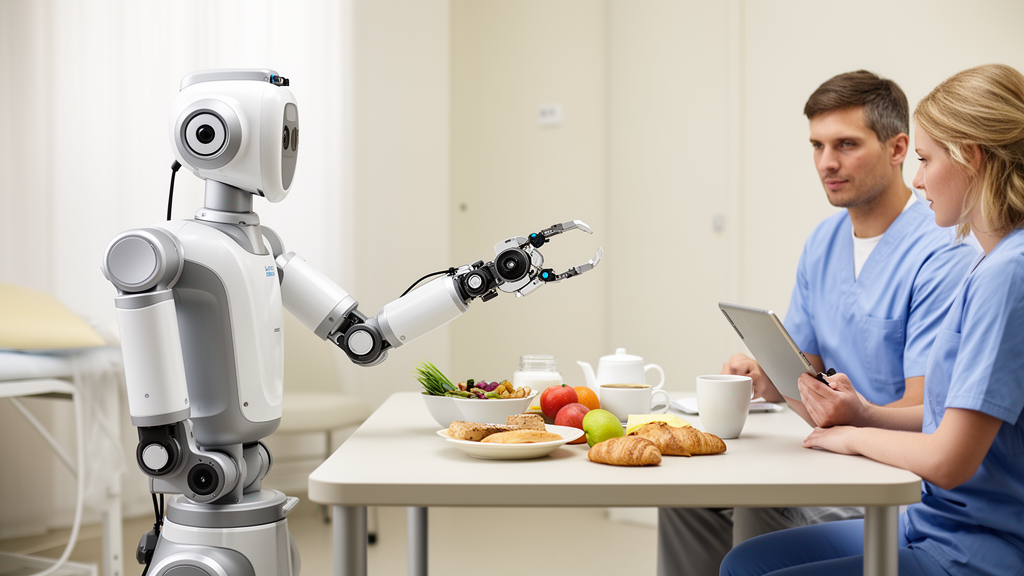
A ROS 2 mobile robot can score reaching attempts and adapt the difficulty of a rehabilitation exercise, according to a technical validation study of the HemiBot system. In experiments with 16 healthy participants, HemiBot’s onboard measurements matched stereophotogrammetric motion-capture classifications in all 120 recorded repetitions, and its adaptive logic selected the expected difficulty for every participant. The study tested the system’s sensing, scoring and decision pipeline under controlled conditions; it did not test rehabilitation effectiveness or safety in people with stroke-related unilateral spatial neglect.
Unilateral spatial neglect, or hemineglect, is a disabling cognitive consequence of right-hemisphere stroke in which a person fails to orient toward or interact with stimuli in the contralesional, usually left, side of space despite having intact primary sensory and motor function. The condition can interfere with reaching, object manipulation and self-care, and it is associated with longer hospitalization and poorer long-term outcomes. HemiBot is intended for post-stroke neglect through a non-contact exercise: the end effector of PAL Robotics’ TIAGo mobile manipulator acts as a moving visual cue while a participant reaches toward it with the affected arm. The robot does not physically guide the limb, and the task is designed to combine attentional cueing with active movement into the neglected hemispace.
The underlying software is divided into two cooperating layers. A session-level Coach node loads a YAML session plan, arranges exercises, receives aggregate results, presents a real-time scoreboard to the therapist and selects the difficulty for a subsequent session. At the individual-repetition level, a Python Behavior Tree built with py_trees coordinates motion commands, skeletal tracking, metric calculation, session aggregation and emergency-stop handling. This modular arrangement allows components such as the hand-pointing metric to be replaced later without redesigning the overall orchestration. After each attempt, the robot also delivers a text-to-speech message in Italian chosen from predefined pools associated with acceptable, failed or high-quality performance.
For the pointing exercise, the TIAGo gripper travels along a semicircular arc centered on the participant’s left shoulder. Easy, medium and hard settings use arc extents of 20, 30 and 40 degrees, respectively, while sharing the same 0.85-meter radius, angular velocity, three repetitions per standard session and dwell time at the extremes. The end effector always faces the arc center. Its movement is generated through a custom C++ ROS 2 action server using MoveIt 2 Cartesian path planning, with a trapezoidal velocity profile applied to the joint trajectory. Limits on joint velocity and acceleration are checked before execution, and invalid trajectories abort the action. Progress feedback is published at 5 hertz, while the Behavior Tree’s main tick runs at 30 hertz.
The system also treats the participant as a moving obstacle. Skeletal joint estimates from the robot’s onboard RGB-D camera are converted into spherical collision objects and updated in the MoveIt 2 planning scene. An OctoMap built directly from the depth stream serves as a coarser fallback when skeletal tracking temporarily deteriorates. This combination is intended to keep the planned trajectory away from the participant’s current body configuration, although the reaching targets themselves are designed a priori to remain at a safe distance. Emergency-stop signals are handled both by the arm action server and the Behavior Tree; the software detects the command within approximately 33 milliseconds at its 30-hertz control rate, but actuator delay, physical stopping time and stopping distance were not measured. The authors therefore describe the safety mechanisms as design provisions requiring quantitative validation before clinical use.
Movement quality is estimated from two quantities captured at 30 hertz: the angle between the line from the participant’s shoulder to the wrist and the line from the shoulder to the robot’s end effector, and the Euclidean distance between the wrist and the end effector. A sample counts as on target only when both fixed thresholds are satisfied, reducing the chance that correct-looking pointing without an adequate reach, or a reach without correct direction, will be rewarded. The proportion of on-target samples becomes a score from 0 to 100, divided into Fail below 25, Acceptable from 25 to 75 and Great at or above 75. Failed attempts must be repeated. At the end of a session, a mean score above 75 triggers promotion, while a failed-attempt ratio of 0.50 triggers demotion; demotion takes precedence if both conditions are met. The thresholds were derived in consultation with rehabilitation specialists and were not tested in patients.
Sixteen healthy adults, nine women and seven men with a mean age of 54.5 years and a standard deviation of 6.8 years, took part in two sessions. Eight entered a high-performance group and completed all repetitions as instructed. Eight entered a low-performance group in which the experimenter directed a scripted pattern of correct, failed and partial attempts during the first session. That partial pattern involved following the robot through the rightward half of the arc and resting during the excursion into the left, contralesional side. It was a controlled software test rather than natural patient behavior, and the participants were capable of correct reaching throughout. The experiment produced 120 recorded repetitions in total, with the robot’s measurements compared against BTS SMART-DX EVO stereophotogrammetric motion capture.
Across the 88 repetitions independently identified as fully correct by the motion-capture reference, measurement error increased as the arm moved farther toward the lateral workspace. The error increase was significant between Easy and the two more demanding levels, while the difference between Medium and Hard was not significant, suggesting that the largest source of difficulty arose when the arm left the frontal workspace rather than accumulating steadily with eccentricity. Median root-mean-square error for arm alignment was 3.42 degrees at Easy, 4.29 degrees at Medium and 4.39 degrees at Hard. For hand-to-end-effector distance, the corresponding medians were 1.59, 1.99 and 2.77 centimeters. Transient wrist occlusions were identified as a cause of larger errors in some trials, particularly when the wrist approached the robot’s gripper or extended laterally. Despite this, the robot and motion-capture systems assigned the same performance band in all 120 repetitions: 24 Fail, 8 Acceptable and 88 Great, with 100 percent classification accuracy and Cohen’s kappa of 1.000.
The adaptive logic also behaved as programmed for every participant. All eight members of the high-performance group were promoted from Medium to Hard after achieving no failed attempts, while all eight in the low-performance group met the demotion threshold and were moved from Medium to Easy. The high-performance group’s first-session mean score was 95.8, with individual means ranging from 86.0 to 100.0 and a fail ratio of zero. The low-performance group had a mean score of 40.7, with individual means from 39.7 to 41.8, and a fail ratio of 0.50, calculated from 24 failed attempts out of 48 first-session repetitions. After demotion, all eight low-performance participants achieved near-perfect scores in the second session, with means from 97.3 to 100.0 and no failed attempts. These results confirm that data collected asynchronously by the robot’s tracking and execution nodes reached the session aggregator and Coach node correctly. However, the performance groups were deliberately separated from the scoring boundaries: only one repetition came close to a boundary. The study therefore cannot establish how the system behaves when real patients produce gradual or fluctuating performance near the promotion and demotion thresholds. Healthy participants also do not reproduce the fatigue, impaired movement or attentional fluctuations expected after stroke.
Several important gaps remain before HemiBot could be used clinically. Its present score is motor-kinematic rather than a direct measurement of where a participant looks, so the system does not yet quantify the attentional side of neglect directly; wearable eye-tracking glasses are being explored for that purpose. Occluded samples can affect scores because the tracker does not explicitly identify every occlusion, and no minimum number of valid observations is required before an attempt is scored. The therapist’s scoreboard can override a repetition, while decisions based on session-wide statistics reduce the influence of a single anomaly, but these safeguards remain untested in a patient population. The study likewise did not establish that the robot improves neglect, that its feedback is perceived as empathetic or engaging, or that the full multi-exercise system is safe. Planned work includes usability testing, a clinical trial in people with post-stroke neglect, eye-tracking integration, gamification and more sophisticated closed-loop methods for adjusting difficulty.
Subject of Research: Technical validation of an adaptive robotic coaching system for unilateral spatial neglect rehabilitation
Article Title: HemiBot: design and technical validation of an adaptive Robotic coaching system for Unilateral Spatial Neglect rehabilitation
Article References: Soldi, R., Guerra, B. M. V., Sozzi, S., Lunghi, F., Russo, L., Schmid, M., & Ramat, S. (2026). HemiBot: design and technical validation of an adaptive Robotic coaching system for Unilateral Spatial Neglect rehabilitation. Frontiers in Robotics and AI, 13, 1950821. https://doi.org/10.3389/frobt.2026.1950821
Image Credits: AI Generated
DOI: 10.3389/frobt.2026.1950821
Keywords: HemiBot, rehabilitation robotics, unilateral spatial neglect, adaptive difficulty, mobile manipulator, ROS 2, motion capture, stroke rehabilitation, technical validation, design, technical, validation
Cite Scienmag News
Denise Maddox. (October 21, 2026). HemiBot robot passes technical tests for adaptive neglect rehabilitation. Scienmag. https://scienmag.com/hemibot-robot-passes-technical-tests-for-adaptive-neglect-rehabilitation/
Denise Maddox. "HemiBot robot passes technical tests for adaptive neglect rehabilitation." Scienmag, 21 October 2026, https://scienmag.com/hemibot-robot-passes-technical-tests-for-adaptive-neglect-rehabilitation/. Accessed 21 October 2026.
Denise Maddox. "HemiBot robot passes technical tests for adaptive neglect rehabilitation." Scienmag. October 21, 2026. https://scienmag.com/hemibot-robot-passes-technical-tests-for-adaptive-neglect-rehabilitation/


