


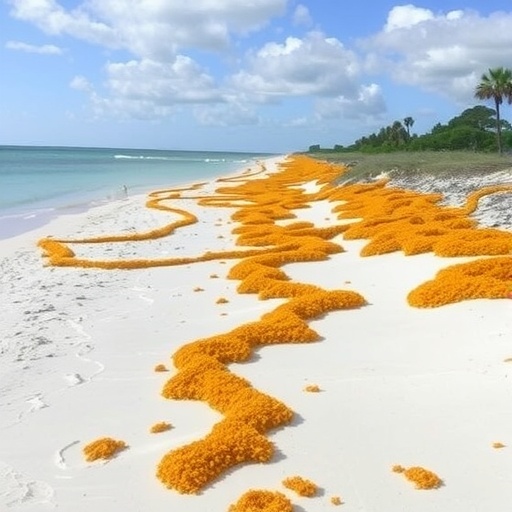
As Florida grapples with unprecedented influxes of sargassum seaweed washing ashore, researchers at Florida International University (FIU) are pioneering innovative strategies to transform this environmental challenge into a tangible resource. The ubiquitous brown algae, which forms massive blooms across the Atlantic Ocean, has traditionally been an ecological and economic nuisance, producing foul odors, disrupting marine ecosystems, and imposing hefty cleanup costs on coastal communities. However, a groundbreaking study published in the prestigious journal Food Hydrocolloids heralds a paradigm shift—revealing sargassum’s potential as a sustainable source of food-grade alginate, a vital polysaccharide additive widely used in the food industry.
Sargassum accumulates on South Florida beaches in staggering quantities, posing persistent difficulties for tourism and local ecosystems. Rather than adhering to conventional approaches focused exclusively on removal and disposal, the FIU-led research collective, collaborating with Florida State University and Florida Atlantic University, has adopted a novel investigative lens. Their work explores the extraction of high-value compounds from sargassum, aiming to repurpose this abundant biomass for industrial and food-based applications, thus redefining it from waste to resource.
Central to this endeavor is alginate, a naturally occurring polysaccharide known for its gel-forming, stabilizing, and thickening properties—qualities that make it indispensable in products ranging from ice cream to plant-based dairy alternatives. The researchers meticulously quantified the alginate content within the sargassum samples, documenting extraction yields reaching approximately 45%. This yield is remarkably competitive with those derived from traditional seaweed sources like brown kelp, positioning sargassum as a promising alternative raw material for alginate production.
Beyond biochemical characterization, the study confronted one of the major hurdles in valorizing sargassum—the presence of contaminants and pathogenic bacteria, which presently preclude its classification as a safe food source. To surmount this, the team evaluated advanced non-thermal processing techniques, chiefly high-pressure processing (HPP). HPP, an emerging technology in food preservation, subjects materials to immense pressures capable of inactivating microbes without resorting to heat, thereby preserving heat-sensitive nutrients and bioactive compounds.
Imran Ahmad, FIU’s esteemed food science and technology research professor and co-author of the study, elaborated on this innovative processing methodology: “Instead of traditional thermal treatments that can degrade the molecular integrity of alginate and other valuable compounds, we employ extremely high pressure to effectively neutralize harmful microorganisms while maintaining the functional qualities essential for food applications.” This selective functional modulation denotes a significant advancement in producing food-grade alginate safely from unconventional biomass.
High-pressure processing, combined with sonication techniques examined in the study, offers dual benefits: microbial safety assurance and optimized extraction efficiency. Sonication, which harnesses ultrasonic waves to disrupt cellular structures, works synergistically with HPP to enhance alginate yield and quality. These refined methodologies collectively pave the way for scalable, sustainable extraction processes with minimized environmental footprint and enhanced economic viability.
While this research marks a pivotal step, the journey toward full commercial adoption of sargassum-derived alginate remains ongoing. The team is actively advancing the development pipeline, engaging in comprehensive safety evaluations, regulatory compliance assessments, and refining formulation techniques to seamlessly integrate this novel alginate into existing food products. Such rigor ensures consumer safety and product efficacy, crucial parameters for widespread market acceptance.
Apart from its direct implications for food science, this work contributes meaningfully to larger environmental and socio-economic narratives confronting coastal regions in Florida and the broader Caribbean. The recurring sargassum blooms not only hinder tourism but disrupt marine biodiversity, fisheries, and local livelihoods. By converting this biomass into a value-added commodity, scientists envision reducing environmental waste, lowering beach maintenance expenditures, and supporting circular bioeconomy principles through sustainable resource management.
Michael Cheng, dean of FIU’s Chaplin School of Hospitality & Tourism Management, emphasized the broader impact of this research: “Our institution prides itself on addressing real-world challenges. Dr. Ahmad’s work exemplifies innovation that transcends academic inquiry, offering tangible solutions for both local communities and global environmental issues. This approach aligns with our mission to foster resilience and sustainability in hospitality and tourism sectors.”
Moreover, the implications extend well beyond food products. Alginate’s industrial applications encompass pharmaceuticals, textiles, and biodegradable packaging, hinting at interdisciplinary opportunities catalyzed by this research. Establishing sargassum as a robust feedstock can unlock diverse markets, catalyze regional economic development, and promote environmentally responsible bioresource utilization.
This innovative study fundamentally reframes the narrative surrounding sargassum seaweed. By shifting the dialogue from eradication and disposal to valorization and opportunity, researchers are fostering a sustainable, science-driven approach to a complex ecological problem. Such paradigm shifts are essential as humanity confronts escalating environmental challenges and seeks circular, regenerative solutions.
In sum, the FIU-led research exposes the substantial untapped potential embedded in pelagic sargassum, revealing its suitability as a raw material for producing high-quality, food-grade alginate through advanced non-thermal processing methodologies. This scientific breakthrough not only offers a strategic avenue for mitigating the impacts of sargassum inundations but also contributes to the broader vision of sustainable ingredient sourcing and environmental stewardship in food science and technology.
For media inquiries or additional information, Brian Zimmerman at Florida International University is available at bzimmerm@fiu.edu.
News Publication Date: 6-Feb-2026
Web References:
Food Hydrocolloids Article
References:
DOI: 10.1016/j.foodhyd.2026.112534
Keywords
Food science, Food production, Food resources, Food safety, Food additives, Food chemistry, Food microbiology
Cite Scienmag News
Denise Maddox. (May 5, 2026). Florida Beaches Overrun by Sargassum: FIU Scientists Discover Novel Food-Grade Applications. Scienmag. https://scienmag.com/florida-beaches-overrun-by-sargassum-fiu-scientists-discover-novel-food-grade-applications/
Denise Maddox. "Florida Beaches Overrun by Sargassum: FIU Scientists Discover Novel Food-Grade Applications." Scienmag, 5 May 2026, https://scienmag.com/florida-beaches-overrun-by-sargassum-fiu-scientists-discover-novel-food-grade-applications/. Accessed 6 September 2026.
Denise Maddox. "Florida Beaches Overrun by Sargassum: FIU Scientists Discover Novel Food-Grade Applications." Scienmag. May 5, 2026. https://scienmag.com/florida-beaches-overrun-by-sargassum-fiu-scientists-discover-novel-food-grade-applications/


