


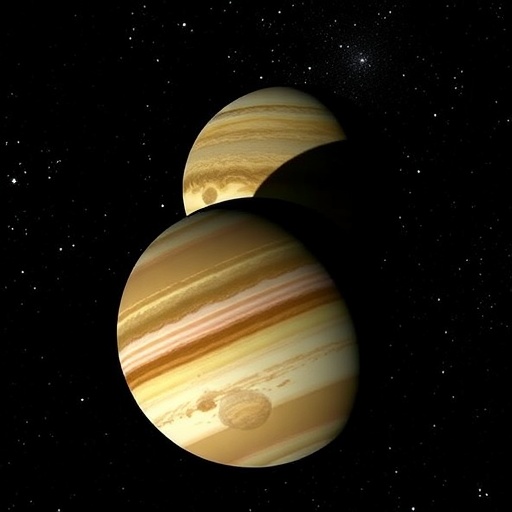
In a remarkable leap forward for exoplanetary science, a team of astronomers leveraging the extraordinary capabilities of NASA’s James Webb Space Telescope (JWST) has unveiled compelling insights into one of the most enigmatic planetary systems discovered to date. Twenty light years shy of two centuries from Earth’s vantage point, orbiting the star known as TOI-1130, lies a planetary oddity that has captivated astronomers since its initial identification in 2020. This system hosts a rare celestial pairing: a hot Jupiter accompanied by a mini-Neptune, a duo whose coexistence upends conventional wisdom about planetary formation and orbital dynamics.
Historically, hot Jupiters—gas giants with blisteringly close orbits to their parent stars—have been considered cosmic loners. Their intense gravitational fields tend to destabilize the orbits of any smaller planets within their sphere of influence, usually leading to either ejection or collision events that leave such giant worlds in isolated journeys around their stars. However, the detection of a mini-Neptune cohabiting space inside the orbit of a hot Jupiter in the TOI-1130 system defies this prevailing narrative, raising fundamental questions concerning the dynamics that permit such unlikely companionships to endure.
Using JWST’s unparalleled spectral resolution, researchers have, for the first time, performed a detailed compositional analysis of the atmosphere enveloping the mini-Neptune, designated TOI-1130b. The data reveal an atmosphere exceptionally rich in heavy molecules—water vapor, carbon dioxide, sulfur dioxide, and traces of methane—marking a stark departure from the expected light, hydrogen and helium-dominated envelopes typical of planets formed close to their stars. These molecules point unambiguously to an origin story far from the star’s intense radiation, in a realm cold enough for volatile ices to congregate and incorporate into the primordial atmospheres of nascent planets.
This “heavy” atmospheric composition suggests that TOI-1130b did not originate where it currently orbits—in the searing proximity inside the hot Jupiter’s path—but was instead formed beyond the star’s frost line. This critical demarcation represents the orbital radius beyond which temperatures are sufficiently low for water and other volatile compounds to freeze, facilitating the accretion of icy solids and gas during planetary assembly. It is within this frigid birthplace that mini-Neptunes can amass thick, volatile-rich atmospheres, setting the stage for subsequent inward migration.
The process that shepherded TOI-1130b and its stellar companion inward appears to have been remarkably gentle, allowing both planets to preserve their atmospheres as they traversed the inner planetary system. This nuanced dance likely involved complex gravitational interactions combined with dissipative mechanisms such as disk-planet tidal forces, enabling the two planets to settle into a resonant orbital configuration where their periods maintain a precise ratio, subtly influencing each other’s trajectories without catastrophic disruption.
Astrophysicists have long debated the possibility that mini-Neptunes might form beyond stellar frost lines and migrate inward, but until now, observational confirmation remained elusive. The JWST observations of TOI-1130b provide the first definitive evidence supporting this formation channel, bridging the gap between theoretical models and empirical data. In doing so, this discovery broadens our understanding of planetary system architectures and challenges models that rely solely on in situ formation scenarios for mini-Neptunes located perilously close to their stars.
The TOI-1130 system also exemplifies the intricate dynamical interplay that can occur in multi-planet systems exhibiting mean motion resonances. The gravitational resonance between the mini-Neptune and the hot Jupiter modulates their orbital periods, necessitating highly precise timing to capture observational data. The success of this campaign hinged on the meticulous synthesis of historic observational records and advanced predictive modeling, enabling astronomers to schedule JWST observations with extraordinary accuracy.
This landmark study was helmed by Saugata Barat, a postdoctoral researcher at MIT’s Kavli Institute for Astrophysics and Space Research, in collaboration with colleagues from prominent institutions worldwide. Their collective efforts confirm the presence of sulfur dioxide in the planetary atmosphere—a molecule rarely observed in extraterrestrial atmospheres—which adds an intriguing layer to the chemical complexity of TOI-1130b and may offer insights into atmospheric photochemistry and potential volcanic activity.
The revelation that the mini-Neptune’s atmosphere is compositionally heavier than previously anticipated underscores the diversity of planetary atmospheres and the varied evolutionary paths planets can undertake. Whereas the solar system lacks mini-Neptune analogs, exoplanet observations increasingly suggest that such worlds are among the most common types orbiting stars in our galaxy, making systems like TOI-1130 valuable laboratories for scrutinizing planetary formation theories beyond the standards set by our local celestial neighborhood.
Furthermore, these findings bear significant implications for our understanding of planetary migration mechanisms. The subtle gravitational interactions facilitating the mini-Neptune and hot Jupiter’s close yet stable orbits may reflect a broader class of migration histories previously underappreciated. The intact atmospheres despite proximity to intense stellar radiation signify that planetary atmospheres can endure complex migrational trajectories without necessarily being stripped away, a finding that refines models of atmospheric retention and erosion.
The TOI-1130 system’s unique architecture stands as a testament to the complex gravitational and chemical choreography that can arise during planetary system formation and evolution. Its detailed study enriches the tapestry of planetary science, providing a poignant example of how new technology like JWST propels the boundaries of what we can discern—from far-flung stars and the miniature Neptunes they harbor. These revelations underscore a transformative era in astronomy, where once theoretical possibilities become object lessons writ large in the cosmos.
This research not only illuminates the mysteries of TOI-1130 but also estuaries understanding that echoes far beyond this single system. By showing how mini-Neptunes can form in icy orbits and endure migration near hot Jupiters, it opens the door to reconsidering models of planet formation across different stellar environments. Future studies will undoubtedly leverage JWST’s capabilities to explore other star systems, testing the universality of these processes and expanding our comprehension of the galaxy’s richly varied planetary menagerie.
In sum, the JWST’s detailed atmospheric characterization of TOI-1130b marks a watershed moment in exoplanet science. This mini-Neptune’s discovery within the orbit of a hot Jupiter, coupled with its heavy, molecule-laden atmosphere indicative of an origin beyond the water ice line, challenges longstanding conceptions of planetary system structure and formation. It also exemplifies the profound insights achievable through cutting-edge observational astronomy, inspiring both awe and new scientific inquiry into the complex mechanisms shaping worlds beyond our own.
Web References: http://dx.doi.org/10.3847/2041-8213/ae5f8b
Keywords
Exoplanets, Mini-Neptunes, Hot Jupiters, Planetary Atmospheres, James Webb Space Telescope, Planetary Formation, Protoplanetary Disks, Frost Line, Atmospheric Composition, Planetary Migration, Mean Motion Resonance, Astrophysics
Cite Scienmag News
Grant Pearson. (May 5, 2026). Astronomers Trace the Origins of a Peculiar Planetary Pair. Scienmag. https://scienmag.com/astronomers-trace-the-origins-of-a-peculiar-planetary-pair/
Grant Pearson. "Astronomers Trace the Origins of a Peculiar Planetary Pair." Scienmag, 5 May 2026, https://scienmag.com/astronomers-trace-the-origins-of-a-peculiar-planetary-pair/. Accessed 4 September 2026.
Grant Pearson. "Astronomers Trace the Origins of a Peculiar Planetary Pair." Scienmag. May 5, 2026. https://scienmag.com/astronomers-trace-the-origins-of-a-peculiar-planetary-pair/


