


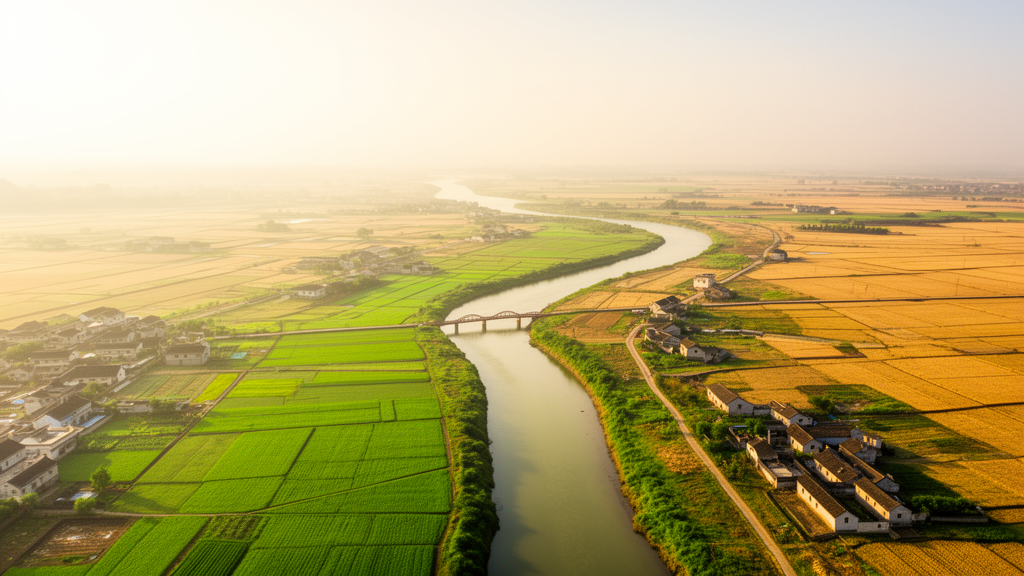
Flash droughts have struck China's Huai River Basin frequently over the past four decades, but a new analysis shows that most of these events were relatively mild in intensity, with only a small share reaching high severity. The finding comes from a study published in Theoretical and Applied Climatology that mapped the spatiotemporal evolution of flash drought across one of China's most important grain-producing and densely populated regions between 1983 and 2023. The research team, led by Zhipeng Zhang and colleagues, identified flash drought events using the Standardized Evapotranspiration Stress Ratio method.
To trace how events unfold in both space and time, the researchers applied three-dimensional clustering, which allowed them to characterize the spatial distribution and migration behavior of individual events across the basin. For trend detection, the team combined the Mann-Kendall test with the Theil-Sen slope estimator. At the scale of the whole watershed, the number of flash drought events showed only a weak trend that was not statistically significant.
At the level of individual grid cells, however, the picture changed markedly: the analysis revealed clear spatial contrasts, with different parts of the basin showing different trajectories over the 41-year record. To probe what sets these events in motion, the researchers carried out anomaly analysis of the meteorological conditions preceding flash drought onset. The results point to a general synergistic influence among multiple meteorological factors before events develop, rather than a single dominant trigger.
The authors emphasize that this pattern reflects a coupling effect between thermal and hydrological conditions in the basin, in which heat-related and water-related drivers interact in the lead-up to rapid drought intensification. The Huai River Basin is particularly sensitive to flash drought because of its role in agriculture and its dense population. The study's authors note that the suddenness and rapid evolution of flash drought pose a serious threat to agricultural production, water resource utilization and ecosystem stability, which makes strengthening research on this basin a priority.
The identification of events through the Standardized Evapotranspiration Stress Ratio method, combined with the clustering-based tracking of their spatial distribution and migration, gave the team a basin-wide catalogue of flash drought occurrences spanning the full 1983 to 2023 period. This catalogue underpins the study's central characterization: flash droughts in the HRB occurred frequently, were generally of low intensity, and high-intensity events were relatively rare. The contrast between the weak, statistically insignificant basin-wide trend and the clear grid-level spatial contrasts is one of the study's key messages.
According to the authors, the research reveals the typical spatiotemporal distribution characteristics and meteorological driving mechanisms of flash drought in the region, and the results could provide a scientific basis for watershed drought monitoring and risk assessment. The study appears in Volume 157 of Theoretical and Applied Climatology as article number 756.
Subject of Research: Spatiotemporal evolution and meteorological driving factors of flash drought in the Huai River Basin, China, from 1983 to 2023
Article Title: Research on spatiotemporal evolution characteristics and driving factors of flash drought in the Huai River Basin, China
Article References: Zhang, Z., Wang, J., Zhou, H., Zhang, W., Pan, J., & Cong, X. (2026). Research on spatiotemporal evolution characteristics and driving factors of flash drought in the Huai River Basin, China. Theoretical and Applied Climatology, 157(11), Article 756. https://doi.org/10.1007/s00704-026-06674-1
Image Credits: AI Generated
DOI: 10.1007/s00704-026-06674-1
Keywords: flash drought, Huai River Basin, Standardized Evapotranspiration Stress Ratio, three-dimensional clustering, Mann-Kendall trend test, Theil-Sen slope, meteorological anomalies, drought monitoring, agricultural drought risk, China, Theoretical and Applied Climatology, Research
Cite Scienmag News
Violet Maxwell. (October 26, 2026). Flash Droughts Strike China’s Huai River Basin Often but Rarely Hard, 41-Year Study Finds. Scienmag. https://scienmag.com/flash-droughts-strike-chinas-huai-river-basin-often-but-rarely-hard-41-year-study-finds/
Violet Maxwell. "Flash Droughts Strike China’s Huai River Basin Often but Rarely Hard, 41-Year Study Finds." Scienmag, 26 October 2026, https://scienmag.com/flash-droughts-strike-chinas-huai-river-basin-often-but-rarely-hard-41-year-study-finds/. Accessed 26 October 2026.
Violet Maxwell. "Flash Droughts Strike China’s Huai River Basin Often but Rarely Hard, 41-Year Study Finds." Scienmag. October 26, 2026. https://scienmag.com/flash-droughts-strike-chinas-huai-river-basin-often-but-rarely-hard-41-year-study-finds/


