


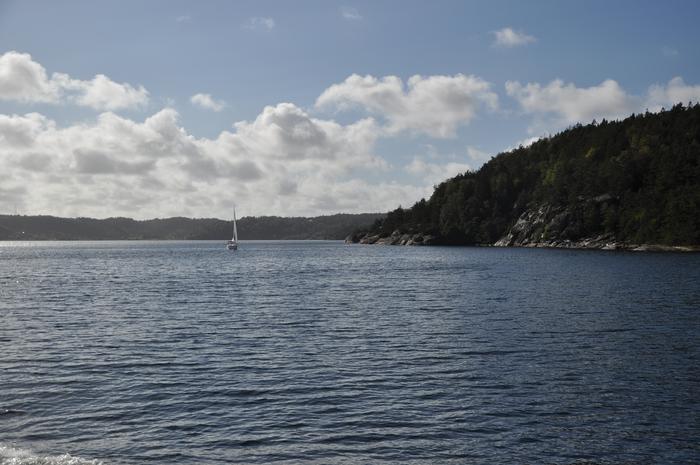
The fjords on Sweden’s west coast act as effective carbon traps regardless of whether the bottom water is oxygen-rich or not. This is the conclusion of a new study with researchers from the University of Gothenburg.

Credit: Astrid Hylén
The fjords on Sweden’s west coast act as effective carbon traps regardless of whether the bottom water is oxygen-rich or not. This is the conclusion of a new study with researchers from the University of Gothenburg.
Large quantities of plant parts sink to the bottom of fjords on the Swedish west coast where they form sediment. This buries organic carbon, which would otherwise contribute to ocean acidification and the greenhouse effect. When the plant parts are exposed to oxygen and other substances, the organic carbon begins to decompose into inorganic carbon, which can be dissolved into carbonic acid in the water. Research has previously assumed that it is the oxygen content of the bottom environment that determines how effectively the carbon can be captured, but measurements in three fjords in Sweden show that oxygen content plays less of a role.
Same pattern in three fjords
“We chose three fjords with different oxygen levels in the bottom water and for these fjords it seems that the amount of particles that settle is so high that the impact of oxygen on decomposition is low,” says Per Hall, professor emeritus of marine biogeochemistry at the University of Gothenburg and co-author of the study published in JGR Biogeosciences.
The three fjords; Byfjorden, Hakefjorden and Gullmarsfjorden show the same pattern in the sediments. Large amounts of organic carbon are stored, and decomposition proceeds at the same rate whether plant parts from land or sea have landed on the seabed.
“This is also new knowledge. Further into the fjords, the proportion of terrestrial plant parts is greater in the sediments than further out in the fjord, closest to the sill. But as a carbon sink, the fjord works equally well everywhere, regardless of the origin of the organic material,” says Per Hall.
Mineral particles contribute to the carbon trap
Another thing that could be noted in the measurements was that the organic material combines with mineral particles that are transported out into the fjord by water courses. This association makes the organic matter sink faster and slows down decomposition because bacteria and other organisms cannot break down this material as well. It also contributes to the carbon sink.
Fjords are the marine environments that bury the most organic carbon relative to their size. About 18 megatonnes (million tonnes) of organic carbon are buried in fjord sediments globally each year, representing 11 percent of all carbon captured in the world’s oceans, even though fjords account for only one-tenth of one percent of all ocean surface area.
“Therefore, we conclude that fjords, especially those located in a temperate climate with surrounding terrestrial vegetation that can contribute to fjord sedimentation, play an important role in climate regulation on longer time scales. This emphasises the importance of exploring these ecosystems in the context of global change,” says Per Hall.
Journal
Journal of Geophysical Research Biogeosciences
Method of Research
Observational study
Article Title
Burial of Organic Carbon in Swedish Fjord Sediments: Highlighting the Importance of Sediment Accumulation Rate in Relation to Fjord Redox Conditions
Article Publication Date
27-Mar-2024
Cite Scienmag News
Violet Maxwell. (May 31, 2024). Fjords are effective carbon traps regardless of oxygen levels. Scienmag. https://scienmag.com/fjords-are-effective-carbon-traps-regardless-of-oxygen-levels/
Violet Maxwell. "Fjords are effective carbon traps regardless of oxygen levels." Scienmag, 31 May 2024, https://scienmag.com/fjords-are-effective-carbon-traps-regardless-of-oxygen-levels/. Accessed 4 September 2026.
Violet Maxwell. "Fjords are effective carbon traps regardless of oxygen levels." Scienmag. May 31, 2024. https://scienmag.com/fjords-are-effective-carbon-traps-regardless-of-oxygen-levels/

