


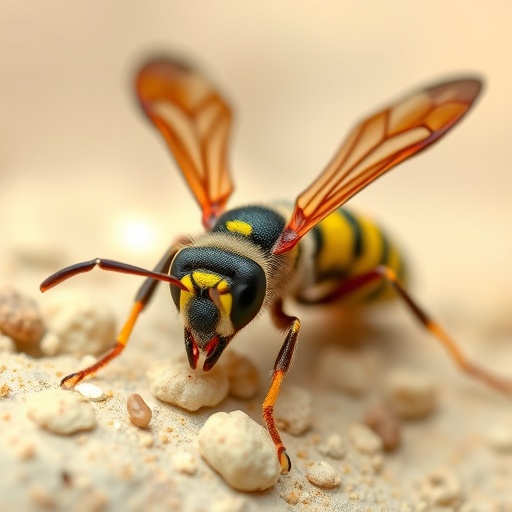
Scientists have identified five species of parasitoid wasp previously unknown to science in Cyprus, more than doubling the number of chalcid wasps known to occur exclusively on the island. The discoveries, reported in the open-access journal ZooKeys, highlight how much biodiversity may still be hidden in landscapes that are familiar to local communities but remain poorly surveyed by entomologists. All five species belong to the family Pteromalidae, a diverse group of tiny wasps whose members are important components of food webs and natural pest-control systems. Although these insects are often only a few millimetres long, they can influence the abundance of other insects across forests, grasslands, wetlands, agricultural areas and coastal habitats.
The research was conducted by Evangelos Koutsoukos and Mircea-Dan Mitroiu as part of a broader project examining chalcid wasp diversity and biological invasions in the Akrotiri Peninsula. The initiative focused particularly on the Akrotiri Sovereign Base Area, a protected region administered by the United Kingdom on Cyprus, while also contributing specimens and data from other parts of the island. The project was funded through the UK Government’s Darwin Plus initiative and administered by the Enalia Physis Environmental Research Centre, with support from the National and Kapodistrian University of Athens, the University of Leeds and Alexandru Ioan Cuza University. The findings demonstrate the value of coordinated biodiversity surveys in regions that have historically received limited taxonomic attention.
Pteromalidae belongs to Chalcidoidea, one of the most species-rich lineages of wasps. Chalcid wasps are generally characterized by their small size, compact bodies and often metallic coloration, although their appearance varies widely between genera and species. Many are parasitoids, meaning that their larvae develop by feeding on and eventually killing a host insect. Depending on the species, hosts may include beetle larvae, caterpillars, flies, aphids or other insects living inside plant tissues, under bark, in soil or within decaying organic matter. Adult wasps locate these concealed hosts and use a specialized ovipositor to deposit eggs in or on them. Once the larvae complete development, new adults emerge and continue the cycle, naturally suppressing populations of other insects.
The newly described species are Ablaxia makrisi, Erythromalus makrisi, Hemitrichus akrotiriensis, Ablaxia toxeftrae and Janssoniella aphrodite. Their formal recognition required detailed examination of morphological traits used in wasp taxonomy, including body proportions, antennal structure, wing venation, surface sculpture, coloration and the shape of reproductive structures. In groups containing many visually similar species, these features can be essential for distinguishing one taxon from another. The researchers also documented the locations where the specimens were collected, preserving so-called type material that serves as a permanent reference for future identification and comparison. Such taxonomic work provides the foundation for ecological studies, conservation assessments and investigations of biological control.
Two of the wasps, Ablaxia makrisi and Erythromalus makrisi, were named in honour of Christodoulos Makris, a prominent Cypriot entomologist. Makris contributed to knowledge of the island’s insect fauna and collected the holotypes of both species. A holotype is the single specimen designated as the name-bearing reference for a newly described species. Its preservation allows other scientists to verify the original description and compare newly collected individuals with the defining characteristics of the species. Naming species after local researchers also recognizes the importance of regional expertise, especially in countries where much of the biodiversity remains under-documented and where field knowledge can guide scientists toward habitats most likely to contain rare or overlooked organisms.
The name Hemitrichus akrotiriensis refers to the Akrotiri Peninsula, where its holotype was collected. The peninsula is regarded as one of Cyprus’s most important biodiversity areas, containing a mosaic of coastal habitats and protected environments. Ablaxia toxeftrae was named after Toxeftra Beach in the Akamas Peninsula, the location where its type specimen was found. The fifth species, Janssoniella aphrodite, carries a name connected to the cultural history of Cyprus. Its holotype was collected near Yeroskipou, in the Paphos area, which was associated in antiquity with the worship of Aphrodite. The name links modern biodiversity discovery with the island’s long history of natural and cultural significance.
Before the study, only three chalcid wasp species were known to be endemic to Cyprus, meaning they had been recorded nowhere else. The addition of five species raises that known total to at least eight, but the researchers caution that even this number is likely an underestimate. Their collecting efforts produced numerous other specimens that may represent additional undescribed species, pending further examination. This uncertainty is typical in hyperdiverse insect groups, where many species remain known only from isolated specimens or have never been collected at all. Small parasitoid wasps are particularly vulnerable to being missed because they are difficult to observe in the field, may occupy specialized microhabitats and often cannot be identified reliably without microscopy and specialist taxonomic analysis.
The discoveries also carry implications beyond the naming of five insects. Parasitoid wasps occupy critical positions in ecological networks by linking host populations to higher trophic levels and by helping regulate insect communities. Their distribution can reveal patterns of habitat specialization, island evolution and biological invasion. Cyprus lies at a biogeographic crossroads between Europe, Asia and Africa, making its fauna especially relevant to understanding how species move and diversify across the eastern Mediterranean. Building a reliable inventory of its chalcid wasps could therefore help researchers detect introduced species, identify habitats supporting unique lineages and evaluate how land-use change, climate pressures and ecosystem disturbance affect natural pest-control services. The study’s authors say that continued sampling will be necessary to approach the island’s true biodiversity and to understand the ecological roles of its newly discovered wasps.
News Publication Date: 23-Jul-2026
Web References: https://zookeys.pensoft.net/article/196157/ ; https://doi.org/10.3897/zookeys.1286.196157
References: Koutsoukos E, Mitroiu M-D (2026) Enriching inventories of rare genera: five new species of Pteromalidae (Hymenoptera, Chalcidoidea) from Cyprus. ZooKeys 1286: 1–16.
Cite Scienmag News
Gavin Prescott. (August 18, 2026). Five new Cyprus wasp species discovered, including one named after Aphrodite. Scienmag. https://scienmag.com/five-new-cyprus-wasp-species-discovered-including-one-named-after-aphrodite/
Gavin Prescott. "Five new Cyprus wasp species discovered, including one named after Aphrodite." Scienmag, 18 August 2026, https://scienmag.com/five-new-cyprus-wasp-species-discovered-including-one-named-after-aphrodite/. Accessed 3 September 2026.
Gavin Prescott. "Five new Cyprus wasp species discovered, including one named after Aphrodite." Scienmag. August 18, 2026. https://scienmag.com/five-new-cyprus-wasp-species-discovered-including-one-named-after-aphrodite/


