


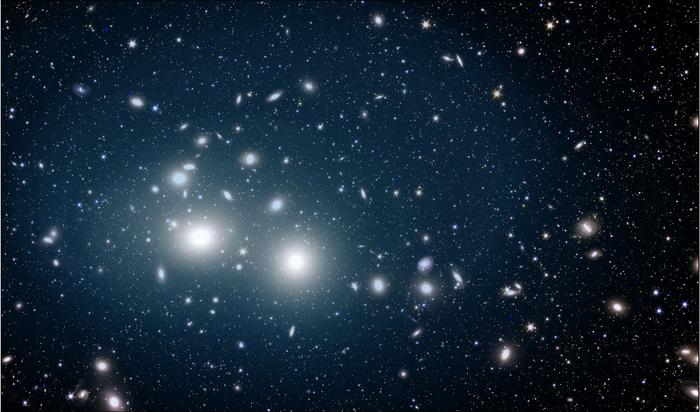
The first scientific pictures from the Euclid satellite mission have revealed more than 1,500 billion orphan stars scattered throughout the Perseus cluster of galaxies.

Credit: ESA/Euclid/Euclid Consortium/NASA, image processing by M. Montes (IAC) and J.-C. Cuillandre (CEA Paris-Saclay)
The first scientific pictures from the Euclid satellite mission have revealed more than 1,500 billion orphan stars scattered throughout the Perseus cluster of galaxies.
Led by astronomers from the University of Nottingham, this discovery sheds light on the origins of these celestial wanderers.
The Perseus cluster, located 240 million light-years away from Earth, is one of the Universe’s most massive structures, boasting thousands of galaxies. However, amidst this cosmic ensemble, the Euclid satellite captured faint ghostly light – the orphan stars – drifting between the cluster’s galaxies.
Stars naturally form within galaxies, so the presence of orphan stars outside these structures raised intriguing questions about their origins.
Professor Nina Hatch, who led the project team, said, “We were surprised by our ability to see so far into the outer regions of the cluster and discern the subtle colours of this light. This light can help us map dark matter if we understand where the intracluster stars came from. By studying their colours, luminosity, and configurations, we found they originated from small galaxies.”
The orphan stars are characterised by their bluish hue and clustered arrangement. Based on these distinctive features the astronomers involved in the study suggest that the stars were torn from the outskirts of galaxies and from the complete disruption of smaller cluster galaxies, known as dwarfs.
After being torn from their parent galaxies, the orphaned stars were expected to orbit around the largest galaxy within the cluster. However, this study revealed a surprising finding: the orphan stars instead circled a point between the two most luminous galaxies in the cluster.
Dr Jesse Golden-Marx, a Nottingham astronomer involved in the study, commented, “This novel observation suggests that the massive Perseus cluster may have recently undergone a merger with another group of galaxies. This recent merger could have induced a gravitational disturbance, causing either the most massive galaxy or the orphan stars to deviate from their expected orbits, thus resulting in the observed misalignment.”
Dr Matthias Kluge, first author on the study, from the Max-Planck institute for Extraterrestrial Physics in Munich, Germany, stated: “This diffuse light is more than 100,000 times fainter than the darkest night sky on Earth. But it is spread over such a large volume that when we add it all up, it accounts for about 20% of the luminosity of the entire cluster.”
ESA’s Euclid mission is designed to explore the composition and evolution of the dark Universe. The space telescope will create a great map of the large-scale structure of the Universe across space and time by observing billions of galaxies out to 10 billion light-years, across more than a third of the sky. Euclid will explore how the Universe has expanded and how structure has formed over cosmic history, revealing more about the role of gravity and the nature of dark energy and dark matter.
Dr Mireia Montes, an astronomer from the Institute of Astrophysics on the Canary Islands involved in the study said, “This work was only possible thanks to Euclid’s sensitivity and sharpness”. Euclid’s revolutionary design means that it can take images with similar sharpness as the Hubble Space Telescope, but covering an area that is 175 times larger.
Method of Research
Observational study
Subject of Research
Not applicable
Article Title
Euclid: Early Release Observations — The intracluster light and intracluster globular clusters of the Perseus cluster.
Article Publication Date
23-May-2024
Cite Scienmag News
Grant Pearson. (May 23, 2024). First pictures from Euclid satellite reveal billions of orphan stars. Scienmag. https://scienmag.com/first-pictures-from-euclid-satellite-reveal-billions-of-orphan-stars/
Grant Pearson. "First pictures from Euclid satellite reveal billions of orphan stars." Scienmag, 23 May 2024, https://scienmag.com/first-pictures-from-euclid-satellite-reveal-billions-of-orphan-stars/. Accessed 4 September 2026.
Grant Pearson. "First pictures from Euclid satellite reveal billions of orphan stars." Scienmag. May 23, 2024. https://scienmag.com/first-pictures-from-euclid-satellite-reveal-billions-of-orphan-stars/

