


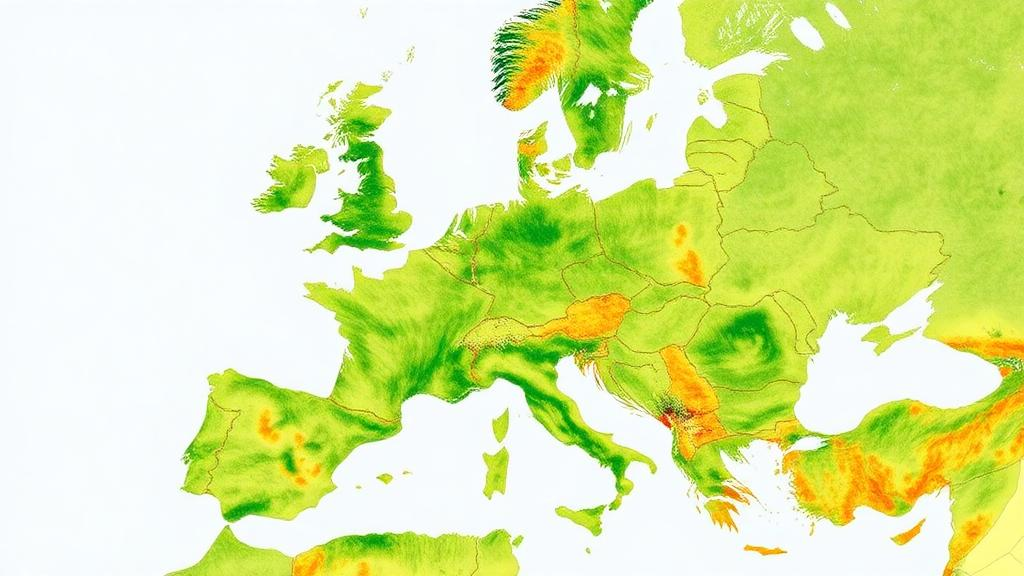
Europe’s grasslands have just been photographed with unprecedented clarity. A team of researchers at the European Commission’s Joint Research Centre in Ispra, Italy, together with collaborators in Luxembourg, Spain and Austria, has produced the first EU27-wide maps of grassland management built entirely on harmonized field observations. Drawing on the 2022 LUCAS grassland and extended grassland surveys, which collected more than 29,900 samples across the entire European Union, the team led by Julien Morel aggregated the in-situ data to the NUTS2 regional level and delivered a dataset that has never existed before: a continental picture of how intensively European grasslands are managed, whether they are grazed or mown, how rich they are in non-grass flowering plants, and whether they are temporary or permanent. The work, published as a preprint under review in Earth System Science Data, arrives at a moment when the pressure on European agricultural systems to become both productive and ecologically resilient has never been greater.
Grasslands occupy a central position in Europe’s environmental calculus. They cover large parts of the continent and deliver a remarkable portfolio of services: food production for livestock, mitigation of greenhouse gases, conservation of biodiversity, and cultural value for the societies that live among them. But not all grasslands are equal. Across Europe they range from extensive, semi-natural, species-rich pastures that shelter rare insects and orchids, to very intensive single-species meadows that function essentially as green factories for fodder. Because management determines which services a grassland provides, it ultimately shapes the resilience of European agriculture as a whole. That is why the authors argue there is a pressing need for a monitoring system capable of informing evidence-based decision-making for sustainable grassland management across the continent. Until now, no such system had a harmonized field-data foundation at the EU scale.
The technical achievement lies in the harmonization. The LUCAS survey, run by Eurostat and the Joint Research Centre, is a large field survey covering the whole European Union, and in 2022 it included dedicated grassland modules. Surveyors visited more than 29,900 sampling points and recorded, using standardized protocols, the use of each grassland parcel, whether it functioned as a meadow, a pasture, or a combination of both, and the intensity of its management, classified as intensive, moderately intensive, or extensive. They also documented the forb-to-grass ratio, the proportion of non-grass herbaceous plants relative to grasses, a widely used proxy for botanical diversity, and the age category of the grassland, distinguishing temporary grasslands that are part of crop rotations from permanent ones that have persisted for years. By aggregating these observations to NUTS2 regions, the standard European administrative units used for regional statistics, the team produced maps that are comparable across borders for the first time.
The results reveal a striking zonation of management across the continent. High-intensity grasslands cluster in central and northern Europe, where favorable climates, fertile soils and dense livestock economies push farmers toward maximum fodder output. Extensive grasslands, by contrast, dominate in southern Europe, where drier conditions, marginal terrain and traditional farming systems favor low-input management. Meadows prevail in central and eastern Europe, reflecting the continental pattern of mowing for winter fodder, while pastures are predominant in western Europe, where grazing-based livestock systems have deep historical roots. These are not subtle gradients. The maps show strong regional differences in both intensity and use, confirming that European grassland management is deeply structured by geography, climate and agricultural tradition rather than being a uniform continental practice.
Perhaps the most ecologically revealing variable in the dataset is the forb-to-grass ratio. Forbs, the non-grass herbaceous plants such as legumes, composites and wildflowers, are a key indicator of grassland botanical richness and of the pollinator and insect communities a grassland can support. The maps show that the highest forb ratios are generally observed in central and northern Europe, a pattern that may seem counterintuitive given that those same regions host the most intensive management. The authors report weak but statistically significant correlations between forb ratio and management intensity, suggesting that while intensity does leave a measurable imprint on botanical composition, other factors, including climate, soil conditions and regional land-use history, exert strong independent influence. This nuance matters for policymakers: it implies that reducing management intensity alone may not automatically restore forb richness everywhere, and that regional context must inform any restoration strategy.
Age category adds another layer to the continental picture. Permanent grasslands, those that have remained unploughed and in grass for extended periods, represent the dominant age category across the EU27. This is significant because permanent grasslands are widely recognized as strongholds of soil carbon storage and biodiversity, and their extent is a recurring concern in European agricultural and environmental policy. The confirmation, from harmonized in-situ data, that permanent grasslands dominate the European landscape provides a baseline against which future change, whether through ploughing, conversion to cropland, or intensification, can be measured. It also gives satellite-based monitoring systems a ground-truth reference for classifying grassland permanence from orbit, a task that has historically been difficult because temporary and permanent grasslands look similar in spectral data.
The dataset’s real power may lie in what it enables next. The authors explicitly position it as a foundation for Earth Observation-based monitoring systems and large-scale modelling studies. Satellite sensors can detect grassland extent and greenness, but interpreting what those signals mean in terms of management, whether a parcel is grazed, mown, fertilized or left extensive, requires ground truth. The LUCAS-based maps provide exactly that reference, allowing researchers to train and validate classification algorithms that translate spectral observations into management categories across the continent. Large-scale models of carbon cycling, greenhouse gas emissions, fodder production and biodiversity, which currently rely on coarse assumptions about grassland management, can now be parameterized with regionally specific, field-verified data. The dataset is openly accessible through the JRC Data Catalogue repository, lowering the barrier for research groups across Europe and beyond to build on it.
The implications extend into policy territory where grasslands have become a recurring flashpoint. European agricultural policy has long struggled to balance production incentives with environmental objectives, and grasslands sit at the heart of that tension. Intensive meadows deliver high fodder yields but contribute little to biodiversity and can be sources of greenhouse gas emissions. Extensive semi-natural pastures are biodiversity hotspots and carbon sinks but produce less food. A monitoring system grounded in harmonized field data gives decision-makers, from Brussels to regional administrations, a common evidence base for targeting support, designing agri-environment schemes and evaluating whether policies are actually shifting management practices on the ground. The authors emphasize that the dataset can strengthen the evidence base for decisions on grassland management and use, and on the multiple productive and ecological services grasslands provide.
What makes this work notable in the broader scientific landscape is its methodological honesty. The team did not attempt to infer management from satellite data or statistical models alone. Instead, they built the maps from the ground up, using in-situ observations collected with standardized protocols across the entire EU27, and then aggregated them to regions. This ground-truth-first approach is what allows the dataset to serve as a reference standard for the satellite-based and model-based systems that will extend it. As climate change alters growing seasons, as livestock economies restructure, and as biodiversity targets tighten, the ability to measure grassland management directly, repeatedly and comparably across the continent becomes a strategic capability. The 2022 LUCAS grassland maps are the first edition of that capability, and they set a template for the monitoring systems Europe will need as it navigates the competing demands of food security and ecological resilience in the decades ahead.
Subject of Research: EU-wide maps of grassland management using 2022 LUCAS grassland and extended grassland data
Article Title: EU-wide maps of grassland management using 2022 LUCAS grassland and extended grassland data
Article References: Morel, J., Skøien, J. O., Iordanov, M., Rossi, M., Marcantonio, M., Rottlan-Puig, X., See, L., & Van der Velde, M. (2026). EU-wide maps of grassland management using 2022 LUCAS grassland and extended grassland data. https://doi.org/10.5194/essd-2026-640
Image Credits: AI Generated
Keywords: EU-wide, maps, grassland, management, LUCAS, extended, data, scientific research
Cite Scienmag News
Margaret Porter. (October 19, 2026). First EU-wide field-data map reveals stark zonation of grassland management. Scienmag. https://scienmag.com/first-eu-wide-field-data-map-reveals-stark-zonation-of-grassland-management/
Margaret Porter. "First EU-wide field-data map reveals stark zonation of grassland management." Scienmag, 19 October 2026, https://scienmag.com/first-eu-wide-field-data-map-reveals-stark-zonation-of-grassland-management/. Accessed 19 October 2026.
Margaret Porter. "First EU-wide field-data map reveals stark zonation of grassland management." Scienmag. October 19, 2026. https://scienmag.com/first-eu-wide-field-data-map-reveals-stark-zonation-of-grassland-management/


