


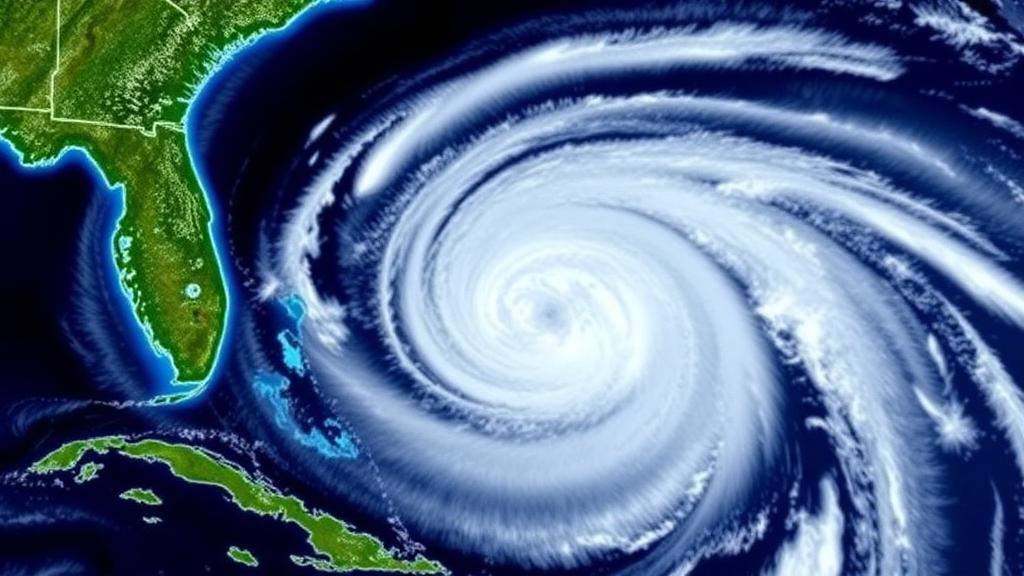
Hurricane forecasting may be on the verge of its most dramatic transformation in decades. A new study published in Frontiers in Environmental Science reports that a hybrid quantum-classical artificial intelligence system, called the Quantum-Enhanced Neural Network (QENN), cut five-day hurricane track errors by 73.2 percent compared with an operational classical ensemble, while also delivering a fourfold speed-up in computation. The findings, drawn from 847 Atlantic tropical cyclones recorded between 1980 and 2024, suggest that quantum computing techniques could push weather prediction beyond the limits that have constrained numerical models for forty years.
The scale of the improvement is striking. On a locked test set covering the 2016 to 2023 hurricane seasons, the QENN achieved a 120-hour track mean absolute error of 83.7 kilometers, with a 95 percent confidence interval of 78.9 to 88.6 kilometers. The operational classical ensemble it was compared against produced an error of 312.0 kilometers over the same storms and lead times. In practical terms, a forecast issued five days before landfall would place the storm’s position roughly 84 kilometers from reality rather than more than 300 kilometers away, a difference that could reshape evacuation planning for millions of coastal residents.
The system’s performance on rapid intensification, the most feared and least predictable phenomenon in tropical meteorology, was equally remarkable. Rapid intensification occurs when a storm’s maximum winds increase dramatically in a short period, often catching forecasters and coastal communities off guard. The QENN achieved a balanced accuracy of 94.7 percent in predicting these events, while the classical baseline managed only 67.3 percent. The false-alarm ratio dropped from 28.4 percent to 12.3 percent, meaning emergency managers would receive far fewer misleading warnings. Intensity errors at 48 hours also fell by 33.7 percent, from 18.7 knots to 12.4 knots.
Architecturally, the QENN is a carefully engineered hybrid. A classical preprocessing pipeline ingests 256 by 256 pixel satellite image patches, 37 pressure levels for 15 ERA5 reanalysis variables, ocean heat content profiles, and radiosonde summaries. Convolutional encoders compress the satellite data into 128 features, while a multilayer perceptron condenses the atmospheric variables into another 128. A two-layer gated recurrent unit processes eight consecutive six-hour time steps, giving the model 48 hours of storm context. The resulting 128-dimensional temporal state is then squeezed through a linear bottleneck into exactly 50 standardized values, one for each qubit in the quantum module.
That quantum module is where the framework departs from conventional deep learning. It employs a four-layer variational quantum circuit in which data-dependent RY and RZ rotations encode the 50 atmospheric correlation features onto qubits, followed by alternating nearest-neighbor CNOT entangling gates arranged in a closed ring in the final layer. The circuit contains 400 trainable rotation angles, optimized using simultaneous perturbation stochastic approximation while the classical parameters are updated separately with AdamW. Grouped Pauli measurements extract 50 single-qubit Z expectation values and 50 adjacent-pair ZZ values, producing a 100-dimensional quantum feature vector that is fused with the classical temporal state before feeding three prediction heads for track displacement, maximum wind intensity, and rapid-intensification probability.
The researchers were careful to design an evaluation that would withstand scrutiny. Every observation belonging to a single tropical cyclone was assigned to exactly one data partition, preventing any storm leakage between training and testing. The 1980 to 2011 data trained the model, 2012 to 2015 storms validated hyperparameters, 2016 to 2023 formed the locked test set, and six hurricanes from the 2024 season served as an independent holdout. Ten complete training runs with different random seeds produced consistent results, and storm-level bootstrap confidence intervals based on 10,000 resamples accounted for the fact that multiple forecasts from the same storm are statistically correlated. All major results survived Holm-corrected statistical testing with adjusted p-values below 0.001.
Perhaps the most scientifically important comparison was a width-matched ablation study. The researchers replaced only the quantum encoding, circuit, and measurement stages with a classical multilayer perceptron of nearly identical parameter count, keeping all data, temporal, fusion, and output layers the same. Against this matched classical backbone, the full QENN reduced track error by an additional 25.7 kilometers, from 109.4 to 83.7 kilometers. A cumulative ablation showed that entanglement operations, variational optimization, error mitigation, and correlation measurements each contributed incrementally to the total improvement, providing evidence that the quantum module itself, rather than sheer model capacity, was responsible for the gain.
Speed matters as much as accuracy in operational forecasting, and here the QENN also delivered. The median wall-clock time for a complete forecast was 50.0 minutes, compared with 210.0 minutes for the classical ensemble, a 4.20-fold speed-up and a 76.2 percent reduction in runtime. When the latency of the IBM quantum processor queue was included for the small subset of runs executed on physical hardware, the speed-up fell to 3.10-fold. The authors are explicit that this timing comparison does not constitute formal quantum computational advantage, since it reflects engineering efficiency rather than a proven complexity separation, and 92 percent of circuit evaluations were performed on a calibrated simulator rather than actual quantum hardware.
The framework was also benchmarked against recent data-driven weather models, including GraphCast, FourCastNet, Pangu-Weather, FuXi, and NeuralGCM, each adapted with an identical hurricane-specific prediction head trained only on the development partition. Under this controlled protocol, all of the adapted global models produced 120-hour track errors between 107.9 and 121.6 kilometers, well above the QENN’s 83.7 kilometers. Against National Hurricane Center consensus products, the QENN’s 72-hour track errors were 12 to 18 percent lower and intensity errors 10 to 15 percent lower. The authors caution that these comparisons quantify performance under task-specific adaptation and should not be read as a universal ranking of the original forecasting systems in their native operational configurations.
Calibration, the property that a model’s stated uncertainty matches its actual error rates, also improved substantially. The 90 percent interval coverage rose from 73.4 percent to 89.1 percent, and the expected calibration error fell by 64.4 percent. In the 2024 holdout evaluation of six storms, the mean landfall-position error was just 45 kilometers. Learned correlation maps assigned the strongest weights to physically meaningful combinations of upper-level divergence, ocean heat content, humidity, and vertical wind shear, and perturbation tests produced the expected directional responses, with warmer water and higher humidity increasing predicted intensity and stronger shear reducing it.
The study’s author, Yunjia Hu of the Chengdu Wenjiang District Meteorological Office, is candid about the limitations. Most circuit evaluations ran on a simulator with an IBM-calibrated noise model, only 8 percent were verified on a physical 127-qubit IBM processor, and the six-storm 2024 holdout is too small to establish operational readiness. No theoretical complexity separation from the matched classical model has been established, and the error mitigation techniques, including zero-noise extrapolation, readout correction, and dynamical decoupling, reduced mean expectation-value error from 0.084 to 0.031 on the hardware verification subset without proving any fundamental quantum speedup. The term quantum-enhanced, the paper stresses, refers strictly to the inclusion of the quantum feature module, not to exponential advantage or operational deployment.
Even with those caveats, the work represents a reproducible proof of concept for hybrid quantum-classical correlation modeling in one of meteorology’s hardest problems. Tropical cyclones cause billions of dollars in losses annually and endanger coastal communities worldwide, and the hardest failures of conventional forecasting, rapid intensification and abrupt track changes during recurvature, are precisely where the QENN showed its largest case-level gains. The path forward, the study concludes, requires prospective multi-basin validation, independent replication, device-drift analysis, and evaluation on larger physical quantum workloads. If those steps confirm what the locked test set suggests, the first practical dividends of quantum computing in weather forecasting may arrive not through exotic physics demonstrations but through quieter, more accurate warnings issued days before a hurricane makes landfall.
Subject of Research: Hybrid quantum-classical machine learning for hurricane track and rapid-intensification prediction
Article Title: Advanced meteorological modeling framework integrating quantum computing and machine learning for hurricane track prediction beyond traditional forecasting limitations
Article References: Hu, Y. (2026). Advanced meteorological modeling framework integrating quantum computing and machine learning for hurricane track prediction beyond traditional forecasting limitations. Frontiers in Environmental Science, 14, Article 1939822. https://doi.org/10.3389/fenvs.2026.1939822
Image Credits: AI Generated
DOI: 10.3389/fenvs.2026.1939822
Keywords: hurricane forecasting, quantum computing, machine learning, tropical cyclones, variational quantum circuits, rapid intensification, numerical weather prediction, QENN, ERA5 reanalysis, track prediction, quantum neural networks, meteorological modeling
Cite Scienmag News
Katie Riggs. (October 19, 2026). Quantum-Enhanced AI Slashes Hurricane Track Errors by 73 Percent in Landmark Test. Scienmag. https://scienmag.com/quantum-enhanced-ai-slashes-hurricane-track-errors-by-73-percent-in-landmark-test/
Katie Riggs. "Quantum-Enhanced AI Slashes Hurricane Track Errors by 73 Percent in Landmark Test." Scienmag, 19 October 2026, https://scienmag.com/quantum-enhanced-ai-slashes-hurricane-track-errors-by-73-percent-in-landmark-test/. Accessed 19 October 2026.
Katie Riggs. "Quantum-Enhanced AI Slashes Hurricane Track Errors by 73 Percent in Landmark Test." Scienmag. October 19, 2026. https://scienmag.com/quantum-enhanced-ai-slashes-hurricane-track-errors-by-73-percent-in-landmark-test/


