


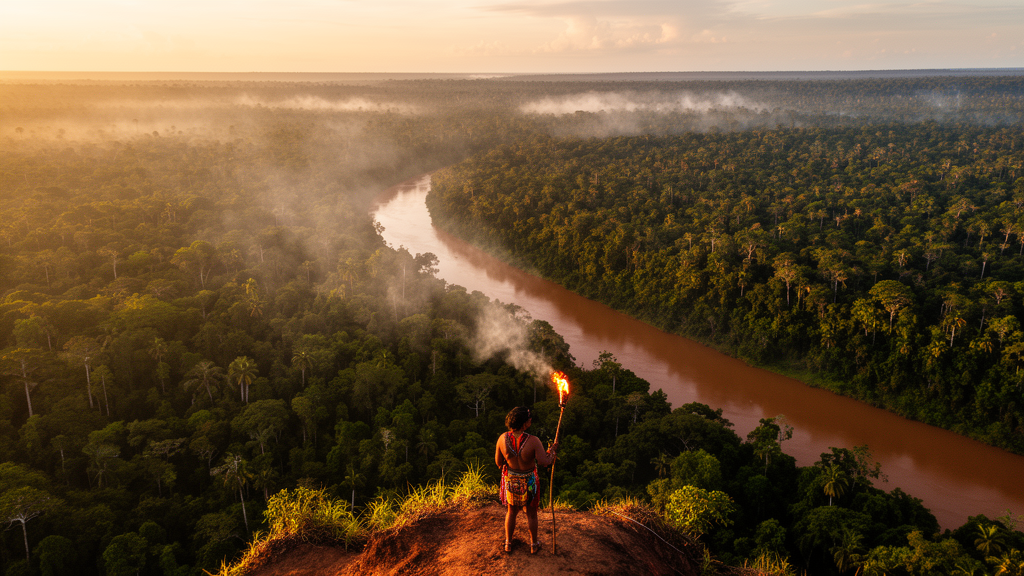
For decades, the Amazon rainforest has been portrayed as a primeval wilderness, a vast green cathedral untouched by human hands until relatively recent history. A new peer-reviewed study published in the open-access journal Frontiers of Biogeography dismantles that narrative with an unusually comprehensive body of evidence. By compiling 1,361 radiocarbon dates from 303 sites across the entire basin, a research team led by paleoecologists has reconstructed ten millennia of Amazonian pyrogeography, the spatial and temporal history of fire across a landscape. Their central finding is stark: in the wet forests of Amazonia, fire is almost exclusively a human phenomenon. Before people arrived, lightning-ignited blazes were so rare that they barely register in the sedimentary record, and the regular burning that has shaped the forest’s composition for thousands of years began only with the arrival of a fire-using species: Homo sapiens.
The technical foundation of the study rests on radiocarbon dating, specifically accelerator mass spectrometry, or AMS, which allows researchers to determine the age of tiny fragments of charcoal recovered from lake sediments, soils, and archaeological deposits. Charcoal is effectively a fossil record of fire: when vegetation burns, some carbonized material is deposited in soils and water bodies, where it can survive for millennia. The team compiled 1,329 previously and newly dated charcoal fragments and burned archaeological materials, then applied summed probability analyses to the resulting distribution of radiocarbon ages. This statistical approach treats each dated sample as a probabilistic signal of fire activity at a given time and place, allowing researchers to detect broad regional patterns in fire frequency across the Holocene epoch, the roughly 11,700-year interval since the end of the last glacial period. The sites were grouped into six geographic regions: central, eastern, northwestern, southwestern, and southern Amazonia, together with the Guiana Shield.
The pre-human baseline that emerges from the data is remarkable for its emptiness. Glacial-aged paleoecological reconstructions from iconic research locations such as the Hill of Six Lakes in Brazil and the Serra Sul dos Carajás reveal that charcoal was either entirely absent or present only in minuscule quantities before human arrival. Even more striking is the Campo Libre sediment core, recovered from the Andean slopes of Ecuador, which recorded a total absence of fire for 30,000 consecutive years. That long silence ended only when humans appeared on the landscape around 4,500 years ago. In a region where wet forest conditions and dense, moisture-laden vegetation make natural ignition extraordinarily improbable, the absence of charcoal is not a gap in the record but a meaningful signal: these forests simply did not burn on their own.
The researchers describe the human arrival as the introduction of fire to a naïve landscape, a term with precise ecological meaning. Because Amazonian plants evolved for millions of years in the near-total absence of fire, they never developed the thick bark, serotinous cones, or resprouting strategies that characterize fire-adapted flora elsewhere in the world. Amazonian vegetation is evolutionarily fire-sensitive, meaning that even low-intensity burns can kill trees that would survive readily in savanna or boreal ecosystems. When a fire-using species began lighting fires regularly in a system that had been stable since the late Pleistocene, the ecological consequences were fundamental. Fire became a selective agent in a forest that had no evolutionary memory of it, filtering the flora not through adaptation to burning but through differential mortality.
The reconstructed ignition timeline unfolds in three distinct phases across the Holocene. Between 10,000 and 6,000 years ago, fires were highly restricted, occurring primarily in the basin’s peripheral areas and along the main channel of the Amazon River, where early human populations concentrated near waterways and riverine resources. This localized footprint shifted dramatically between 6,000 and 4,000 years ago, when the geographic spread of both fire and occupation sites accelerated sharply across most regions. Critically, this expansion coincided with the onset of early maize cultivation in northwestern and southwestern Amazonia, linking the spread of fire to the spread of agriculture. Slashing and burning to open garden plots and enrich soils with charcoal and ash would have introduced recurring ignition sources into forest interiors that had never before experienced them.
The third phase, between 3,000 and 2,000 years ago, saw fire penetrate the deep interior of the basin. Central Amazonia had functioned as a relatively fire-free refuge for thousands of years while the periphery burned, but it was ultimately transformed as expanding human influence and fire-use reached the very heart of the forest. This pattern suggests that pre-Columbian societies were not confined to easily accessible river margins but had established a substantial and widespread presence throughout the basin, managing and modifying the forest far from major waterways. The archaeological record of dated burned materials tracks this inland expansion in parallel with the soil charcoal record, providing two independent lines of evidence that converge on the same conclusion.
Perhaps the most dramatic chapter in this fire history is its ending, which unfolded in two phases over the last 700 years. The first decline in fire frequency occurred 600 to 700 years ago, several centuries before European arrival. Physical evidence from lake sediments shows a significant pollen surge during this window, a palynological signature of massive reforestation. The researchers interpret this as evidence for the early abandonment of lands and a major pre-Columbian shift in land use, indicating that Indigenous populations were relocating or reorganizing well before contact. The second and far larger decline followed the so-called Great Dying after A.D. 1541, when introduced disease, warfare, and enslavement killed an estimated 90 to 95 percent of Indigenous peoples in the Americas. As human ignitions vanished with the population, the forest entered a second, more extensive phase of recovery, regrowing over abandoned gardens, orchards, and settlements.
The ecological legacy of this ten-thousand-year fire history is written into the composition of the modern forest. The intensification of human-caused fire over the last two millennia accelerated changes in vegetation at rates and magnitudes that the researchers compare to major climatic shifts, including the deglaciation at the end of the Pleistocene and the extinction of Pleistocene megafauna. The impact was subtle rather than catastrophic: fire did not convert closed forest to grassland across the basin, but it selectively favored species that were already present and showed the greatest fire tolerance, such as certain palms, over fire-sensitive vegetation. Palms are among the most economically and culturally important plants in Amazonia today, and their current abundance may partly reflect millennia of human fire management. In this sense, the configuration of Amazonian plant communities is not a purely natural artifact of climate and soils but a composite of ecological and anthropogenic forces.
The study carries significant implications for conservation policy and for how scientists model the forest’s future. If the Amazon’s plant communities have been co-shaped by human activity for thousands of years, then the benchmark of a pristine, pre-human baseline is a myth, and restoration targets must account for the deep history of Indigenous land use embedded in the vegetation itself. The findings also sharpen concerns about the present: modern droughts and deforestation are reintroducing fire to a landscape whose flora remains as fire-sensitive as it was 10,000 years ago, but now at industrial scales and in a warming climate. Understanding that the Amazon’s forests have always burned only when people set them alight reframes contemporary fire as a solvable governance problem rather than an inevitable natural hazard, and it underscores the extent to which the forest’s past, and possibly its future, has been and will be written by human hands.
Subject of Research: Holocene pyrogeography of the Amazon basin and the role of human-ignited fire in shaping rainforest vegetation
Article Title: Human-driven fires have shaped the Amazonian forest for over 10,000 years
Article References: Human-driven fires have shaped the Amazonian forest for over 10,000 years. (n.d.). Original publication
Image Credits: AI Generated
DOI: Not provided
Keywords: Amazon rainforest, pyrogeography, radiocarbon dating, charcoal records, paleoecology, Indigenous land use, pre-Columbian fire, Holocene, fire-sensitive vegetation, maize cultivation, Great Dying, Frontiers of Biogeography
Cite Scienmag News
Violet Maxwell. (October 8, 2026). Fire in the Amazon Was Almost Never Natural: Humans Shaped the Rainforest for 10,000 Years. Scienmag. https://scienmag.com/fire-in-the-amazon-was-almost-never-natural-humans-shaped-the-rainforest-for-10000-years/
Violet Maxwell. "Fire in the Amazon Was Almost Never Natural: Humans Shaped the Rainforest for 10,000 Years." Scienmag, 8 October 2026, https://scienmag.com/fire-in-the-amazon-was-almost-never-natural-humans-shaped-the-rainforest-for-10000-years/. Accessed 8 October 2026.
Violet Maxwell. "Fire in the Amazon Was Almost Never Natural: Humans Shaped the Rainforest for 10,000 Years." Scienmag. October 8, 2026. https://scienmag.com/fire-in-the-amazon-was-almost-never-natural-humans-shaped-the-rainforest-for-10000-years/


