


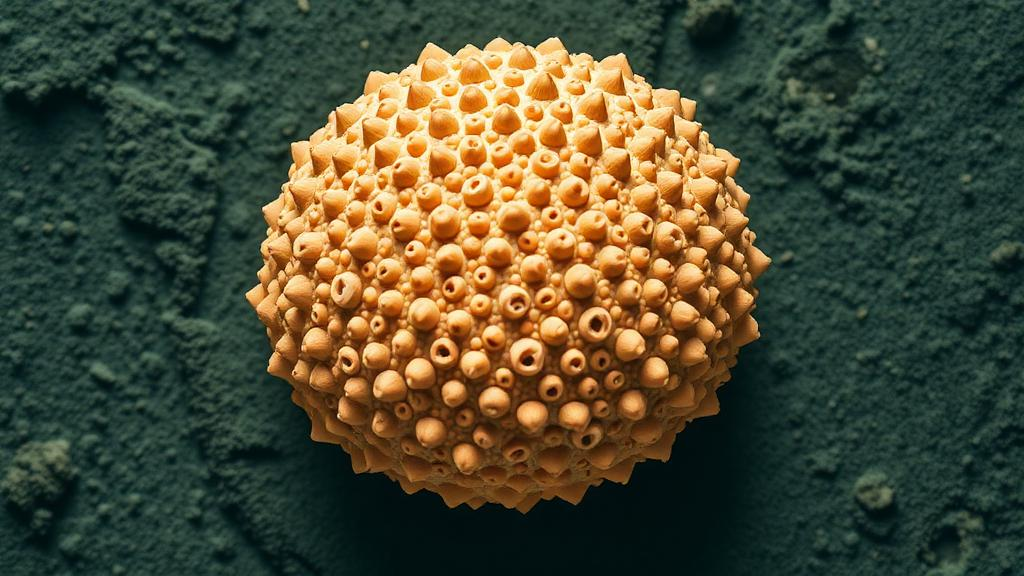
Some of the most consequential travelers in Earth’s history are smaller than a grain of rice. A new study of Miogypsinidae, a family of larger benthic foraminifera that built elaborate calcareous shells on tropical seafloors some 25 million years ago, has redrawn the map of where these single-celled organisms lived, how they moved between ocean basins, and what ultimately killed them off. The findings, based on a meticulous reassessment of museum type specimens scanned with cutting-edge X-ray technology, overturn a long-standing assumption that American Oligocene faunas evolved in isolation from the rest of the tropical world.
Larger benthic foraminifera, or LBF, are marine protists with complex, often coin-sized shells that host photosynthetic symbionts and thrive in sunlit shallow-water carbonates. Because their shells evolved rapidly and are abundant in drill cores and outcrops, miogypsinids have served for decades as biostratigraphic markers for upper Oligocene to middle Miocene deposits from the Mediterranean to Southeast Asia and Central America. But their taxonomy has been notoriously tangled. Generations of researchers relied on morphometric measurements, particularly the number of chambers in the early whorl of the shell, to define species, sometimes without verifying the underlying shell architecture that distinguishes one genus from another.
An international team led by Davide Bassi of the University of Ferrara, together with Juan Carlos Braga of the University of Granada, Shunichi Kinoshita of Fukui Prefectural University, Johannes Pignatti of Sapienza University of Rome, and Yasufumi Iryu of Tohoku University, went back to the source. They re-examined the original type specimens described by Shoshiro Hanzawa in 1940 from drill cores on Kitadaito Jima, a small island in the Philippine Sea, preserved at Tohoku University Museum in Sendai. Using a Zeiss Xradia 510 Versa micro-computed tomography system at the University of Granada, the team produced three-dimensional renderings at submicron resolution, with true spatial resolution of 0.7 micrometers and voxel sizes down to 70 nanometers, revealing internal canal systems, chamber walls, and apertural structures that thin sections alone had obscured for more than eighty years.
The CT scans delivered a decisive verdict on Miogypsinella borodinensis, the type species of the genus Miogypsinella. The scans revealed a suite of diagnostic features, including a cover on the intraseptal interlocular space, an apertural lip, subsutural canals, a septal flap, and a primary spiral canal with vertical branches extending only to the ventral side of the shell. These characters confirm that Miogypsinella is a valid genus, distinct from the closely related Miogypsinoides, whose members possess thick lamellar lateral walls and canal systems on both sides of the test. The team formally designated a lectotype from Hanzawa’s thin sections to stabilize the species name, and showed that Miogypsinella borodinensis is genuinely different from Miogypsinoides complanatus, a species with which it had been repeatedly confused.
Compiling every reliably illustrated occurrence of these foraminifera worldwide, the researchers traced a remarkable biogeographic story. Two species, Miogypsinella borodinensis and Miogypsinella ubaghsi, were widespread across the central Indo-Pacific, appearing in the Chattian stage of the late Oligocene at localities including Kitadaito Jima, Saipan, Chichi Jima, northeastern Borneo, and Eniwetok Atoll. But Miogypsinella borodinensis also turned up in eastern Mexico, Jamaica, and Antigua, having never been recorded in the Mediterranean or western Tethys. The most plausible explanation, the authors argue, is that Pacific larvae or propagules rode eastward currents all the way to Central America, a dispersal route well documented for corals, coralline algae, and other shallow-water benthic organisms of the same interval.
This eastward migration carries a big implication. For decades, paleontologists assumed that the Oligocene larger foraminifera of the Americas formed a distinctly isolated fauna, cut off from the Indo-Pacific realm. The new evidence shows otherwise: the American Oligocene faunas were not largely isolated as previously thought, and at least one genus arrived from the Pacific rather than originating in the Caribbean. In Central America, Miogypsinella borodinensis gave rise to a descendant, Miogypsinella bermudezi, originally described from early Miocene deposits of Cuba, which differs from its ancestor in having a smaller proloculus, more nepionic chambers, and a nearly horizontal early whorl. The team also rejected hypotheses placing the family’s origin in Central America or the Mediterranean, noting that no confidently identified Miogypsinella specimens have ever been found in Mediterranean Oligocene or early Miocene carbonates.
The study also rehabilitated a second forgotten species. Miogypsinoides lateralis, described by Hanzawa from the same Kitadaito Jima cores, had been shuffled between synonyms for half a century and lumped with species such as Miogypsinoides bantamensis and Miogypsinoides dehaartii, largely because its low number of nepionic chambers resembled other forms. The CT analysis confirmed it as a clearly distinct species, and one with an awkward implication for the field’s guiding paradigm. Since the 1930s, miogypsinid evolution has been framed by nepionic acceleration, a trend in which the number of early chambers progressively decreased through time, allowing species to be ordered along a supposed lineage. Miogypsinoides lateralis breaks the pattern: its morphometric values resemble those of the much younger Burdigalian to Langhian species Miogypsinoides indica, yet it lived earlier, in the Aquitanian. It is, the authors conclude, an exception to the presumed morphological trend within the Miogypsinoides lineage.
Then came the extinction. The last known occurrences of Miogypsinella borodinensis, Miogypsinella ubaghsi, Miogypsinella bermudezi, and Miogypsinoides lateralis all cluster near the end of the Aquitanian, around 20 million years ago. That timing coincides with two major environmental upheavals. First, the ongoing collision of Australia with Southeast Asia and the Philippine Sea Plate initiated the restriction of the Indonesian Seaway, cutting the shallow-water connectivity between the Indian Ocean and the Pacific. Second, Southeast Asia’s vast carbonate platforms, which in places stacked more than two kilometers of limestone, abruptly gave way to deeper-water marine clays near the top of the classic Letter Stage Te, as Borneo became a major source of clastic sediments smothering the shallow shelves around Sundaland. For organisms dependent on sunlit carbonate substrates, the habitat simply vanished.
The study’s conclusions ripple beyond taxonomy. By demonstrating that a foraminiferal genus could cross the Pacific barrier during the Chattian, the work aligns with growing evidence that the Oligocene-Miocene tropical oceans were far more connected than the classic provincial schemes suggested, with eastward currents carrying Indo-Pacific species into the eastern Pacific and Caribbean. It also cautions against building evolutionary lineages purely on morphometric numbers without verifying the shell structures that define genera. Several species assigned to Miogypsinella in the literature, including Miogypsinella bornea, Miogypsinella cyprea, and Miogypsinella elongata, lack the diagnostic features of the genus and probably belong in Miogypsinoides, a correction that will force revisions of regional biostratigraphic schemes from Turkey to Borneo.
For a family of organisms that has quietly anchored Oligocene-Miocene stratigraphy for nearly a century, the message is striking: even the smallest fossils, when re-examined with modern imaging, can rewrite the geography of ancient oceans. The miogypsinids that once flourished from Borneo to Mexico were not relics of isolated worlds but participants in a dynamic, interconnected tropical sea, one whose tectonic reorganization closed the doors they had traveled through and erased the platforms they called home.
Subject of Research: Taxonomic revision and palaeobiogeography of Miocene miogypsinid larger benthic foraminifera
Article Title: Taxonomic reassessment and palaeobiogeographical patterns of some Miogypsinidae species, larger benthic foraminifera
Article References: Bassi, D., Braga, J. C., Kinoshita, S., Pignatti, J., & Iryu, Y. (2026). Taxonomic reassessment and palaeobiogeographical patterns of some Miogypsinidae species, larger benthic foraminifera. Journal of Micropalaeontology, 45(2), 653-677. https://doi.org/10.5194/jm-45-653-2026
Image Credits: AI Generated
Keywords: larger benthic foraminifera, Miogypsinidae, Miogypsinella, Miogypsinoides, Chattian, Aquitanian, Indo-Pacific, Indonesian Seaway, paleobiogeography, micro-CT, taxonomy, Oligocene-Miocene
Cite Scienmag News
Violet Maxwell. (October 8, 2026). Ancient Giant Foraminifera Crossed the Pacific Before a Colliding Seaway Wiped Them Out. Scienmag. https://scienmag.com/ancient-giant-foraminifera-crossed-the-pacific-before-a-colliding-seaway-wiped-them-out/
Violet Maxwell. "Ancient Giant Foraminifera Crossed the Pacific Before a Colliding Seaway Wiped Them Out." Scienmag, 8 October 2026, https://scienmag.com/ancient-giant-foraminifera-crossed-the-pacific-before-a-colliding-seaway-wiped-them-out/. Accessed 8 October 2026.
Violet Maxwell. "Ancient Giant Foraminifera Crossed the Pacific Before a Colliding Seaway Wiped Them Out." Scienmag. October 8, 2026. https://scienmag.com/ancient-giant-foraminifera-crossed-the-pacific-before-a-colliding-seaway-wiped-them-out/


