


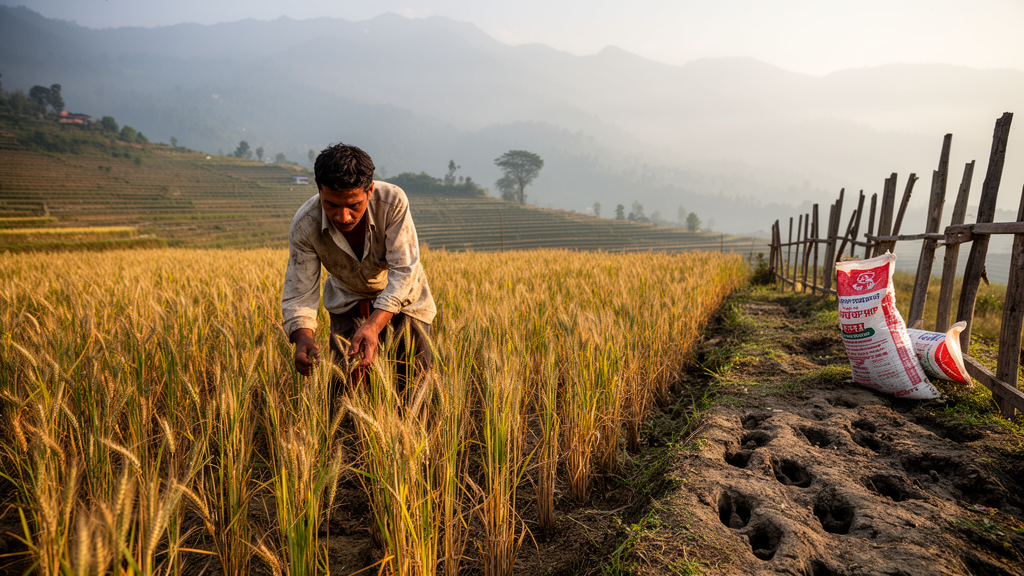
Wheat is one of Nepal’s most important staple crops, yet in the southwestern district of Kanchanpur the yields achieved by local farmers fall noticeably short of what the land and climate should allow. A new study published in Innovations in Agriculture examines why productivity in Kanchanpur lags behind that of neighboring districts such as Kailali, Banke, Kapilbastu, and Rupandehi, which share broadly similar meteorological conditions. The research, conducted by Kamal Kafle and Pankaj Prasad Joshi, combines statistical modeling with field surveys to identify both the factors that boost wheat output and the practical obstacles that hold it back.
The team selected Kanchanpur purposively because of its considerable potential for wheat cultivation, and carried out the research during March and April of 2022. Using a simple random sampling technique, they systematically chose one hundred wheat-farming households across the district. Primary data were collected through pre-tested semi-structured questionnaires administered in face-to-face interviews, while secondary data were drawn from relevant journals and official records. This dual approach allowed the researchers to capture both quantitative production figures and the lived experience of farmers struggling with unreliable inputs and market access.
To determine which variables actually drive wheat production, the researchers applied a multiple regression model to their survey data. The analysis revealed that four factors exerted a significant positive influence on output: the quantity of applied NPK fertilizer, meaning the combined nutrients nitrogen, phosphorus, and potassium; the educational level of the household head; the extent of wheat-cultivated land equipped with irrigation facilities; and the farmers’ years of experience in the field. Each of these variables, when increased, was associated with measurably higher wheat production in the study area.
The fertilizer finding is particularly consequential. Nitrogen, phosphorus, and potassium are the backbone of modern cereal nutrition, and inadequate or poorly timed application directly limits grain filling and tillering in wheat. In Kanchanpur, however, farmers frequently cannot obtain chemical fertilizer at all during the critical growth periods when the crop needs it most. The study identifies this unavailability of fertilizer during key developmental stages as the single most severe constraint on wheat production in the district, a problem that undermines even the most experienced farmers’ efforts.
Education emerged as another powerful lever. Households headed by individuals with more formal schooling tended to produce more wheat, a pattern consistent with the idea that educated farmers are better positioned to interpret agronomic recommendations, calculate appropriate input doses, adopt improved technologies, and navigate extension services. Similarly, the area of wheat land with reliable irrigation proved decisive. Wheat in the Terai plains is often grown after rice on residual soil moisture, and access to controlled water supply allows farmers to time irrigation at critical stages such as crown root initiation and grain filling, protecting yields against the erratic rainfall that increasingly characterizes the region.
Experience also mattered. Farmers with more years in the field achieved higher production, reflecting accumulated knowledge of local soil behavior, sowing windows, variety selection, and pest management. This finding suggests that extension programs could gain leverage by pairing experienced lead farmers with newer producers, transferring practical know-how that formal training alone often fails to convey. It also hints at a generational risk: as older, seasoned farmers retire from cultivation, their tacit agronomic knowledge may not be replaced quickly enough to sustain district-level output.
Beyond the regression results, the researchers used an indexing method to rank the major constraints farmers face. After fertilizer unavailability, the second most damaging problem was crop destruction by wild animals and stray cattle. In Kanchanpur, proximity to forest areas and wildlife corridors means that nilgai, wild boar, monkeys, and roaming domestic livestock frequently invade fields overnight, flattening standing crops and eating grain. Farmers respond with watch huts, night patrols, and noise deterrents, but these measures demand labor and rarely provide complete protection, effectively taxing every harvest.
The indexed ranking also highlighted the lack of access to improved seeds and irrigation as a major constraint. Improved, disease-resistant wheat varieties can raise yields substantially, but many farmers in the district continue to sow saved or uncertified seed because quality seed is not available locally or is priced beyond reach. Combined with limited irrigation infrastructure, this leaves crops vulnerable to moisture stress and to the diseases and pests that the study lists among the significant production challenges. Inadequate market access rounds out the constraint list, with farmers facing poor roads, weak price information, and limited buyer networks that reduce the incentive to invest in higher inputs.
The comparative context sharpens the urgency of these findings. Districts such as Kailali, Banke, Kapilbastu, and Rupandehi, operating under similar weather patterns, achieve higher wheat productivity than Kanchanpur, which indicates that the yield gap is not dictated by climate but by controllable factors: input supply chains, irrigation coverage, seed systems, and market institutions. The study’s authors argue that addressing these bottlenecks could unlock the district’s considerable prospective for wheat cultivation, contributing to national food security at a time when cereal imports and price volatility weigh heavily on Nepal’s economy.
For policymakers, the message is that raising wheat output in Kanchanpur requires coordinated intervention rather than isolated fixes. Ensuring timely fertilizer availability during critical growth periods, expanding irrigation infrastructure, improving the distribution of improved seed, managing human-wildlife conflict around farmland, and strengthening market linkages together form the pathway the evidence points toward. The regression results show that farmers respond strongly when given the means, more nutrients, more water, more knowledge, and more experience, while the constraint indexing shows exactly where the system currently fails them. Closing that gap between potential and performance could transform wheat farming in Kanchanpur from a marginal enterprise into a reliable contributor to Nepal’s grain supply.
Subject of Research: Factors affecting wheat productivity and production constraints in Kanchanpur district, Nepal
Article Title: An assessment of factors affecting productivity and production limitations of wheat farming in Kanchanpur district of Nepal
Article References: Kafle, K., & Joshi, P. P. (2024). An assessment of factors affecting productivity and production limitations of wheat farming in Kanchanpur district of Nepal. Innovations in Agriculture, 7, 1–8. https://doi.org/10.3897/ia.2024.124216
Image Credits: AI Generated
Keywords: wheat farming, Nepal, Kanchanpur, crop productivity, NPK fertilizer, irrigation, improved seeds, multiple regression, wild animal damage, market access, agricultural constraints, food security
Cite Scienmag News
Alan Morgan. (October 17, 2026). Fertilizer shortages and wild animal damage hold back wheat farming in Nepal’s Kanchanpur district. Scienmag. https://scienmag.com/fertilizer-shortages-and-wild-animal-damage-hold-back-wheat-farming-in-nepals-kanchanpur-district/
Alan Morgan. "Fertilizer shortages and wild animal damage hold back wheat farming in Nepal’s Kanchanpur district." Scienmag, 17 October 2026, https://scienmag.com/fertilizer-shortages-and-wild-animal-damage-hold-back-wheat-farming-in-nepals-kanchanpur-district/. Accessed 17 October 2026.
Alan Morgan. "Fertilizer shortages and wild animal damage hold back wheat farming in Nepal’s Kanchanpur district." Scienmag. October 17, 2026. https://scienmag.com/fertilizer-shortages-and-wild-animal-damage-hold-back-wheat-farming-in-nepals-kanchanpur-district/


